1 引言
本文研究了改进的 Aw-Rascle-Zhang (ARZ) 交通流模型[20 ]
(1.1) $\begin{cases}\rho_t+\left( \rho u \right)_x=0,\\\left(\rho(F(u)+p(\rho))\right)_t+\left( \rho u (F(u)+p(\rho))\right)_x=0\\\end{cases}$
的柯西问题, 其中 $(x,t)\in \mathbb{R}\times[0,+\infty)$. $\rho$ 和 $u$ 分别表示交通流的密度和速度, $p$ 表示压力满足
(1.2) $p(\rho)= {\rho}^{\gamma},$
其中 $\gamma\geq1$ 是常数, $F(u)$ 满足
(1.3) $F'\left( u \right) >0,\ F''\left( u \right) <0,\ \left( \gamma +1 \right) F'\left( u \right) F'''\left( u \right) \ge \left( \gamma +2 \right) F''^2\left( u \right).$
根据文献 [20 ,引理 3.1], 在 $(\rho,q)$ 平面上, 第一族波线仅有单个拐点, 其中 $q=\rho u$, 因此第一族特征是非真正非线性的. % 另外存在 $F(u)$ 满足 (3) 式.
(1.4) $\left( \rho, u\right) \left( x, 0 \right)=\left( \rho_0(x), u_0(x) \right), \quad -\infty<x<+\infty,$
(1.5) $\rho_0(x)\geq \alpha>0,$
(1.6) $F(u_0(y))\leq F(u_0(x))+p(\rho_0(x))-p(\alpha), \quad \quad \forall~ y\geq x,$
当 $F(u)=u$ 时, Aw-Rascle[1 ] 和 Zhang[40 ] 分别独立地提出了 Aw-Rascle-Zhang(ARZ) 交通流模型 (1.1). 在该模型中, 第一族特征场是真正非线性的, 第二族特征场是线性退化的. 此模型已被广泛研究并得到诸多拓展, 相关文献可参见文献 [2 ,4 ,5 ,10 ,11 ,13 ,14 ,16 18,25 27,30 32,35 ,37 ,41 ] 及其参考文献. 然而, 工程师[19 ] 和数学家[23 ] 均在实际交通观测中发现了流量-密度图存在非凹特性. 为此, 文献 [20 ] 的作者提出了一种改进的 ARZ 交通流模型 (1.1). 该模型采用压力项 (1.2), 其反应项 $F(u)$ 满足条件 (1.3), 并具有非真正非线性的特征场, 其结果验证了 Kerner[24 ] 所发现的相变现象. 关于该模型更多研究进展可参考文献 [8 ,21 ,22 ].
我们现在回顾关于 $2\times2$ 非线性双曲系统柯西问题解的存在性研究. 在特征场为真正非线性或线性退化的情形下, Glimm 在其开创性工作[15 ] 中首次证明了弱解的全局存在性. 随后, Nishida 在文献 [33 ] 中建立了弱解的大初值全局存在性定理. 对于具有非真正非线性特征场的 Temple 型模型, Temple[38 ] 获得了其解的存在性结果. Chen-LeFloch[7 ] 建立了含一般形式压力项的欧拉方程熵解的存在性理论. 文献 [2 ] 的作者通过平均化与随机抽样方法, 研究了特征场几乎处处真正非线性的 ARZ 模型, 但其初值被限制在区间 $ [0,1]$ 内. 关于 $2\times2$ 非线性双曲系统解存在性的更多结果, 可参阅文献 [3 ,6 ,9 ,12 ,28 ,29 ,34 ].
本文研究改进的 ARZ 模型 (1.1) 关于柯西初值 (1.4) 的弱解存在性问题. 在初值满足条件 (1.5) 和 (1.6) 的前提下, 我们证明对任意 $t>0$, 方程的弱解仍满足这些条件. 基于此, 我们通过压力项的全变差估计推导出密度的全变差估计. 由于模型 (1) 的第一特征场具有非真正非线性特性, 其黎曼问题的解中不仅包含激波, 稀疏波和接触间断 (见文献 [8 ,21 ]), 还会出现复合波结构. 为此, 我们引入黎曼不变量来定义各类波的强度, 并基于修正的 Glimm 格式, 推导出近似解的全变差的先验估计. 最终, 我们在不要求初始全变差足够小的条件下, 证明了弱解的全局存在性.
本文的结构安排如下: 第 2 节简要回顾系统 (1.1), (1.2) 及 (1.3) 的黎曼解; 第 3 节针对改进的 ARZ 模型, 介绍修正的 Glimm 格式方法; 第 4 节给出黎曼不变量全变差估计的证明; 第 5 节证明近似解的收敛性, 并最终得到柯西问题弱解的存在性结果.
2 预备知识
本节我们简要地回顾改进的 ARZ 交通流模型 (1.1) 满足如下初值
(2.1) $(\rho_0(x), u_0(x))=\begin{cases}(\rho_l, u_l), \quad x<0, \\ (\rho_r,u_r), \quad x>0,\end{cases}$
的黎曼问题, 其中 (7) 式中 $\rho_{l,r}\geq\alpha>0$, $u_{l,r}\geq0$ 是常数且满足初始条件
(2.2) $F(u_r)\leq F(u_l)+p(\rho_l)-p(\alpha).$
改进的 ARZ 模型 (1.1), (1.2) 的特征值为 $\lambda _1=u- \rho p'(\rho)/{F'(u)}, \lambda_2=u$. 除了在真空处, 该模型是严格双曲系统.特征对应的右特征向量分别为 $\vec{r}_1=(1, - {p'({\rho})}/{F'(u)})^T$, $\vec{r}_2=(1,0)^T,$ 且满足
(2.3) $\nabla\lambda _1\cdot \vec{r}_1=-\frac{(2p'(\rho)+\rho p''(\rho))F'(u)^2+\rho p'(\rho)^2F''(u)}{F'(u)^3}, \quad \nabla\lambda _2\cdot \vec{r}_2=0,$
其中 $\nabla=(\partial / \partial \rho, \partial / \partial u)$. 当 $\rho>0$ 时, 根据 (1.3) 式的第三个不等式可知, 除了单点 $(\rho_B,u_B)$ (该点满足 $\nabla\lambda_1\cdot \vec{r}_1(\rho_B,u_B)=0$), 第一族特征是真正非线性的. 该族特征对应的波型为激波, 稀疏波或者复合波[20 ] . 第一族波线满足
(2.4) $F(u)+p(\rho)=F(u_l)+p(\rho_l).$
第一族稀疏波满足 (2.4) 式, 记为 $R_1$, 且有
(2.5) $R_1:\begin{cases}\rho<\rho_l, \quad \text{若}\quad \rho_l<\rho_B,\\\rho>\rho_l, \quad \text{若} \quad \rho_l>\rho_B.\end{cases}$
第一族复合波也满足 (2.4) 式, 记为 $SR_1$, 且有
(2.6) $SR_1:\begin{cases}\rho>\rho_C, \quad \text{若}\quad \rho_l<\rho_B,\\\rho<\rho_C, \quad \text{若} \quad \rho_l>\rho_B,\end{cases}$
(2.7) $\lambda_1(\rho_C,u_C)=s(\rho_l,u_l;\rho_C,u_C)=\frac{\rho_l u_l-\rho_Cu_C}{\rho_l-\rho_C},$
$s(\rho_l,u_l;\rho_C,u_C)$ 表示激波波速. 第一族激波同样满足 (2.4) 式, 记为 $S_1$, 且有
(2.8) $S_1:\begin{cases}\rho_l<\rho<\rho_C, \quad \text{若}\quad \rho_l<\rho_B,\\\rho_C<\rho<\rho_l, \quad \text{若} \quad \rho_l>\rho_B,\end{cases}$
其中 $(\rho_C,u_C)$ 满足 (2.7) 式. 第二族特征是线性退化的且对应的基本波为接触间断, 用 $J$ 表示, 满足
(2.9) $J: u=u_l.$
(2.10) $\omega=F(u)+p(\rho),\ \ z=u.$
本文针对改进的 ARZ 模型柯西问题 (1.1)-(1.6) 的弱解 ($\rho$, $u$) 定义如下.
定义 2.1 对任意的 $\varphi$, $\psi$\in$C_0^1((-\infty, +\infty)\times [0,+\infty))$, ($\rho(x,t)$, $u(x,t)$) 是有界可测的, 且满足积分等式
(2.11) $\left\{\begin{array}{l}\iint_{t>0}\left(\rho \varphi_{t}+\rho u \varphi_{x}\right) \mathrm{d} x \mathrm{~d} t+\int_{t=0} \rho_{0}(x) \varphi(0, x) \mathrm{d} x=0 \\\iint_{t>0}\left(\rho(F(u)+p(\rho)) \psi_{t}+\rho u(F(u)+p(\rho)) \psi_{x}\right) \mathrm{d} x \mathrm{~d} t+\int_{t=0} \rho_{0}(x) \psi(0, x) \mathrm{d} x=0\end{array}\right.$
3 修正的 Glimm 格式
本节通过随机抽样变量构造阶梯函数对初值进行逼近, 并在有限时间 $t$ 内求解所有局部黎曼问题, 现给出黎曼解的如下结果.
引理 3.1 关于改进的 ARZ 模型 (1.1), (1.2) 满足黎曼初值 (2.1), (2.2), 存在分片光滑黎曼解 $(\rho(x,t), u(x,t))$ 满足
(3.1) $\rho(x,t)\geq\alpha>0, \quad \quad t>0,$
其中 (3.1) 式中的 $\alpha$ 与 (2.2) 式中的 $\alpha$ 相同, 及
(3.2) $\begin{cases}\omega(\rho(x,t),u(x,t))\leq \max\{\omega(\rho_l,u_l),\omega(\rho_r,u_r)\},\\z(\rho(x,t),u(x,t)) \geq \min \{z(\rho_l,u_l),z(\rho_r,u_r) \}.\end{cases}$
证 若 $(\omega_{1},z_{1})$ 表示黎曼解的中间状态, 根据黎曼不变量的性质, 可知
(3.3) $\omega_{1}=\omega_l, \quad z_{1}=z_r,$
则不等式 (3.2) 成立. (3.3) 式即为 $F(u_1)+p(\rho_1)=F(u_l)+p(\rho_l)$ 及 $u_1=u_r$, 于是 $F(u_r)=F(u_l)+p(\rho_l)-p(\rho_1)$, 根据 (2.2) 式, 有 $F(u_l)+p(\rho_l)-p(\rho_1)\leq F(u_l)+p(\rho_l)-p(\alpha)$ 成立, 即 $p(\rho_1)>p(\alpha)$. 再利用 $p$ 的单调性可知 (3.1) 式成立.
沿改进的 ARZ 模型 (式 (1.1)) 的第一特征方向, 其黎曼问题的解可能包含激波, 稀疏波或复合波[20 ] . 文献 [36 ] 中通过关系式 $\lambda_k(u) = \lambda_k(u_l) + \varepsilon$ 定义的波强参数 $\varepsilon$ 在本研究中并不适用.原因在于 $\varepsilon$ 的符号依赖于波的类型 (激波或稀疏波), 并且该定义未涵盖复合波的情形. 为此, 我们采用第一族黎曼不变量 $\omega$ 来定义第二族波的波强: 若 $\omega_r \geq \omega_l$, 则波强为 $0$; 若 $\omega_r < \omega_l$, 则波强为 $|\omega_r - \omega_l|$. 类似地, 采用第二族黎曼不变量 $z$ 来定义第一族波的波强. 该定义的优势在于: 当黎曼不变量沿相应特征族单调递减时, 直接取其变差作为波强, 从而避免了对波型 (激波, 稀疏波或复合波) 的依赖. 于是设 $\varepsilon=(\varepsilon_1,\varepsilon_2)$, 其中 $\varepsilon_1$, $\varepsilon_2$ 满足
(3.4) $\begin{cases}\varepsilon_1=z_r-z_l, \\\varepsilon_2=\omega_{r}-\omega_{l}.\end{cases}$
关于改进的 ARZ 模型 (1.1), 我们定义第一族波强为
(3.5) $|\varepsilon_1|=\max\{-\varepsilon_1, 0\},$
即, 如果 $u_r<u_l$, 第一族波强为 $|\varepsilon_1|>0$, 否则波强为零. 如果 $F(u_r)+p(\rho_r)<F(u_l)+p(\rho_l)$, 第二族波强为
(3.6) $|\varepsilon_2|=\max\{-\varepsilon_2, 0\},$
类似, 设 $\zeta=(\zeta_1, \zeta_2)$ 和 $\delta=(\delta_1, \delta_2)$ 分别是模型 (1.1) 满足如下初值的黎曼解
(3.7) $(\rho_0(x), u_0(x))=\begin{cases}(\rho_l, u_l), \quad x<-\mu, \\ (\rho_m,u_m), \quad -\mu<x<\mu,\end{cases} \text{及 } \begin{cases}(\rho_m,u_m), \quad -\mu<x<\mu,\\(\rho_r,u_r), x>\mu,\end{cases}$
(3.8) $\begin{cases}|\zeta_1|=\max\{z_l-z_m,0\}, \\|\zeta_2|=\max\{ \omega_{l}-\omega_{m},0\},\end{cases}\begin{cases}|\delta_1|=\max\{z_m-z_r,0\}, \\|\delta_2|= \max\{\omega_{m}-\omega_{r},0\}.\end{cases}$
设网格点为 $(x_m,t_n)$, 满足 $x_m=mr$, $t_n= nh$, 其中 $m=0,\pm1,\pm2,\cdots$ 和 $n=0,1,2,\cdots$, 空间步长 $r=2^{-l}$, $l$ 为自然数. 利用阶梯函数
(3.9) $(\rho_0^l(x),u_0^l(x))=\begin{cases}(\rho_0(-\infty),u_0(-\infty)),\quad x<-Kr,\\(\rho_0(mr),u_0(mr)), \quad -Kr\leq(m-1)r<x<(m+1)r\leq Kr,\\(\rho_0(+\infty),u_0(+\infty)),\quad x>Kr,\end{cases}$
近似初值 (1.4) 式, 其中 $K=2^{2l+1}$, $m$ 是奇数.
定义 $\omega_0=\sup\limits_{-\infty<x<\infty}{\omega(\rho_0(x), u_0(x))}>0$, $z_0=\inf\limits_{-\infty<x<\infty}{z(\rho_0(x),u_0(x))}\geq0$. 利用引理 3.1, 可知 $\omega=F(u)+p(\rho)\leq\omega_0$ 和 $z\geq z_0$. 由于 $ F(u), p(\rho)\geq 0$, 因此有 $0 \leq F(u),p(\rho) \leq \omega_0$ 和 $u\geq z_0$ 成立. 于是有 $|\lambda_1|=|u- {\gamma p(\rho)}/{F'(u)}|\leq F^{-1}(\omega_0)+ {\gamma \omega_0}/{F'(F^{-1}(\omega_0))}$ 和 $z_0\leq|\lambda_2|\leq F^{-1}(\omega_0)$ 成立. 为了满足 Courant-Friedrichs-Levy (CFL) 条件, 取时间步长 $h$ 和空间步长 $r$ 满足条件
(3.10) $h\leq \frac{{F'(F^{-1}(\omega_0))}}{F^{-1}(\omega_0){F'(F^{-1}(\omega_0))}+ {\gamma \omega_0}}r.$
设 $ \theta_1\in (-1,1)$ 为任意实数, 且 $m$ 是偶数. 令 $y_m=x_{m}+r\theta_1$, 则 $y_m\in (x_{m-1}, x_{m+1})$. 首先, 在时间 $t=t_1$ 处, 定义
(3.11) $\rho^l(x,t_1)=\rho^l(y_m, t_1-0),\quad u^l(x,t_1)=u^l(y_m, t_1-0), \quad x \in (x_{m-1}, x_{m+1}),$
由此可构造时间区间 $ [t_1, t_2)$ 上的黎曼解. 现设时间 $t<t_n$ 的黎曼解 $(\rho(x,t),u(x,t))$ 已知, 则对于任意 $ \theta_n\in (-1,1)$, 当 $m+n$ 为奇数时, 取 $y_m=x_{m}+r\theta_n$, 并定义
(3.12) $\rho^l(x,t_n)=\rho^l(y_m, t_n-0),\quad u^l(x,t_n)=u^l(y_m, t_n-0),\quad x\in (x_{m-1}, x_{m+1}),$
基于此, 可构造 $\{(x,t)|t_n\leq t<t_{n+1}, -\infty<x<+\infty\}$ 上的黎曼解.
4 先验估计
我们首先证明: 对于任意满足条件 (1.5) 和 (1.6) 的初值, 以及任意 $t>0$, 该性质关于空间变量仍然成立.
引理 4.1 改进的 ARZ 模型 (1.1) (1.2), 当初始条件满足 (1.5), (1.6) 和 (3.7) 时, 存在分片光滑解 $(\rho(x,t), u(x,t))$, 且该解对任意的 $t>0$, 满足
(24) $\rho(x,t)\geq\alpha,$
(4.1) 及$F(u(y,t))\leq F(u(x,t))+p(\rho(x,t))-p(\alpha) \quad \quad \forall ~y\geq x,$
其中 $\alpha>0$ 为 (5) 式中的同一常数.
证 改进的 ARZ 模型 (1.1) (1.2) (1.5) (1.6) 满足初值条件 (3.7) (即双黎曼问题) 下, 根据引理 3.1 的证明, 如果初始满足 (4.2) 式, 则存在分片光滑解 $(\rho(x,t),u(x,t))$ 满足 $\rho(x,t)\geq\alpha$. 下面通过将初值分为四种不同情形, 可证明不等式 (4.2) 成立.
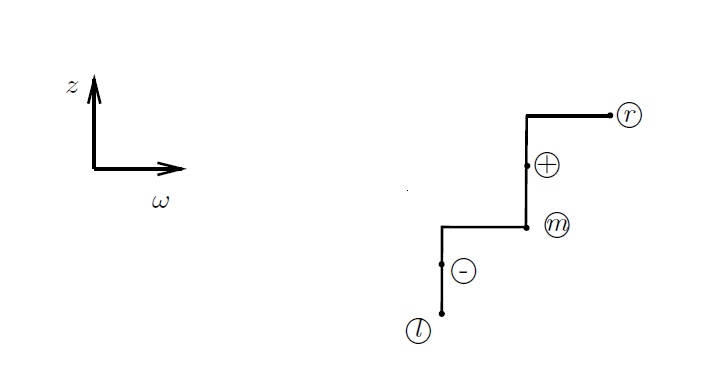
情形 (i) $u_l<u_m<u_r$. 设状态 $(\rho_l,u_l)$ 与 $(\rho_m,u_m)$ 的中间状态 $(\rho_1,u_1)$; 状态 $(\rho_m,u_m)$ 与 $(\rho_r,u_r)$ 的中间状态为 $(\rho_2,u_2)$. 进一步, 当 $(\rho_l, u_l)$ 和 $(\rho_1, u_1)$ 通过第一族稀疏波连接时, 记其对应的中间状态为 $(\rho_-, u_-)$, 在图 2 中标记为 $\ominus $; 类似地, 当 $(\rho_m, u_m)$ 和 $(\rho_2, u_2)$ 通过稀疏波连接时, 记其对应的中间状态为 $(\rho_+, u_+)$, 在图 2 中标记为 ⊕. 设方程的分片光滑解 $(\rho(x,t),u(x,t))$, 对给定的 $t$, 按照 $x$ 从小到大为$(\rho_l,u_l)\rightarrow(\rho_-,u_-)\rightarrow(\rho_1,u_1)\rightarrow(\rho_m,u_m)\rightarrow(\rho_+,u_+) \rightarrow(\rho_2,u_2)\rightarrow(\rho_r,u_r)$, 其中 $(\rho_1,u_1)$ 和 $(\rho_2,u_2)$ 分别满足 $u_1=u_m$ 及 $u_2=u_r$. 由于 $F(u_m)\leq F(u_l)+p(\rho_l)-p(\alpha)$ 及 $u_-\leq u_m$, 利用 $F$ 的单调性, 可得
又 $F(u_l)+p(\rho_l)=F(u_-)+p(\rho_-)=F(u_1)+p(\rho_1)$, 可知
类似地, 由于 $F(u_r)\leq F(u_m)+p(\rho_m)-p(\alpha)$ 及 $u_+\leq u_r$,
成立. 根据 $F(u_m)+p(\rho_m)=F(u_+)+p(\rho_+)=F(u_2)+p(\rho_2)$, 有
由于 $F(u_r)\leq F(u_l)+p(\rho_l)-p(\alpha)$ 及 $u_+<u_r$, 可得
图1
图2
图2
$|\zeta_2|=0,|\delta_1|=0$
情形 (ii) $u_r<u_m<u_l$. 对给定的 $t$, 按照 $x$ 从小到大为 $(\rho_l,u_l)\rightarrow(\rho_1,u_1)\rightarrow(\rho_m,u_m) \rightarrow(\rho_2,u_2)\rightarrow(\rho_r,u_r)$. 由于 $F(u_m)\leq F(u_l)+p(\rho_l)-p(\alpha)$ 及 $u_2=u_r< u_m=u_1$, 可得 $F(u_2)=F(u_r)<F(u_1)=F(u_m)\leq F(u_l)+p(\rho_l)-p(\alpha)=F(u_1)+F(\rho_1)-p(\alpha)$, 又 $F(u_r)\leq F(u_m)+p(\rho_m)-p(\alpha)$ 且 $u_2=u_m$, 可得 $F(u_2)\leq F(u_m)+p(\rho_m)-p(\alpha)$.
类似可证情形 (iii), $u_m<u_l,u_m<u_r$ 和情形 (iv), $u_m>u_l,u_m>u_r$, (4.2) 式均成立.
注 4.1 对于固定的 $t$, 若 $u(x,\cdot)$ 关于 $x$ 单调递减时, (4.2) 式恒成立.
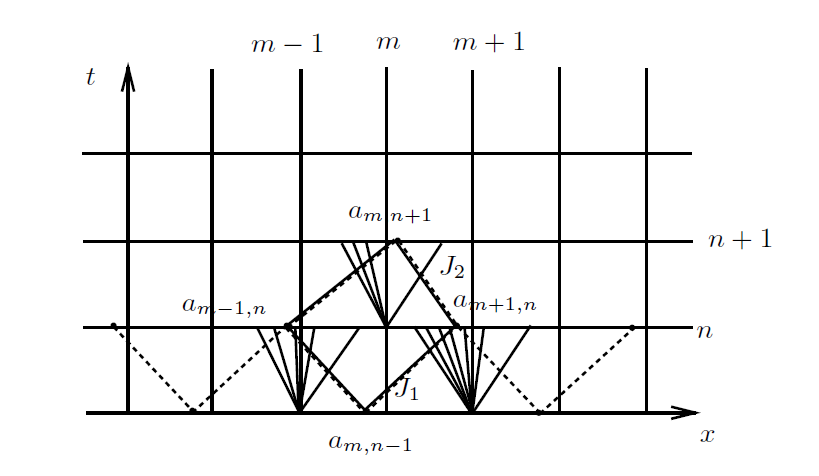
接下来, 我们将估计黎曼不变量 $\omega$ 和 $z$ 的总变差. 当 $m+n$ 为奇数时, 取网格点为 $a_{m,n}=mr+\theta_nr$ (其中 $\theta_n$ 是在区间 $(-1,1)$ 中随机选取的参数). 设 $J_1$ 为连接网格点 $a_{m-1,n}$, $a_{m,n-1}$, $a_{m+1,n}$ 形成的折线, $J_2$ 为连接网格点 $a_{m-1,n}$, $a_{m,n+1}$, $a_{m+1,n}$ 形成的折线. 在 $J_1$ 和 $J_2$ 上定义泛函如下
(4.3) $\mathcal{F}(J_i)=\Sigma_{J_i}(|\varepsilon_1|+|\varepsilon_2|),\quad i=1,2,$
其中 $|\varepsilon_1|$ 和 $|\varepsilon_2|$ 分别表示跨越 $J_i$ 的第一族波和第二族波的强度. 下文我们将证明 $\mathcal{F}$ 是非增的.
引理 4.2 (全变差估计) 对任意满足条件的折线 $J_i$, $i=1,2$, 不等式
(4.4) $\mathcal{F}(J_2)\leq \mathcal{F}(J_1)$
证 假设 $\diamondsuit_{m,n}$ 表示相互作用菱形, $\tilde{\zeta}$ 和 $\tilde{\delta}$ 分别表示传入 $\diamondsuit_{m,n}$ 的波强, $\tilde{\varepsilon}$ 表示传出 $\diamondsuit_{m,n}$ 的波强. 为估计 $\diamondsuit_{m,n}$ 内弱解的变差, 我们将分析四种不同初值条件情形. 假设 $\theta_n\in(-1,0)$ (见图 1 ), 则有
(i)若 $|\zeta_2|=0, |\delta_1|=0$, 则 $\tilde{\zeta}=0$, $\tilde{\delta}=0$, $|\varepsilon_1|=0$ 且 $|\varepsilon_2|=0$; 见图 2 ;
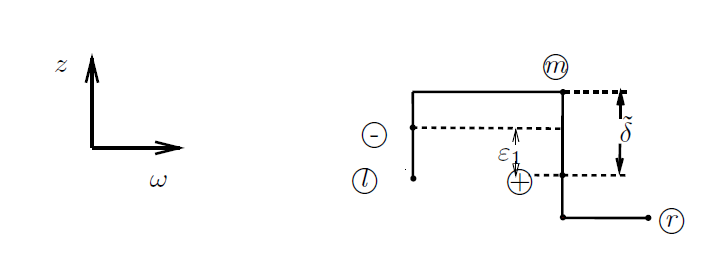
(ii)若 $|\zeta_2|=0, |\delta_1|>0$, 则 $\tilde{\zeta}=0$, $\tilde{\delta}\leq|\delta_1|$, $|\varepsilon_1|\leq\tilde{\delta}$ 且 $|\varepsilon_2|=0$; 见图 3 ;
图3
图3
$|\zeta_2|=0,|\delta_1|>0$.
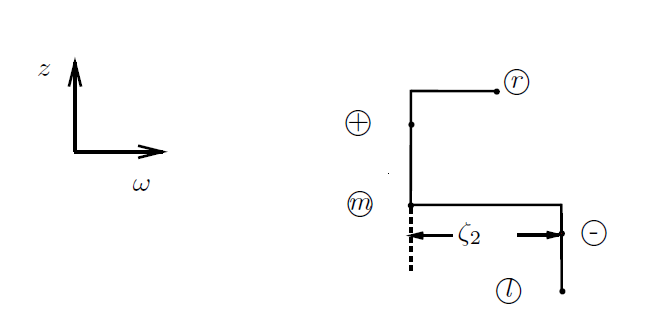
(iii)若 $|\zeta_2|>0, |\delta_1|=0$, 则 $\tilde{\zeta}=|\zeta_2| $, $\tilde{\delta}=0$, $|\varepsilon_1|=0$ 且 $|\varepsilon_2|=|\zeta_2|$; 见图 4 ;
图4
图4
$|\zeta_2|>0,|\delta_1|=0$
(iv)若 $|\zeta_2|>0, |\delta_1|>0$, 则 $\tilde{\zeta}=|\zeta_2| $, $\tilde{\delta}\leq|\delta_1|$, $|\varepsilon_1|\leq\tilde{\delta}$ 且 $|\varepsilon_2|=|\zeta_2|$; 见图 5.
图5
图5
$|\zeta_2|>0,|\delta_1|>0$.
综上可知, 传入 $\diamondsuit_{m,n}$ 的波强 $\tilde{\zeta}+\tilde{\delta}$ 不小于传出波强 $\tilde{\varepsilon}$, 即满足 (4.4) 式.
注 4.2 随机变量 $\theta_n$ 可在区间 $(-1,1)$ 内任意取值.
下面可将局部折线 $J_{1,2}$ 拓展为全局折线 $\hat{J}$. 该折线通过连接相邻随机网格点 $a_{m,n}$ 形成连续路径, 其中指标 $m$ 沿路径单调遍历所有整数. 定义泛函 $\mathcal{F}(\hat{J})=\Sigma_{\hat{J}}|\varepsilon|$, 则由不等式 (4.4) 可得 $\mathcal{F}(\hat{J})\leq \mathcal{F}(O)$, 其中 $O$ 为连接 $t=0$ 和 $t=h$ 处网格点的基准曲线.由于初值条件满足
(4.5) $\mathcal{F}(O)\leq \text{TV}(\omega(\rho_0(x),u_0(x)),(-\infty,+\infty))+\text{TV}(z(\rho_0(x),u_0(x)),(-\infty,+\infty))$
可得总变差估计 $\text{TV}(\omega, \hat{J})+\text{TV}(z, \hat{J})\leq 5M_0,$ 其中 $M_0=\text{TV}(\omega(\rho_0(x),u_0(x)),(-\infty,+\infty))+\text{TV}(z(\rho_0(x),u_0(x)),(-\infty,+\infty))$ 为初始总变差. 这意味着以下全局总变差估计成立 $\text{TV}(u(\cdot,t)$,$ (-\infty, \infty)) \leq 5M_0$ 和 $\text{TV}(F(u)+p(\rho)(\cdot,t), (-\infty, \infty))\leq 5M_0, $ 因此 $F(u)$ 和 $p(\rho)$ 均为有界变差函数. 由关系式 (4.1) 及压力函数导数 $p'(\rho)=\gamma\rho^{\gamma-1} (\gamma\geq1)$, 可知密度函数 $\rho$ 也是有界变差的, 且满足
(4.6) $\text{TV}(\rho(\cdot,t),(-\infty,\infty))\leq \frac{1}{\gamma \alpha^{\gamma-1}}\text{TV}(p(\cdot,t),(-\infty,\infty))\leq \frac{M_0}{\gamma \alpha^{\gamma-1}}.$
利用 (4.6) 式, 可得 $\rho(F(u)+p(\rho))(\cdot,t)$ 的总变差估计
(4.7) $\begin{split}&\text{TV}(\rho(F(u)+p(\rho))(\cdot,t),(-\infty,\infty))\\\leq\,& 2\omega_0\text{TV}(\rho(\cdot,t),(-\infty,\infty))+p^{-1}(\omega_0)\text{TV}(F(u)+p(\rho)(\cdot,t), (-\infty, \infty))\\\leq\,&(\frac{2\omega_0}{\gamma\alpha^{\gamma-1}}+5p^{-1}(\omega_0))M_0.\end{split}$
注 4.3 由估计式 (4.6) 与 (4.7) 可知, 该结论不依赖于初始值总变差的大小. 因此, 我们可在有界变差函数空间中研究初值问题.
基于估计式 (4.6) 和 (4.7), 我们得到改进的 ARZ 模型 (1) 守恒量关于时间 $t$ 的连续性估计.
引理 4.3 对任意的时间 $t_1, t_2\geq 0$, 存在与 $l$ 和 $\theta$ 无关正常数 $K_0$ 和 $K_1$, 使得
(4.8) $\begin{split}&\int_{-\infty}^{\infty}|\rho_\theta^l(x,t_1)-\rho_\theta^l(x,t_2)|{\rm d}x \leq K_0(|t_2-t_1|+2h),\\&\int_{-\infty}^{\infty}|(\rho_\theta^l(F(u_\theta^l)+p(\rho_\theta^l)))(x,t_1)-(\rho_\theta^l(F(u_\theta^l)+p(\rho_\theta^l)))(x,t_2)|{\rm d}x \\\leq& K_1(|t_2-t_1|+2h).\end{split}$
证 设 $t_1$, $t_2$ 满足 $nh\leq t_1<(n+1)h<\cdots<(n+d)h<t_2\leq(n+d+1)h$, 其中 $n$ 和 $d$ 为非负整数且 $m+n$ 是奇数, 则对任意 $x\in (mr,(m+2)r)$, 有
(4.9) $\begin{split}|\rho_\theta^l(x,t_1)-\rho_\theta^l(x,t_2)|\leq &|\rho_\theta^l(x,t_1)-\rho_\theta^l(x,(n+1)h)|+|\rho_\theta^l(x,(n+1)h)-\rho_\theta^l(x,(n+2)h)| \\&+ \cdots+|\rho_\theta^l(x,(n+d)h)-\rho_\theta^l(x,t_2)|\\\leq & \text{TV}(\rho_\theta^l(\cdot,(n+1)h-0),(mr,(m+2)r))\\&+\text{TV}(\rho_\theta^l(\cdot,(n+2)h-0),((m-1)r,(m+3)r))+\cdots\\&+\text{TV}(\rho_\theta^l(\cdot,(n+d+1)h-0),((m-1)r,(m+3)r))\\\leq &\sum_{i=1}^{d+1}{\text{TV}\{\rho_\theta^l(\cdot, (n+i)h-0),((m-1)r,(m+3)r)\}}.\end{split}$
(4.10) $\begin{equation}\label{intrho} \begin{split} &\int_{-\infty}^{\infty}|\rho_\theta^l(x,t_1)-\rho_\theta^l(x,t_2)|{\rm d}x\\ =&\sum_{m}{\int_{mr}^{(m+2)r}|\rho_\theta^l(x,t_1)-\rho_\theta^l(x,t_2)|{\rm d}x}\\ \leq&\sum_{m}{\int_{mr}^{(m+2)r}\sum_{i=1}^{d+1}{\text{TV}\{\rho_\theta^l(\cdot,(n+i)h-0),((m-1)r,(m+3)r)\}}{\rm d}x}\\ =&2r\sum_{m}\sum_{i=1}^{d+1}{\text{TV}\{\rho_\theta^l(\cdot,(n+i)h-0),((m-1)r,(m+3)r)\}}\\ =&4r\sum_{i=1}^{d+1}{\text{TV}\{\rho_\theta^l(\cdot,(n+i)h-0),R\}}\\ \leq&4r(d+1)\frac{M_0}{\gamma \alpha^{\gamma-1}} \quad (\text{根据 } (4.6)\text{ 式} )\\ \leq&K_0(|t_2-t_1|+2h), \end{split} \end{equation}$
此即 (4.8) 式的第一个不等式, 其中正常数 $K_0$ 与 $l$, $\theta$ 无关. 类似地, 利用 (4.7) 式可得 (4.8) 式的第二个不等式.
引理 4.4 在满足估计式 (4.6), (4.8) 的第一个不等式, 及参数空间 $\theta\in \Theta=\Pi[(-1,1)\times{nh}]$ 的条件下, 存在 $\{\rho_{\theta}^l\}_{l=1}^\infty$ 的子列 $\{\rho_{\theta}^{l_i}\}_{i=1}^\infty$ 收敛于有界可测函数 $\rho_{\theta}(x,t)$, 即对任意 $X>0$, $T>0$ 及固定 $t>0$, 当 $i\rightarrow\infty$ 时满足
(4.11) $\begin{split}&\int_0^T\int_{-X}^{X}|\rho_{\theta}^{l_i}(x,t)-\rho_{\theta}(x,t)|{\rm d}x{\rm d}t \rightarrow 0,\\&\int_{-X}^{X}|\rho_{\theta}^{l_i}(x,t)-\rho_{\theta}(x,t)|{\rm d}x \rightarrow 0.\end{split}$
证 对任意固定 $t>0$, 由 (4.6) 式及 Helly 选择原理, 存在 $\{\rho_{\theta}^l\}_{l=1}^{\infty}$ 在 $[-X,X]$ 上几乎处处收敛. 进一步, 利用对角线法则, 对于有理数的时间 $t'$, 存在子列 $\{\rho_{\theta}^{l_i}\}_{i=1}^{\infty}$ 几乎处处收敛. 于是有
(4.12) $\int_{-X}^{X}|\rho_{\theta}^{l_i}(x,t')-\rho_{\theta}^{l_j}(x,t')|{\rm d}x \rightarrow 0,\quad i,j\rightarrow \infty.$
(1.13) $\begin{split}|\rho_{\theta}^{l_i}(x,t)-\rho_{\theta}^{l_j}(x,t)| \leq & |\rho_{\theta}^{l_i}(x,t)-\rho_{\theta}^{l_i}(x,t')|+|\rho_{\theta}^{l_i}(x,t')-\rho_{\theta}^{l_j}(x,t')|+\\&|\rho_{\theta}^{l_j}(x,t)-\rho_{\theta}^{l_j}(x,t')|.\end{split}$
当 $i,j \rightarrow \infty$( 对应$h\rightarrow0$), 取有理序列 $t'\rightarrow t$, 利用 (4.8) 式可得
(4.14) $\int_{-X}^{X}|\rho_{\theta}^{l_i}(x,t)-\rho_{\theta}^{l_j}(x,t)|{\rm d}x \rightarrow 0,\quad i,j\rightarrow \infty.$
因此, 对任意 $t>0$, 在 $L^1$ 空间中可定义 $\rho_{\theta}(x,t)$. 于是根据 Lebesgue 控制收敛定理, 对任意 $T>0$, 有
(4.15) $\int_0^T\int_{-X}^{X}|\rho_{\theta}^{l_i}(x,t)-\rho_{\theta}(x,t)|{\rm d}x{\rm d}t \rightarrow 0, \quad i,j \rightarrow \infty,$
即子列 $\{\rho_{\theta}^{l_i}\}$ 在 $L^{1}([-X,X]\times[T])$ 中收敛.
注 4.4 类似地, 在 (4.7) 和 (4.8) 条件下, 当 $i\rightarrow \infty$ 时, 我们有
5 弱解
本节将验证通过 Glimm 方法构造的近似解收敛到满足定义 2.1 所述的弱解. 设测试函数 $\varphi(x,t)\in C_0^1(\mathbb{R}\times [0,\infty))$, 由于在时间条带 $[nh, (n+1)h)$ 内, 近似解 $(\rho_{\theta}^l, u_{\theta}^l)$ 为黎曼问题的精确解, 则有
引理 5.1 存在零测集 $\mathfrak{N}\subset\Theta$ 和子列指标 $\{l_i\}_{i=1}^{\infty}$, 使得对所有的 $\theta\in \Theta-\mathfrak{N}$ 及 $\varphi \in C_0^{1}(\mathbb{R} \times (0,\infty))$, 成立
(5.1) $\begin{split}|\Delta_n(l,\theta,\varphi)|=&|\int_{-\infty}^{+\infty}\varphi(x,nh)(\rho_{\theta}^l(x,nh)-\rho_{\theta}^l(x,nh-0)) {\rm d}x|\\=&|\Sigma_{m+n=odd}\int_{(m-1)r}^{(m+1)r}\varphi(x,nh)(\rho_\theta^l((m+\theta_n)r,nh-0)-\rho_\theta^l(x,nh-0)){\rm d}x|\\\leq& \|\varphi\|_{L^\infty}\cdot2r\cdot \text{TV}\rho_\theta^l(\cdot, nh-0)\leq N_0r\end{split}$
其中 $N_0= {2M_0\|\varphi\|_{L^\infty}}\gamma^{-1}\alpha^{1-\gamma} $.
其次, 测试函数 $\varphi$ 可通过一列分片常值函数 $\{\varphi_i\}_1^{\infty}$ 在 $L^{\infty}$ 范数下逼近, 其中每个 $\varphi_i$ 在顶点为 $(m-1,n)$, $(m+1,n)$, $(m,n+1)$ 或 $(m,n-1)$ 的三角形上取常值 (此处 $m+n$ 为奇数). 由于 $r=2^{-l}$, 当参数 $l$ 增大时, $\varphi$ 的逼近性质保持一致. 下证
(5.2) $\Delta_{n_1}(l,\cdot,\varphi_i)\bot \Delta_{n_2}(l,\cdot,\varphi_i) \quad {\text{当 }}\quad n_1<n_2$
(5.3) $\|\Delta(l,\cdot,\varphi_i)\|_{L^2(\Theta)} \rightarrow 0 \quad \text{当} \quad l\rightarrow \infty.$
事实上, $\Delta_{n_1}(l,\cdot,\varphi_i)$ 与 $\Delta_{n_2}(l,\cdot,\varphi_i) $ 的内积可表示为若干形如
(5.4) $\begin{split}\int_{\hat{\Theta}}\int_{-1}^{1}&\{\int_{(m_2-1)r}^{(m_2+1)r}\varphi_i(x, n_2h)(\rho_\theta^l(x,n_2h)-\rho_\theta^l(x,n_2h-0)){\rm d}x\\&\times\int_{-\infty}^{+\infty}\varphi_i(x, n_1h)(\rho_\theta^l(x,n_1h)-\rho_\theta^l(x,n_1h-0)){\rm d}x\}{\rm d}\theta_{n_2}{\rm d}\hat{\Theta}\end{split}$
的有限项之和, 其中 $\hat{\Theta}=(\theta_1,\cdots,\theta_{n_2-1},\theta_{n_2+1},\cdots)$. 由于 $n_1<n_2$, 且方程的解直到 $t=n_1h$ 与 $\theta_{n_2}$ 无关, 有
(5.5) $\int_{-\infty}^{+\infty}\varphi_i(x, n_1h)(\rho_\theta^l(x,n_1h)-\rho_\theta^l(x,n_1h-0)){\rm d}x=\tilde{C},$
其中常数 $\tilde{C}$ 与 $\theta_{n_2}$ 无关. 当 $x\in((m_2-1)r,(m_2+1)r)$ 且 $m_2+n_2$ 为奇数时, $\varphi_i(x, n_2h)=\varphi_i(m_2r,n_2h)$. 利用 (5.5), (5.4) 式变成
(5.6) $\begin{split}\int_{\hat{\Theta}}\tilde{C}\varphi_i(m_2r,n_2h)\int_{-1}^{1}(\int_{(m_2-1)r}^{(m_2+1)r}(\rho_\theta^l(x,n_2h)-\rho_\theta^l(x,n_2h-0)){\rm d}x{\rm d}\theta_{n_2}{\rm d}\hat{\Theta}.\end{split}$
(5.7) $\begin{split}&\int_{-1}^{1}(\int_{(m_2-1)r}^{(m_2+1)r}(\rho_\theta^l(x,n_2h)-\rho_\theta^l(x,n_2h-0)){\rm d}x{\rm d}\theta_{n_2}\\=&\int_{-1}^{1}2r\rho_\theta^l((m_2+\theta_{n_2})r,n_2h-0){\rm d}\theta_{n_2}-2\int_{(m_2-1)r}^{(m_2+1)r}\rho_\theta^l(x,n_2h-0)){\rm d}x=0,\end{split}$
得知 (5.6) 式恒为零, 故正交性 (5.20) 式成立.
因为 $\varphi_i$ 有紧支集, 利用正交性得
(5.8) $\|\Delta(l,\cdot,\varphi_i)\|_{L^2(\Theta)}^2\leq \frac{T}{h}\|\Delta_n(l,\cdot,\varphi_i)\|_{L^2(\Theta)}^2 \leq \frac{T}{h} (N_0r)^2 = (T\frac{r}{h}N_0^2)r.$
当 $r\rightarrow0$ 时, 有 $\|\Delta(l,\cdot,\varphi_i)\|_{L^2(\Theta)}\rightarrow0$, 即 (5.3) 式成立. 利用 $\varphi$ 的分片常数逼近性质, 存在子序列 $\{l_i\}$ 使得
利用对角线法则, 进一步取子列 $\{l_j\}$ 使得对所有 $\{\varphi_i\}_{i=0}^{\infty}$, 有
成立. 因为 $\{\varphi_i\}_{i=0}^{\infty}$ 在 $C_0^{1}$ 中以 $L^{\infty}$ 范数稠密, 所以 $\varphi-\varphi_i$ 满足估计式 (39). 引理得证.
类似地, 可证近似解极限满足 (2.11) 式中的第二个方程. 基于引理 5.1, 得到弱解的全局存在性结果
定理 5.1 若初值 $\rho_0(x), u_0(x)\in BV(\mathbb{R})$ 满足条件 (1.5) 和 (1.6),则存在零测集 $\mathfrak{N} \subset \Theta=\Pi[(-1,1)\times{n \Delta t}]$, $t=n \Delta t$, $r_i=\Delta x_i=2^{-l_i}$, $i=1,2,\cdots$, 使得 $\theta\in \Theta- \mathfrak{N}$, 极限
是改进的 ARZ 模型 (1.1) (1.2) (1.3) 满足柯西初值 (1.4) 式的弱解, 且 $(\rho,u) \in BV(\mathbb{R}\times [0,+\infty))$.
参考文献
View Option
[2]
Betancourt F Burger R Chalons C et al . A random sampling method for a family of Temple-class systems of conservation laws
Numer Math , 2018 , 138 37 -73
DOI:10.1007/s00211-017-0900-z
URL
[本文引用: 2]
[3]
Bianchini S The semigroup generated by a Temple class system with non-convex flux function
Diferential Integral Equations , 2000 , 13 10-12 ): 1529 -1550
[本文引用: 1]
[4]
Chalons C Goatin P Godunov scheme and sampling technique for computing phase transitions in traffic flow modeling
Interfaces Free Bound , 2008 , 10 2 ): 197 -221
DOI:10.4171/ifb
URL
[本文引用: 1]
[5]
Chalons C Goatin P Transport-equilibrium schemes for computing contact discontinuities in traffic flow modeling
Commun Math Sci , 2007 , 5 3 ): 533 -551
DOI:10.4310/CMS.2007.v5.n3.a2
URL
[本文引用: 1]
[6]
Chen G Huang F Wang T Isothermal limit of entropy solutions of the Euler equations for isentropic gas dynamics
SIAM J Math Anal , 2024 , 56 1300 -1320
DOI:10.1137/23M1549948
URL
[本文引用: 1]
[8]
Chen T Jiang W Li T On the stability of the improved Aw-Rascle-Zhang model with Chaplygin pressure
Nonlinear Anal Real world Appl , 2021 , 62 : Art 103351
[本文引用: 2]
[9]
Chen T Qu A Wang Z Existence and uniqueness of the global $L^1$ solution of the Euler equations for Chaplygin gas
Acta Math Sci , 2021 , {\bf 41B} (3 ): 941 -958
[本文引用: 1]
[10]
Cheng H Two-dimensional Aw-Rascle model with Chaplygin pressures: Riemann solutions consisting of contact discontinuities
Rocky Mountain J Math , 2022 , 52 1267 -1288
[本文引用: 1]
[12]
Dafermos C M Hyperbolic Conservation Laws in Continuum Physics . Berlin Heidelberg : Springer , 2016
[本文引用: 1]
[13]
Fan S Herty M Seibold B Comparative model accuracy of a data-fitted generalized Aw-Rascle-Zhang model
Netw Heterog Media , 2014 , 9 2 ): 239 -268
DOI:10.3934/nhm.2014.9.239
URL
[本文引用: 1]
[15]
Glimm J Solutions in the large for nonlinear hyperbolic systems of equations
Comm Pure Appl Math , 1965 , 18 4 ): 687 -715
[本文引用: 1]
[17]
Godvik M Hanche-Olsen H Existence of solutions for the Aw-Rascle traffic flow model with vacuum
J Hyperbolic Differ Equ , 2008 , 5 1 ): 45 -63
DOI:10.1142/S0219891608001428
URL
[18]
Gottlich S Herty M Moutari S Weissen J Second-order traffic flow models on networks
SIAM J Appl Math , 2021 , 81 1 ): 258 -281
DOI:10.1137/20M1339908
URL
[本文引用: 1]
[21]
Jiang W Chen T Li T Wang Z The wave interactions of an improved Aw-Rascle-Zhang model with a non-genuinely nonlinear field
Discrete Contin Dyn Syst Ser B , 2023 , 28 1528 -1552
DOI:10.3934/dcdsb.2022134
URL
[本文引用: 2]
[22]
Jiang W Chen T Li T Wang Z The Riemann problem with delta initial data for the non-isentropic improved Aw-Rascle-Zhang model
Acta Math Sci , 2023 , 43B 1 ): 237 -258
[本文引用: 1]
[23]
Jin W L Zhang H M The formation and structure of vehicle clusters in the Payne-Whitham traffic flow model
Transp Res Part B Methodol , 2003 , 37 3 ): 207 -223
DOI:10.1016/S0191-2615(02)00008-5
URL
[本文引用: 1]
[24]
Kerner B S Rehborn H Experimental properties of phase transitions in traffic flow
Phys Rev Lett , 1997 , 79 20 ): Art 4030
[本文引用: 1]
[25]
Lebacque J P Mammar S Haj-Salem H The Aw-Rascle and Zhang's model: vacuum problems, existence and regularity of the solutions of the Riemann problem
Transp Res Part B Methodol , 2007 , 41 7 ): 710 -721
DOI:10.1016/j.trb.2006.11.005
URL
[本文引用: 1]
[26]
Li S Wang Q Yang H Riemann problem for the Aw-Rascle model of traffic flow with general pressure
Bull Malays Math Sci Soc , 2020 , 43 3757 -3775
DOI:10.1007/s40840-020-00892-0
[30]
Liu Y Sun W Wave interactions and stability of Riemann solutions of the Aw-Rascle model for generalized Chaplygin gas
Acta Appl Math , 2018 , 154 95 -109
DOI:10.1007/s10440-017-0135-0
URL
[本文引用: 1]
[31]
Lu Y Existence of global bounded weak solutions to nonsymmetric systems of Keyfitz-Kranzer type
J Funct Anal , 2011 , 261 10 ): 2797 -2815
DOI:10.1016/j.jfa.2011.07.008
URL
[32]
Moutari S Rascle M A hybrid Lagrangian model based on the Aw-Rascle traffic flow model
SIAM J Appl Math , 2007 , 68 2 ): 413 -436
DOI:10.1137/060678415
URL
[本文引用: 1]
[33]
Nishida T Global solution for an initial boundary value problem of a quasilinear hyperbolic system
Proc Japan Acad , 1968 , 44 7 ): 642 -646
[本文引用: 1]
[34]
Qu A Yuan H Measure solutions of one-dimensional piston problem for compressible Euler equations of Chaplygin gas
J Math Anal Appl , 2020 , 481 1 ): Art 123486
[本文引用: 1]
[35]
Shen C Sun M Formation of delta-shocks and vacuum states in the vanishing pressure limit of solutions to the Aw-Rascle model
J Differ Equations , 2010 , 249 12 ): 3024 -3051
DOI:10.1016/j.jde.2010.09.004
URL
[本文引用: 1]
[36]
Smoller J Shock Waves and Reaction-Diffusion Equations . New York : Springer-Verlag , 1994
[本文引用: 1]
[40]
Zhang Q Sheng W Interaction of elementary waves for the Aw-Rascle traffic flow model with variable lane width
Z Angew Math Phys , 2021 , 72 5 ): Art 175
[本文引用: 1]
Resurrection of “second order” models of traffic flow
1
2000
... 当 $F(u)=u$ 时, Aw-Rascle[1 ] 和 Zhang[40 ] 分别独立地提出了 Aw-Rascle-Zhang(ARZ) 交通流模型 (1.1). 在该模型中, 第一族特征场是真正非线性的, 第二族特征场是线性退化的. 此模型已被广泛研究并得到诸多拓展, 相关文献可参见文献 [2 ,4 ,5 ,10 ,11 ,13 ,14 ,16 18 ,25 27 ,30 32 ,35 ,37 ,41 ] 及其参考文献. 然而, 工程师[19 ] 和数学家[23 ] 均在实际交通观测中发现了流量-密度图存在非凹特性. 为此, 文献 [20 ] 的作者提出了一种改进的 ARZ 交通流模型 (1.1). 该模型采用压力项 (1.2), 其反应项 $F(u)$ 满足条件 (1.3), 并具有非真正非线性的特征场, 其结果验证了 Kerner[24 ] 所发现的相变现象. 关于该模型更多研究进展可参考文献 [8 ,21 ,22 ]. ...
A random sampling method for a family of Temple-class systems of conservation laws
2
2018
... 当 $F(u)=u$ 时, Aw-Rascle[1 ] 和 Zhang[40 ] 分别独立地提出了 Aw-Rascle-Zhang(ARZ) 交通流模型 (1.1). 在该模型中, 第一族特征场是真正非线性的, 第二族特征场是线性退化的. 此模型已被广泛研究并得到诸多拓展, 相关文献可参见文献 [2 ,4 ,5 ,10 ,11 ,13 ,14 ,16 18 ,25 27 ,30 32 ,35 ,37 ,41 ] 及其参考文献. 然而, 工程师[19 ] 和数学家[23 ] 均在实际交通观测中发现了流量-密度图存在非凹特性. 为此, 文献 [20 ] 的作者提出了一种改进的 ARZ 交通流模型 (1.1). 该模型采用压力项 (1.2), 其反应项 $F(u)$ 满足条件 (1.3), 并具有非真正非线性的特征场, 其结果验证了 Kerner[24 ] 所发现的相变现象. 关于该模型更多研究进展可参考文献 [8 ,21 ,22 ]. ...
... 我们现在回顾关于 $2\times2$ 非线性双曲系统柯西问题解的存在性研究. 在特征场为真正非线性或线性退化的情形下, Glimm 在其开创性工作[15 ] 中首次证明了弱解的全局存在性. 随后, Nishida 在文献 [33 ] 中建立了弱解的大初值全局存在性定理. 对于具有非真正非线性特征场的 Temple 型模型, Temple[38 ] 获得了其解的存在性结果. Chen-LeFloch[7 ] 建立了含一般形式压力项的欧拉方程熵解的存在性理论. 文献 [2 ] 的作者通过平均化与随机抽样方法, 研究了特征场几乎处处真正非线性的 ARZ 模型, 但其初值被限制在区间 $ [0,1]$ 内. 关于 $2\times2$ 非线性双曲系统解存在性的更多结果, 可参阅文献 [3 ,6 ,9 ,12 ,28 ,29 ,34 ]. ...
The semigroup generated by a Temple class system with non-convex flux function
1
2000
... 我们现在回顾关于 $2\times2$ 非线性双曲系统柯西问题解的存在性研究. 在特征场为真正非线性或线性退化的情形下, Glimm 在其开创性工作[15 ] 中首次证明了弱解的全局存在性. 随后, Nishida 在文献 [33 ] 中建立了弱解的大初值全局存在性定理. 对于具有非真正非线性特征场的 Temple 型模型, Temple[38 ] 获得了其解的存在性结果. Chen-LeFloch[7 ] 建立了含一般形式压力项的欧拉方程熵解的存在性理论. 文献 [2 ] 的作者通过平均化与随机抽样方法, 研究了特征场几乎处处真正非线性的 ARZ 模型, 但其初值被限制在区间 $ [0,1]$ 内. 关于 $2\times2$ 非线性双曲系统解存在性的更多结果, 可参阅文献 [3 ,6 ,9 ,12 ,28 ,29 ,34 ]. ...
Godunov scheme and sampling technique for computing phase transitions in traffic flow modeling
1
2008
... 当 $F(u)=u$ 时, Aw-Rascle[1 ] 和 Zhang[40 ] 分别独立地提出了 Aw-Rascle-Zhang(ARZ) 交通流模型 (1.1). 在该模型中, 第一族特征场是真正非线性的, 第二族特征场是线性退化的. 此模型已被广泛研究并得到诸多拓展, 相关文献可参见文献 [2 ,4 ,5 ,10 ,11 ,13 ,14 ,16 18 ,25 27 ,30 32 ,35 ,37 ,41 ] 及其参考文献. 然而, 工程师[19 ] 和数学家[23 ] 均在实际交通观测中发现了流量-密度图存在非凹特性. 为此, 文献 [20 ] 的作者提出了一种改进的 ARZ 交通流模型 (1.1). 该模型采用压力项 (1.2), 其反应项 $F(u)$ 满足条件 (1.3), 并具有非真正非线性的特征场, 其结果验证了 Kerner[24 ] 所发现的相变现象. 关于该模型更多研究进展可参考文献 [8 ,21 ,22 ]. ...
Transport-equilibrium schemes for computing contact discontinuities in traffic flow modeling
1
2007
... 当 $F(u)=u$ 时, Aw-Rascle[1 ] 和 Zhang[40 ] 分别独立地提出了 Aw-Rascle-Zhang(ARZ) 交通流模型 (1.1). 在该模型中, 第一族特征场是真正非线性的, 第二族特征场是线性退化的. 此模型已被广泛研究并得到诸多拓展, 相关文献可参见文献 [2 ,4 ,5 ,10 ,11 ,13 ,14 ,16 18 ,25 27 ,30 32 ,35 ,37 ,41 ] 及其参考文献. 然而, 工程师[19 ] 和数学家[23 ] 均在实际交通观测中发现了流量-密度图存在非凹特性. 为此, 文献 [20 ] 的作者提出了一种改进的 ARZ 交通流模型 (1.1). 该模型采用压力项 (1.2), 其反应项 $F(u)$ 满足条件 (1.3), 并具有非真正非线性的特征场, 其结果验证了 Kerner[24 ] 所发现的相变现象. 关于该模型更多研究进展可参考文献 [8 ,21 ,22 ]. ...
Isothermal limit of entropy solutions of the Euler equations for isentropic gas dynamics
1
2024
... 我们现在回顾关于 $2\times2$ 非线性双曲系统柯西问题解的存在性研究. 在特征场为真正非线性或线性退化的情形下, Glimm 在其开创性工作[15 ] 中首次证明了弱解的全局存在性. 随后, Nishida 在文献 [33 ] 中建立了弱解的大初值全局存在性定理. 对于具有非真正非线性特征场的 Temple 型模型, Temple[38 ] 获得了其解的存在性结果. Chen-LeFloch[7 ] 建立了含一般形式压力项的欧拉方程熵解的存在性理论. 文献 [2 ] 的作者通过平均化与随机抽样方法, 研究了特征场几乎处处真正非线性的 ARZ 模型, 但其初值被限制在区间 $ [0,1]$ 内. 关于 $2\times2$ 非线性双曲系统解存在性的更多结果, 可参阅文献 [3 ,6 ,9 ,12 ,28 ,29 ,34 ]. ...
Existence Theory for the Isentropic Euler Equations
1
2003
... 我们现在回顾关于 $2\times2$ 非线性双曲系统柯西问题解的存在性研究. 在特征场为真正非线性或线性退化的情形下, Glimm 在其开创性工作[15 ] 中首次证明了弱解的全局存在性. 随后, Nishida 在文献 [33 ] 中建立了弱解的大初值全局存在性定理. 对于具有非真正非线性特征场的 Temple 型模型, Temple[38 ] 获得了其解的存在性结果. Chen-LeFloch[7 ] 建立了含一般形式压力项的欧拉方程熵解的存在性理论. 文献 [2 ] 的作者通过平均化与随机抽样方法, 研究了特征场几乎处处真正非线性的 ARZ 模型, 但其初值被限制在区间 $ [0,1]$ 内. 关于 $2\times2$ 非线性双曲系统解存在性的更多结果, 可参阅文献 [3 ,6 ,9 ,12 ,28 ,29 ,34 ]. ...
On the stability of the improved Aw-Rascle-Zhang model with Chaplygin pressure
2
2021
... 当 $F(u)=u$ 时, Aw-Rascle[1 ] 和 Zhang[40 ] 分别独立地提出了 Aw-Rascle-Zhang(ARZ) 交通流模型 (1.1). 在该模型中, 第一族特征场是真正非线性的, 第二族特征场是线性退化的. 此模型已被广泛研究并得到诸多拓展, 相关文献可参见文献 [2 ,4 ,5 ,10 ,11 ,13 ,14 ,16 18 ,25 27 ,30 32 ,35 ,37 ,41 ] 及其参考文献. 然而, 工程师[19 ] 和数学家[23 ] 均在实际交通观测中发现了流量-密度图存在非凹特性. 为此, 文献 [20 ] 的作者提出了一种改进的 ARZ 交通流模型 (1.1). 该模型采用压力项 (1.2), 其反应项 $F(u)$ 满足条件 (1.3), 并具有非真正非线性的特征场, 其结果验证了 Kerner[24 ] 所发现的相变现象. 关于该模型更多研究进展可参考文献 [8 ,21 ,22 ]. ...
... 本文研究改进的 ARZ 模型 (1.1) 关于柯西初值 (1.4) 的弱解存在性问题. 在初值满足条件 (1.5) 和 (1.6) 的前提下, 我们证明对任意 $t>0$, 方程的弱解仍满足这些条件. 基于此, 我们通过压力项的全变差估计推导出密度的全变差估计. 由于模型 (1) 的第一特征场具有非真正非线性特性, 其黎曼问题的解中不仅包含激波, 稀疏波和接触间断 (见文献 [8 ,21 ]), 还会出现复合波结构. 为此, 我们引入黎曼不变量来定义各类波的强度, 并基于修正的 Glimm 格式, 推导出近似解的全变差的先验估计. 最终, 我们在不要求初始全变差足够小的条件下, 证明了弱解的全局存在性. ...
Existence and uniqueness of the global $L^1$ solution of the Euler equations for Chaplygin gas
1
2021
... 我们现在回顾关于 $2\times2$ 非线性双曲系统柯西问题解的存在性研究. 在特征场为真正非线性或线性退化的情形下, Glimm 在其开创性工作[15 ] 中首次证明了弱解的全局存在性. 随后, Nishida 在文献 [33 ] 中建立了弱解的大初值全局存在性定理. 对于具有非真正非线性特征场的 Temple 型模型, Temple[38 ] 获得了其解的存在性结果. Chen-LeFloch[7 ] 建立了含一般形式压力项的欧拉方程熵解的存在性理论. 文献 [2 ] 的作者通过平均化与随机抽样方法, 研究了特征场几乎处处真正非线性的 ARZ 模型, 但其初值被限制在区间 $ [0,1]$ 内. 关于 $2\times2$ 非线性双曲系统解存在性的更多结果, 可参阅文献 [3 ,6 ,9 ,12 ,28 ,29 ,34 ]. ...
Two-dimensional Aw-Rascle model with Chaplygin pressures: Riemann solutions consisting of contact discontinuities
1
2022
... 当 $F(u)=u$ 时, Aw-Rascle[1 ] 和 Zhang[40 ] 分别独立地提出了 Aw-Rascle-Zhang(ARZ) 交通流模型 (1.1). 在该模型中, 第一族特征场是真正非线性的, 第二族特征场是线性退化的. 此模型已被广泛研究并得到诸多拓展, 相关文献可参见文献 [2 ,4 ,5 ,10 ,11 ,13 ,14 ,16 18 ,25 27 ,30 32 ,35 ,37 ,41 ] 及其参考文献. 然而, 工程师[19 ] 和数学家[23 ] 均在实际交通观测中发现了流量-密度图存在非凹特性. 为此, 文献 [20 ] 的作者提出了一种改进的 ARZ 交通流模型 (1.1). 该模型采用压力项 (1.2), 其反应项 $F(u)$ 满足条件 (1.3), 并具有非真正非线性的特征场, 其结果验证了 Kerner[24 ] 所发现的相变现象. 关于该模型更多研究进展可参考文献 [8 ,21 ,22 ]. ...
A $2\times2$ hyperbolic traffic flow model
1
2002
... 当 $F(u)=u$ 时, Aw-Rascle[1 ] 和 Zhang[40 ] 分别独立地提出了 Aw-Rascle-Zhang(ARZ) 交通流模型 (1.1). 在该模型中, 第一族特征场是真正非线性的, 第二族特征场是线性退化的. 此模型已被广泛研究并得到诸多拓展, 相关文献可参见文献 [2 ,4 ,5 ,10 ,11 ,13 ,14 ,16 18 ,25 27 ,30 32 ,35 ,37 ,41 ] 及其参考文献. 然而, 工程师[19 ] 和数学家[23 ] 均在实际交通观测中发现了流量-密度图存在非凹特性. 为此, 文献 [20 ] 的作者提出了一种改进的 ARZ 交通流模型 (1.1). 该模型采用压力项 (1.2), 其反应项 $F(u)$ 满足条件 (1.3), 并具有非真正非线性的特征场, 其结果验证了 Kerner[24 ] 所发现的相变现象. 关于该模型更多研究进展可参考文献 [8 ,21 ,22 ]. ...
1
2016
... 我们现在回顾关于 $2\times2$ 非线性双曲系统柯西问题解的存在性研究. 在特征场为真正非线性或线性退化的情形下, Glimm 在其开创性工作[15 ] 中首次证明了弱解的全局存在性. 随后, Nishida 在文献 [33 ] 中建立了弱解的大初值全局存在性定理. 对于具有非真正非线性特征场的 Temple 型模型, Temple[38 ] 获得了其解的存在性结果. Chen-LeFloch[7 ] 建立了含一般形式压力项的欧拉方程熵解的存在性理论. 文献 [2 ] 的作者通过平均化与随机抽样方法, 研究了特征场几乎处处真正非线性的 ARZ 模型, 但其初值被限制在区间 $ [0,1]$ 内. 关于 $2\times2$ 非线性双曲系统解存在性的更多结果, 可参阅文献 [3 ,6 ,9 ,12 ,28 ,29 ,34 ]. ...
Comparative model accuracy of a data-fitted generalized Aw-Rascle-Zhang model
1
2014
... 当 $F(u)=u$ 时, Aw-Rascle[1 ] 和 Zhang[40 ] 分别独立地提出了 Aw-Rascle-Zhang(ARZ) 交通流模型 (1.1). 在该模型中, 第一族特征场是真正非线性的, 第二族特征场是线性退化的. 此模型已被广泛研究并得到诸多拓展, 相关文献可参见文献 [2 ,4 ,5 ,10 ,11 ,13 ,14 ,16 18 ,25 27 ,30 32 ,35 ,37 ,41 ] 及其参考文献. 然而, 工程师[19 ] 和数学家[23 ] 均在实际交通观测中发现了流量-密度图存在非凹特性. 为此, 文献 [20 ] 的作者提出了一种改进的 ARZ 交通流模型 (1.1). 该模型采用压力项 (1.2), 其反应项 $F(u)$ 满足条件 (1.3), 并具有非真正非线性的特征场, 其结果验证了 Kerner[24 ] 所发现的相变现象. 关于该模型更多研究进展可参考文献 [8 ,21 ,22 ]. ...
The Aw-Rascle traffic model with locally constrained flow
1
2011
... 当 $F(u)=u$ 时, Aw-Rascle[1 ] 和 Zhang[40 ] 分别独立地提出了 Aw-Rascle-Zhang(ARZ) 交通流模型 (1.1). 在该模型中, 第一族特征场是真正非线性的, 第二族特征场是线性退化的. 此模型已被广泛研究并得到诸多拓展, 相关文献可参见文献 [2 ,4 ,5 ,10 ,11 ,13 ,14 ,16 18 ,25 27 ,30 32 ,35 ,37 ,41 ] 及其参考文献. 然而, 工程师[19 ] 和数学家[23 ] 均在实际交通观测中发现了流量-密度图存在非凹特性. 为此, 文献 [20 ] 的作者提出了一种改进的 ARZ 交通流模型 (1.1). 该模型采用压力项 (1.2), 其反应项 $F(u)$ 满足条件 (1.3), 并具有非真正非线性的特征场, 其结果验证了 Kerner[24 ] 所发现的相变现象. 关于该模型更多研究进展可参考文献 [8 ,21 ,22 ]. ...
Solutions in the large for nonlinear hyperbolic systems of equations
1
1965
... 我们现在回顾关于 $2\times2$ 非线性双曲系统柯西问题解的存在性研究. 在特征场为真正非线性或线性退化的情形下, Glimm 在其开创性工作[15 ] 中首次证明了弱解的全局存在性. 随后, Nishida 在文献 [33 ] 中建立了弱解的大初值全局存在性定理. 对于具有非真正非线性特征场的 Temple 型模型, Temple[38 ] 获得了其解的存在性结果. Chen-LeFloch[7 ] 建立了含一般形式压力项的欧拉方程熵解的存在性理论. 文献 [2 ] 的作者通过平均化与随机抽样方法, 研究了特征场几乎处处真正非线性的 ARZ 模型, 但其初值被限制在区间 $ [0,1]$ 内. 关于 $2\times2$ 非线性双曲系统解存在性的更多结果, 可参阅文献 [3 ,6 ,9 ,12 ,28 ,29 ,34 ]. ...
The Aw-Rascle vehicular traffic flow model with phase transitions
1
2006
... 当 $F(u)=u$ 时, Aw-Rascle[1 ] 和 Zhang[40 ] 分别独立地提出了 Aw-Rascle-Zhang(ARZ) 交通流模型 (1.1). 在该模型中, 第一族特征场是真正非线性的, 第二族特征场是线性退化的. 此模型已被广泛研究并得到诸多拓展, 相关文献可参见文献 [2 ,4 ,5 ,10 ,11 ,13 ,14 ,16 18 ,25 27 ,30 32 ,35 ,37 ,41 ] 及其参考文献. 然而, 工程师[19 ] 和数学家[23 ] 均在实际交通观测中发现了流量-密度图存在非凹特性. 为此, 文献 [20 ] 的作者提出了一种改进的 ARZ 交通流模型 (1.1). 该模型采用压力项 (1.2), 其反应项 $F(u)$ 满足条件 (1.3), 并具有非真正非线性的特征场, 其结果验证了 Kerner[24 ] 所发现的相变现象. 关于该模型更多研究进展可参考文献 [8 ,21 ,22 ]. ...
Existence of solutions for the Aw-Rascle traffic flow model with vacuum
0
2008
Second-order traffic flow models on networks
1
2021
... 当 $F(u)=u$ 时, Aw-Rascle[1 ] 和 Zhang[40 ] 分别独立地提出了 Aw-Rascle-Zhang(ARZ) 交通流模型 (1.1). 在该模型中, 第一族特征场是真正非线性的, 第二族特征场是线性退化的. 此模型已被广泛研究并得到诸多拓展, 相关文献可参见文献 [2 ,4 ,5 ,10 ,11 ,13 ,14 ,16 18 ,25 27 ,30 32 ,35 ,37 ,41 ] 及其参考文献. 然而, 工程师[19 ] 和数学家[23 ] 均在实际交通观测中发现了流量-密度图存在非凹特性. 为此, 文献 [20 ] 的作者提出了一种改进的 ARZ 交通流模型 (1.1). 该模型采用压力项 (1.2), 其反应项 $F(u)$ 满足条件 (1.3), 并具有非真正非线性的特征场, 其结果验证了 Kerner[24 ] 所发现的相变现象. 关于该模型更多研究进展可参考文献 [8 ,21 ,22 ]. ...
Traffic and related self-driven many-particle systems
1
2001
... 当 $F(u)=u$ 时, Aw-Rascle[1 ] 和 Zhang[40 ] 分别独立地提出了 Aw-Rascle-Zhang(ARZ) 交通流模型 (1.1). 在该模型中, 第一族特征场是真正非线性的, 第二族特征场是线性退化的. 此模型已被广泛研究并得到诸多拓展, 相关文献可参见文献 [2 ,4 ,5 ,10 ,11 ,13 ,14 ,16 18 ,25 27 ,30 32 ,35 ,37 ,41 ] 及其参考文献. 然而, 工程师[19 ] 和数学家[23 ] 均在实际交通观测中发现了流量-密度图存在非凹特性. 为此, 文献 [20 ] 的作者提出了一种改进的 ARZ 交通流模型 (1.1). 该模型采用压力项 (1.2), 其反应项 $F(u)$ 满足条件 (1.3), 并具有非真正非线性的特征场, 其结果验证了 Kerner[24 ] 所发现的相变现象. 关于该模型更多研究进展可参考文献 [8 ,21 ,22 ]. ...
Developing an Aw-Rascle model of traffic flow
5
2016
... 本文研究了改进的 Aw-Rascle-Zhang (ARZ) 交通流模型[20 ] ...
... 根据文献 [20 ,引理 3.1], 在 $(\rho,q)$ 平面上, 第一族波线仅有单个拐点, 其中 $q=\rho u$, 因此第一族特征是非真正非线性的. % 另外存在 $F(u)$ 满足 (3) 式. ...
... 当 $F(u)=u$ 时, Aw-Rascle[1 ] 和 Zhang[40 ] 分别独立地提出了 Aw-Rascle-Zhang(ARZ) 交通流模型 (1.1). 在该模型中, 第一族特征场是真正非线性的, 第二族特征场是线性退化的. 此模型已被广泛研究并得到诸多拓展, 相关文献可参见文献 [2 ,4 ,5 ,10 ,11 ,13 ,14 ,16 18 ,25 27 ,30 32 ,35 ,37 ,41 ] 及其参考文献. 然而, 工程师[19 ] 和数学家[23 ] 均在实际交通观测中发现了流量-密度图存在非凹特性. 为此, 文献 [20 ] 的作者提出了一种改进的 ARZ 交通流模型 (1.1). 该模型采用压力项 (1.2), 其反应项 $F(u)$ 满足条件 (1.3), 并具有非真正非线性的特征场, 其结果验证了 Kerner[24 ] 所发现的相变现象. 关于该模型更多研究进展可参考文献 [8 ,21 ,22 ]. ...
... 其中 $\nabla=(\partial / \partial \rho, \partial / \partial u)$. 当 $\rho>0$ 时, 根据 (1.3) 式的第三个不等式可知, 除了单点 $(\rho_B,u_B)$ (该点满足 $\nabla\lambda_1\cdot \vec{r}_1(\rho_B,u_B)=0$), 第一族特征是真正非线性的. 该族特征对应的波型为激波, 稀疏波或者复合波[20 ] . 第一族波线满足 ...
... 沿改进的 ARZ 模型 (式 (1.1)) 的第一特征方向, 其黎曼问题的解可能包含激波, 稀疏波或复合波[20 ] . 文献 [36 ] 中通过关系式 $\lambda_k(u) = \lambda_k(u_l) + \varepsilon$ 定义的波强参数 $\varepsilon$ 在本研究中并不适用.原因在于 $\varepsilon$ 的符号依赖于波的类型 (激波或稀疏波), 并且该定义未涵盖复合波的情形. 为此, 我们采用第一族黎曼不变量 $\omega$ 来定义第二族波的波强: 若 $\omega_r \geq \omega_l$, 则波强为 $0$; 若 $\omega_r < \omega_l$, 则波强为 $|\omega_r - \omega_l|$. 类似地, 采用第二族黎曼不变量 $z$ 来定义第一族波的波强. 该定义的优势在于: 当黎曼不变量沿相应特征族单调递减时, 直接取其变差作为波强, 从而避免了对波型 (激波, 稀疏波或复合波) 的依赖. 于是设 $\varepsilon=(\varepsilon_1,\varepsilon_2)$, 其中 $\varepsilon_1$, $\varepsilon_2$ 满足 ...
The wave interactions of an improved Aw-Rascle-Zhang model with a non-genuinely nonlinear field
2
2023
... 当 $F(u)=u$ 时, Aw-Rascle[1 ] 和 Zhang[40 ] 分别独立地提出了 Aw-Rascle-Zhang(ARZ) 交通流模型 (1.1). 在该模型中, 第一族特征场是真正非线性的, 第二族特征场是线性退化的. 此模型已被广泛研究并得到诸多拓展, 相关文献可参见文献 [2 ,4 ,5 ,10 ,11 ,13 ,14 ,16 18 ,25 27 ,30 32 ,35 ,37 ,41 ] 及其参考文献. 然而, 工程师[19 ] 和数学家[23 ] 均在实际交通观测中发现了流量-密度图存在非凹特性. 为此, 文献 [20 ] 的作者提出了一种改进的 ARZ 交通流模型 (1.1). 该模型采用压力项 (1.2), 其反应项 $F(u)$ 满足条件 (1.3), 并具有非真正非线性的特征场, 其结果验证了 Kerner[24 ] 所发现的相变现象. 关于该模型更多研究进展可参考文献 [8 ,21 ,22 ]. ...
... 本文研究改进的 ARZ 模型 (1.1) 关于柯西初值 (1.4) 的弱解存在性问题. 在初值满足条件 (1.5) 和 (1.6) 的前提下, 我们证明对任意 $t>0$, 方程的弱解仍满足这些条件. 基于此, 我们通过压力项的全变差估计推导出密度的全变差估计. 由于模型 (1) 的第一特征场具有非真正非线性特性, 其黎曼问题的解中不仅包含激波, 稀疏波和接触间断 (见文献 [8 ,21 ]), 还会出现复合波结构. 为此, 我们引入黎曼不变量来定义各类波的强度, 并基于修正的 Glimm 格式, 推导出近似解的全变差的先验估计. 最终, 我们在不要求初始全变差足够小的条件下, 证明了弱解的全局存在性. ...
The Riemann problem with delta initial data for the non-isentropic improved Aw-Rascle-Zhang model
1
2023
... 当 $F(u)=u$ 时, Aw-Rascle[1 ] 和 Zhang[40 ] 分别独立地提出了 Aw-Rascle-Zhang(ARZ) 交通流模型 (1.1). 在该模型中, 第一族特征场是真正非线性的, 第二族特征场是线性退化的. 此模型已被广泛研究并得到诸多拓展, 相关文献可参见文献 [2 ,4 ,5 ,10 ,11 ,13 ,14 ,16 18 ,25 27 ,30 32 ,35 ,37 ,41 ] 及其参考文献. 然而, 工程师[19 ] 和数学家[23 ] 均在实际交通观测中发现了流量-密度图存在非凹特性. 为此, 文献 [20 ] 的作者提出了一种改进的 ARZ 交通流模型 (1.1). 该模型采用压力项 (1.2), 其反应项 $F(u)$ 满足条件 (1.3), 并具有非真正非线性的特征场, 其结果验证了 Kerner[24 ] 所发现的相变现象. 关于该模型更多研究进展可参考文献 [8 ,21 ,22 ]. ...
The formation and structure of vehicle clusters in the Payne-Whitham traffic flow model
1
2003
... 当 $F(u)=u$ 时, Aw-Rascle[1 ] 和 Zhang[40 ] 分别独立地提出了 Aw-Rascle-Zhang(ARZ) 交通流模型 (1.1). 在该模型中, 第一族特征场是真正非线性的, 第二族特征场是线性退化的. 此模型已被广泛研究并得到诸多拓展, 相关文献可参见文献 [2 ,4 ,5 ,10 ,11 ,13 ,14 ,16 18 ,25 27 ,30 32 ,35 ,37 ,41 ] 及其参考文献. 然而, 工程师[19 ] 和数学家[23 ] 均在实际交通观测中发现了流量-密度图存在非凹特性. 为此, 文献 [20 ] 的作者提出了一种改进的 ARZ 交通流模型 (1.1). 该模型采用压力项 (1.2), 其反应项 $F(u)$ 满足条件 (1.3), 并具有非真正非线性的特征场, 其结果验证了 Kerner[24 ] 所发现的相变现象. 关于该模型更多研究进展可参考文献 [8 ,21 ,22 ]. ...
Experimental properties of phase transitions in traffic flow
1
1997
... 当 $F(u)=u$ 时, Aw-Rascle[1 ] 和 Zhang[40 ] 分别独立地提出了 Aw-Rascle-Zhang(ARZ) 交通流模型 (1.1). 在该模型中, 第一族特征场是真正非线性的, 第二族特征场是线性退化的. 此模型已被广泛研究并得到诸多拓展, 相关文献可参见文献 [2 ,4 ,5 ,10 ,11 ,13 ,14 ,16 18 ,25 27 ,30 32 ,35 ,37 ,41 ] 及其参考文献. 然而, 工程师[19 ] 和数学家[23 ] 均在实际交通观测中发现了流量-密度图存在非凹特性. 为此, 文献 [20 ] 的作者提出了一种改进的 ARZ 交通流模型 (1.1). 该模型采用压力项 (1.2), 其反应项 $F(u)$ 满足条件 (1.3), 并具有非真正非线性的特征场, 其结果验证了 Kerner[24 ] 所发现的相变现象. 关于该模型更多研究进展可参考文献 [8 ,21 ,22 ]. ...
The Aw-Rascle and Zhang's model: vacuum problems, existence and regularity of the solutions of the Riemann problem
1
2007
... 当 $F(u)=u$ 时, Aw-Rascle[1 ] 和 Zhang[40 ] 分别独立地提出了 Aw-Rascle-Zhang(ARZ) 交通流模型 (1.1). 在该模型中, 第一族特征场是真正非线性的, 第二族特征场是线性退化的. 此模型已被广泛研究并得到诸多拓展, 相关文献可参见文献 [2 ,4 ,5 ,10 ,11 ,13 ,14 ,16 18 ,25 27 ,30 32 ,35 ,37 ,41 ] 及其参考文献. 然而, 工程师[19 ] 和数学家[23 ] 均在实际交通观测中发现了流量-密度图存在非凹特性. 为此, 文献 [20 ] 的作者提出了一种改进的 ARZ 交通流模型 (1.1). 该模型采用压力项 (1.2), 其反应项 $F(u)$ 满足条件 (1.3), 并具有非真正非线性的特征场, 其结果验证了 Kerner[24 ] 所发现的相变现象. 关于该模型更多研究进展可参考文献 [8 ,21 ,22 ]. ...
Riemann problem for the Aw-Rascle model of traffic flow with general pressure
0
2020
Global solutions of nonconcave hyperbolic conservation laws with relaxation arising from traffic flow
1
2003
... 当 $F(u)=u$ 时, Aw-Rascle[1 ] 和 Zhang[40 ] 分别独立地提出了 Aw-Rascle-Zhang(ARZ) 交通流模型 (1.1). 在该模型中, 第一族特征场是真正非线性的, 第二族特征场是线性退化的. 此模型已被广泛研究并得到诸多拓展, 相关文献可参见文献 [2 ,4 ,5 ,10 ,11 ,13 ,14 ,16 18 ,25 27 ,30 32 ,35 ,37 ,41 ] 及其参考文献. 然而, 工程师[19 ] 和数学家[23 ] 均在实际交通观测中发现了流量-密度图存在非凹特性. 为此, 文献 [20 ] 的作者提出了一种改进的 ARZ 交通流模型 (1.1). 该模型采用压力项 (1.2), 其反应项 $F(u)$ 满足条件 (1.3), 并具有非真正非线性的特征场, 其结果验证了 Kerner[24 ] 所发现的相变现象. 关于该模型更多研究进展可参考文献 [8 ,21 ,22 ]. ...
The deterministic version of the Glimm scheme
1
1975
... 我们现在回顾关于 $2\times2$ 非线性双曲系统柯西问题解的存在性研究. 在特征场为真正非线性或线性退化的情形下, Glimm 在其开创性工作[15 ] 中首次证明了弱解的全局存在性. 随后, Nishida 在文献 [33 ] 中建立了弱解的大初值全局存在性定理. 对于具有非真正非线性特征场的 Temple 型模型, Temple[38 ] 获得了其解的存在性结果. Chen-LeFloch[7 ] 建立了含一般形式压力项的欧拉方程熵解的存在性理论. 文献 [2 ] 的作者通过平均化与随机抽样方法, 研究了特征场几乎处处真正非线性的 ARZ 模型, 但其初值被限制在区间 $ [0,1]$ 内. 关于 $2\times2$ 非线性双曲系统解存在性的更多结果, 可参阅文献 [3 ,6 ,9 ,12 ,28 ,29 ,34 ]. ...
Weak solutions of general systems of hyperbolic conservation laws
1
2002
... 我们现在回顾关于 $2\times2$ 非线性双曲系统柯西问题解的存在性研究. 在特征场为真正非线性或线性退化的情形下, Glimm 在其开创性工作[15 ] 中首次证明了弱解的全局存在性. 随后, Nishida 在文献 [33 ] 中建立了弱解的大初值全局存在性定理. 对于具有非真正非线性特征场的 Temple 型模型, Temple[38 ] 获得了其解的存在性结果. Chen-LeFloch[7 ] 建立了含一般形式压力项的欧拉方程熵解的存在性理论. 文献 [2 ] 的作者通过平均化与随机抽样方法, 研究了特征场几乎处处真正非线性的 ARZ 模型, 但其初值被限制在区间 $ [0,1]$ 内. 关于 $2\times2$ 非线性双曲系统解存在性的更多结果, 可参阅文献 [3 ,6 ,9 ,12 ,28 ,29 ,34 ]. ...
Wave interactions and stability of Riemann solutions of the Aw-Rascle model for generalized Chaplygin gas
1
2018
... 当 $F(u)=u$ 时, Aw-Rascle[1 ] 和 Zhang[40 ] 分别独立地提出了 Aw-Rascle-Zhang(ARZ) 交通流模型 (1.1). 在该模型中, 第一族特征场是真正非线性的, 第二族特征场是线性退化的. 此模型已被广泛研究并得到诸多拓展, 相关文献可参见文献 [2 ,4 ,5 ,10 ,11 ,13 ,14 ,16 18 ,25 27 ,30 32 ,35 ,37 ,41 ] 及其参考文献. 然而, 工程师[19 ] 和数学家[23 ] 均在实际交通观测中发现了流量-密度图存在非凹特性. 为此, 文献 [20 ] 的作者提出了一种改进的 ARZ 交通流模型 (1.1). 该模型采用压力项 (1.2), 其反应项 $F(u)$ 满足条件 (1.3), 并具有非真正非线性的特征场, 其结果验证了 Kerner[24 ] 所发现的相变现象. 关于该模型更多研究进展可参考文献 [8 ,21 ,22 ]. ...
Existence of global bounded weak solutions to nonsymmetric systems of Keyfitz-Kranzer type
0
2011
A hybrid Lagrangian model based on the Aw-Rascle traffic flow model
1
2007
... 当 $F(u)=u$ 时, Aw-Rascle[1 ] 和 Zhang[40 ] 分别独立地提出了 Aw-Rascle-Zhang(ARZ) 交通流模型 (1.1). 在该模型中, 第一族特征场是真正非线性的, 第二族特征场是线性退化的. 此模型已被广泛研究并得到诸多拓展, 相关文献可参见文献 [2 ,4 ,5 ,10 ,11 ,13 ,14 ,16 18 ,25 27 ,30 32 ,35 ,37 ,41 ] 及其参考文献. 然而, 工程师[19 ] 和数学家[23 ] 均在实际交通观测中发现了流量-密度图存在非凹特性. 为此, 文献 [20 ] 的作者提出了一种改进的 ARZ 交通流模型 (1.1). 该模型采用压力项 (1.2), 其反应项 $F(u)$ 满足条件 (1.3), 并具有非真正非线性的特征场, 其结果验证了 Kerner[24 ] 所发现的相变现象. 关于该模型更多研究进展可参考文献 [8 ,21 ,22 ]. ...
Global solution for an initial boundary value problem of a quasilinear hyperbolic system
1
1968
... 我们现在回顾关于 $2\times2$ 非线性双曲系统柯西问题解的存在性研究. 在特征场为真正非线性或线性退化的情形下, Glimm 在其开创性工作[15 ] 中首次证明了弱解的全局存在性. 随后, Nishida 在文献 [33 ] 中建立了弱解的大初值全局存在性定理. 对于具有非真正非线性特征场的 Temple 型模型, Temple[38 ] 获得了其解的存在性结果. Chen-LeFloch[7 ] 建立了含一般形式压力项的欧拉方程熵解的存在性理论. 文献 [2 ] 的作者通过平均化与随机抽样方法, 研究了特征场几乎处处真正非线性的 ARZ 模型, 但其初值被限制在区间 $ [0,1]$ 内. 关于 $2\times2$ 非线性双曲系统解存在性的更多结果, 可参阅文献 [3 ,6 ,9 ,12 ,28 ,29 ,34 ]. ...
Measure solutions of one-dimensional piston problem for compressible Euler equations of Chaplygin gas
1
2020
... 我们现在回顾关于 $2\times2$ 非线性双曲系统柯西问题解的存在性研究. 在特征场为真正非线性或线性退化的情形下, Glimm 在其开创性工作[15 ] 中首次证明了弱解的全局存在性. 随后, Nishida 在文献 [33 ] 中建立了弱解的大初值全局存在性定理. 对于具有非真正非线性特征场的 Temple 型模型, Temple[38 ] 获得了其解的存在性结果. Chen-LeFloch[7 ] 建立了含一般形式压力项的欧拉方程熵解的存在性理论. 文献 [2 ] 的作者通过平均化与随机抽样方法, 研究了特征场几乎处处真正非线性的 ARZ 模型, 但其初值被限制在区间 $ [0,1]$ 内. 关于 $2\times2$ 非线性双曲系统解存在性的更多结果, 可参阅文献 [3 ,6 ,9 ,12 ,28 ,29 ,34 ]. ...
Formation of delta-shocks and vacuum states in the vanishing pressure limit of solutions to the Aw-Rascle model
1
2010
... 当 $F(u)=u$ 时, Aw-Rascle[1 ] 和 Zhang[40 ] 分别独立地提出了 Aw-Rascle-Zhang(ARZ) 交通流模型 (1.1). 在该模型中, 第一族特征场是真正非线性的, 第二族特征场是线性退化的. 此模型已被广泛研究并得到诸多拓展, 相关文献可参见文献 [2 ,4 ,5 ,10 ,11 ,13 ,14 ,16 18 ,25 27 ,30 32 ,35 ,37 ,41 ] 及其参考文献. 然而, 工程师[19 ] 和数学家[23 ] 均在实际交通观测中发现了流量-密度图存在非凹特性. 为此, 文献 [20 ] 的作者提出了一种改进的 ARZ 交通流模型 (1.1). 该模型采用压力项 (1.2), 其反应项 $F(u)$ 满足条件 (1.3), 并具有非真正非线性的特征场, 其结果验证了 Kerner[24 ] 所发现的相变现象. 关于该模型更多研究进展可参考文献 [8 ,21 ,22 ]. ...
1
1994
... 沿改进的 ARZ 模型 (式 (1.1)) 的第一特征方向, 其黎曼问题的解可能包含激波, 稀疏波或复合波[20 ] . 文献 [36 ] 中通过关系式 $\lambda_k(u) = \lambda_k(u_l) + \varepsilon$ 定义的波强参数 $\varepsilon$ 在本研究中并不适用.原因在于 $\varepsilon$ 的符号依赖于波的类型 (激波或稀疏波), 并且该定义未涵盖复合波的情形. 为此, 我们采用第一族黎曼不变量 $\omega$ 来定义第二族波的波强: 若 $\omega_r \geq \omega_l$, 则波强为 $0$; 若 $\omega_r < \omega_l$, 则波强为 $|\omega_r - \omega_l|$. 类似地, 采用第二族黎曼不变量 $z$ 来定义第一族波的波强. 该定义的优势在于: 当黎曼不变量沿相应特征族单调递减时, 直接取其变差作为波强, 从而避免了对波型 (激波, 稀疏波或复合波) 的依赖. 于是设 $\varepsilon=(\varepsilon_1,\varepsilon_2)$, 其中 $\varepsilon_1$, $\varepsilon_2$ 满足 ...
Interactions of elementary waves for the Aw-Rascle model
1
2009
... 当 $F(u)=u$ 时, Aw-Rascle[1 ] 和 Zhang[40 ] 分别独立地提出了 Aw-Rascle-Zhang(ARZ) 交通流模型 (1.1). 在该模型中, 第一族特征场是真正非线性的, 第二族特征场是线性退化的. 此模型已被广泛研究并得到诸多拓展, 相关文献可参见文献 [2 ,4 ,5 ,10 ,11 ,13 ,14 ,16 18 ,25 27 ,30 32 ,35 ,37 ,41 ] 及其参考文献. 然而, 工程师[19 ] 和数学家[23 ] 均在实际交通观测中发现了流量-密度图存在非凹特性. 为此, 文献 [20 ] 的作者提出了一种改进的 ARZ 交通流模型 (1.1). 该模型采用压力项 (1.2), 其反应项 $F(u)$ 满足条件 (1.3), 并具有非真正非线性的特征场, 其结果验证了 Kerner[24 ] 所发现的相变现象. 关于该模型更多研究进展可参考文献 [8 ,21 ,22 ]. ...
Global solution of the Cauchy problem for a class of $2\times2$ nonstrictly hyperbolic conservation laws
1
1982
... 我们现在回顾关于 $2\times2$ 非线性双曲系统柯西问题解的存在性研究. 在特征场为真正非线性或线性退化的情形下, Glimm 在其开创性工作[15 ] 中首次证明了弱解的全局存在性. 随后, Nishida 在文献 [33 ] 中建立了弱解的大初值全局存在性定理. 对于具有非真正非线性特征场的 Temple 型模型, Temple[38 ] 获得了其解的存在性结果. Chen-LeFloch[7 ] 建立了含一般形式压力项的欧拉方程熵解的存在性理论. 文献 [2 ] 的作者通过平均化与随机抽样方法, 研究了特征场几乎处处真正非线性的 ARZ 模型, 但其初值被限制在区间 $ [0,1]$ 内. 关于 $2\times2$ 非线性双曲系统解存在性的更多结果, 可参阅文献 [3 ,6 ,9 ,12 ,28 ,29 ,34 ]. ...
A non-equilibrium traffic model devoid of gas-like behavior
1
2002
... 当 $F(u)=u$ 时, Aw-Rascle[1 ] 和 Zhang[40 ] 分别独立地提出了 Aw-Rascle-Zhang(ARZ) 交通流模型 (1.1). 在该模型中, 第一族特征场是真正非线性的, 第二族特征场是线性退化的. 此模型已被广泛研究并得到诸多拓展, 相关文献可参见文献 [2 ,4 ,5 ,10 ,11 ,13 ,14 ,16 18 ,25 27 ,30 32 ,35 ,37 ,41 ] 及其参考文献. 然而, 工程师[19 ] 和数学家[23 ] 均在实际交通观测中发现了流量-密度图存在非凹特性. 为此, 文献 [20 ] 的作者提出了一种改进的 ARZ 交通流模型 (1.1). 该模型采用压力项 (1.2), 其反应项 $F(u)$ 满足条件 (1.3), 并具有非真正非线性的特征场, 其结果验证了 Kerner[24 ] 所发现的相变现象. 关于该模型更多研究进展可参考文献 [8 ,21 ,22 ]. ...
Interaction of elementary waves for the Aw-Rascle traffic flow model with variable lane width
1
2021
... 当 $F(u)=u$ 时, Aw-Rascle[1 ] 和 Zhang[40 ] 分别独立地提出了 Aw-Rascle-Zhang(ARZ) 交通流模型 (1.1). 在该模型中, 第一族特征场是真正非线性的, 第二族特征场是线性退化的. 此模型已被广泛研究并得到诸多拓展, 相关文献可参见文献 [2 ,4 ,5 ,10 ,11 ,13 ,14 ,16 18 ,25 27 ,30 32 ,35 ,37 ,41 ] 及其参考文献. 然而, 工程师[19 ] 和数学家[23 ] 均在实际交通观测中发现了流量-密度图存在非凹特性. 为此, 文献 [20 ] 的作者提出了一种改进的 ARZ 交通流模型 (1.1). 该模型采用压力项 (1.2), 其反应项 $F(u)$ 满足条件 (1.3), 并具有非真正非线性的特征场, 其结果验证了 Kerner[24 ] 所发现的相变现象. 关于该模型更多研究进展可参考文献 [8 ,21 ,22 ]. ...