1 引言
众所周知,偏微分方程 (PDEs) 在物理和工程领域占据关键地位, 众多学术著作中对此有广泛记载[1 ,2 ,3 ,4 ] . 鉴于非线性的普遍性, 含空间和时间自变量的非线性偏微分方程, 有时也被称作非线性演化方程. 例如, 在流体研究中, 非线性偏微分方程是描述非线性流体动力学的基础, 涵盖湍流、冲击波、流体不稳定性等现象[5 ,6 ,7 ] . 在光学领域, 它们对于建模自聚焦、光孤子、非线性波传播等非线性光学现象至关重要[8 ,9 ,10 ] . 此外, 在电磁学背景下, 非线性偏微分方程对理解和预测非线性电磁行为及相互作用意义重大[11 ,12 ] . 探寻偏微分方程的非线性局域解备受关注, 可采用多种方法求解,如 Hirota 双线性方法[13 ,14 ,15 ] , Riemann-Hilbert 方法[16 ,17 ] , Darboux 变换[18 ,19 ,20 ,21 ,22 ] .
"孤子分子" 的概念最初是为了阐释凝聚态物质中一类特殊的平行孤子而提出的, 这类孤子以其具有弹性、 自持和束缚的状态为特征[23 ,24 ] . 孤子分子的一个显著特征是, 基础孤子应具备相等的群速度. 孤子分子的一个显著特点是, 其基本构成单元 (基态孤子) 必须具有相同的传播速度. 显然, 孤子分子在实验和理论研究领域都已成为一个备受关注的课题[25 ,26 ,27 ,28 ,29 ,30 ] . 在物理现象的语境中, 共振被定义为这样一种现象: 当某些物理量 (例如波频率) 被赋予特定值时, 一个物理系统能够产生幅度更大的振动[31 ] . 当孤子——那些极其稳定的波包——处于一种高度特定的相互作用状态时, 共振便会出现. 这种相互作用会导致它们集体行为的显著放大, 常常引发新颖且复杂的波图样的出现[32 ,33 ] . 通常而言, positon 可视为孤子的长程类比物, 其特点是具有振荡行为和强度 (或振幅) 的逐渐衰减[34 ] . 在大多数情况下, 这些存在于非零背景上的非奇异 positons 被称为简并孤子或平滑波势. 值得注意的是, 在非零背景上激发、并在各种非线性薛定谔方程中构造的 breather-positon, 其本质与 positon 不同[35 ,36 ] . 更重要的是, 研究表明, breather-positon 的中心区域会呈现出怪波, 即可以通过特定的极限过程将其转化为怪波[37 ] . 在非线性可积方程中关于平滑 positon 和 breather-positon 的研究活动数量已显著增加[38 ,39 ,40 ,41 ,42 ,43 ,44 ,45 ] .
(1.1) $\begin{equation} \begin{split} &{\rm i}q_{1t}+q_{1xxx}+\frac{2}{3}{\rm i}[(a|q_1|^2+c|q_2|^2+bq_1q_2^*+b^*q_1^*q_2)q_{1}]_x=0,\\ &{\rm i}q_{2t}+q_{2xxx}+\frac{2}{3}{\rm i}[(a|q_1|^2+c|q_2|^2+bq_1q_2^*+b^*q_1^*q_2)q_{2}]_x=0, \end{split} \end{equation}$
其中 $q_1=q_1(x,t)$ $q_2=q_2(x,t)$ $*$ $a$ $c$ $b$ $a$ $c$ $b$ $b^*$ $a=c$ $b=0$ [46 ] , 其在孤子分子、孤子共振及 breather-positon 等高阶非线性结构方面的系统性研究尚属空白. 本文基于该方程的 Lax 对, 构建了行列式形式的 $N$ $N$ - 孤子分析, 揭示了多孤子在速度共振条件下的束缚机制; ii) 孤子共振态, 展示了孤子分子与暗孤子/类呼吸子之间的非弹性相互作用; iii) 高阶 breather-positon 解, 其中心区域在特定极限下可演化为怪波结构.
文章结构如下. 第 2 节基于 Lax 对, 以行列式形式构建了广义耦合导数非线性薛定谔方程 (1.1) 的 $N$ $N$ - 孤子分子及孤子共振解, 同时通过复杂的数学推导给出孤子分子与孤子共振的产生条件. 第 4 节采用非零种子解, 结合达布变换与极限技术, 得到高阶 breather-positon 解. 最后一节总结全文核心研究成果.
2 $N$
(2.1) $\begin{equation} \begin{split} &\Psi_x=({\rm i}\lambda^2U_0+\lambda U_1)\Psi,\\ &\Psi_t=[{\rm i}\lambda^4V_0+3\lambda^3 U_1-{\rm i}\lambda^2V_1U_1^2+{\rm i}\lambda(V_1U_{1x}-\frac{2}{3}{\rm i}Q^3)]\Psi, \end{split} \end{equation}$
$\Psi$ $\lambda$
接下来, 我们构造方程 (1.1) 的 $N$
令 $\Psi_1=(\psi_1^{(1)},\psi_2^{(1)},\psi_3^{(1)})^T$ $\lambda=\lambda_1$
(2.2) $\begin{equation} T[1]=\frac{\lambda^2-\lambda_1^{*2}}{\lambda_1^{*2}}+\frac{\lambda_1^{*2}-\lambda_1^2}{\lambda_1^{*2}}M(\lambda) \begin{pmatrix} \lambda\varphi_1^{(1)} & \lambda_1^*\varphi_2^{(1)} & \lambda_1^*\varphi_3^{(1)}\\ \lambda_1^*\varphi_1^{(1)} & \lambda\varphi_2^{(1)} & \lambda\varphi_3^{(1)}\\ \lambda_1^*\varphi_1^{(1)} & \lambda\varphi_2^{(1)} & \lambda\varphi_3^{(1)}\\ \end{pmatrix}, \end{equation}$
(2.3) $\begin{equation} \varphi_1^{(1)}=\psi_1^{(1)*},\;\varphi_2^{(1)}=\frac{-c\psi_2^{(1)*}+b^*\psi_3^{(1)*}}{|b|^2-ac},\;\varphi_3^{(1)}=\frac{b\psi_2^{(1)*}-a\psi_3^{(1)*}}{|b|^2-ac}, \end{equation}$
(2.4) $\begin{equation} M(\lambda)={\rm diag}\left(\frac{\lambda\psi_1^{(1)}}{\lambda_1D},\frac{\lambda\psi_2^{(1)}}{\lambda_1D^*},\frac{\lambda\psi_3^{(1)}}{\lambda_1D^*}\right), \;D=\lambda_1|\psi_1^{(1)}|^2+\lambda_1^*(|\psi_2^{(1)}|^2+|\psi_3^{(1)}|^2). \end{equation}$
(2.5) $\begin{equation} \begin{split} &q_1[ 1]=q_1-\frac{\lambda_1^{*2}-\lambda_1^2}{|\lambda_1|^2}\left(\frac{\varphi_2^{(1)}\psi_1^{(1)}}{D}\right)_x,\\ &q_2[1]=q_2-\frac{\lambda_1^{*2}-\lambda_1^2}{|\lambda_1|^2}\left(\frac{\varphi_3^{(1)}\psi_1^{(1)}}{D}\right)_x. \end{split} \end{equation}$
通过迭代上述 Darboux 变换 $N$ $N$ $\Psi_k=(\psi_1^{(k)},\psi_2^{(k)},\psi_3^{(k)})^T(1\leq k \leq N)$ $\lambda=\lambda_k$
(2.6) $\begin{equation} T[k]=\frac{\lambda^2-\lambda_k^{*2}}{\lambda_k^{*2}}+\frac{\lambda_k^{*2}-\lambda_k^2}{\lambda_k^{*2}}M_k(\lambda) \begin{pmatrix} \lambda\varphi_1^{(k)}[k-1] & \lambda_k^*\varphi_2^{(k)}[k-1] & \lambda_k^*\varphi_3^{(k)}[k-1]\\ \lambda_k^*\varphi_1^{(k)}[k-1] & \lambda\varphi_2^{(k)}[k-1] & \lambda\varphi_3^{(k)}[k-1]\\ \lambda_k^*\varphi_1^{(k)}[k-1] & \lambda\varphi_2^{(k)}[k-1] & \lambda\varphi_3^{(k)}[k-1]\\ \end{pmatrix}, \end{equation}$
(2.7) $\begin{equation} T_N=T[N]T[N-1]\cdots T[2]T[1]. \end{equation}$
(2.8) $\begin{equation} \widetilde{\Psi}_{k}^{1}=(-\varphi_{2}^{(k)},\varphi_{1}^{(k)},0)^{T}, \quad \widetilde{\Psi}_{k}^{2}=(-\varphi_{3}^{(k)},0,\varphi_{1}^{(k)})^{T}. \end{equation}$
(2.9) $\begin{equation} \widetilde{\Psi}_{k}^{l}[k - 1]=T_{k - 1}|_{\lambda=\lambda_{k}}\widetilde{\Psi}_{k}^{l}. \end{equation}$
(2.10) $\begin{equation} T_{k}|_{\lambda=\lambda_{k}}\widetilde{\Psi}_{k}^{l}=0, \quad l = 1,2. \end{equation}$
(2.11) $\begin{equation} T_{k}|_{\lambda=\lambda_{k}}\widetilde{\Psi}_{k}^{l}=T[k]|_{\lambda=\lambda_{k}}\widetilde{\Psi}_{k}^{l}[k - 1]. \end{equation}$
(2.12) $\begin{equation} T_{N}|_{\lambda=\lambda_{k}}\Psi_{k}=0,\quad T_{N}|_{\lambda=\lambda_{k}}\widetilde{\Psi}_{k}^{1}=0,\quad T_{N}|_{\lambda=\lambda_{k}}\widetilde{\Psi}_{k}^{2}=0,\quad (k=1,2,...,N). \end{equation}$
基于上述讨论, $q_1[N]$ $q_2[N]$
(2.13) $\begin{equation} q_{1}[N]=q_{1}-\left(\frac{\Omega_{1}}{\Omega}\right)_{x},\quad q_{2}[N]=q_{2}-\left(\frac{\Omega_{2}}{\Omega}\right)_{x}, \end{equation}$
(2.14) $\begin{equation} \Omega=\begin{vmatrix} \lambda_{1}^{2N}\psi_{1}^{(1)} & \lambda_{1}^{2N - 1}\psi_{2}^{(1)} & \lambda_{1}^{2N - 1}\psi_{3}^{(1)} & \cdots & \lambda_{1}^{2}\psi_{1}^{(1)} & \lambda_{1}\psi_{2}^{(1)} & \lambda_{1}\psi_{3}^{(1)} \\ -\lambda_{1}^{*2N}\varphi_{2}^{(1)} & \lambda_{1}^{*2N - 1}\varphi_{1}^{(1)} & 0 & \cdots & -\lambda_{1}^{*2}\varphi_{2}^{(1)} & \lambda_{1}^*\varphi_{1}^{(1)} & 0 \\ -\lambda_{1}^{*2N}\varphi_{3}^{(1)} & 0 & \lambda_{1}^{*2N - 1}\varphi_{1}^{(1)} & \cdots & -\lambda_{1}^{*2}\varphi_{3}^{(1)} & 0 & \lambda_{1}^*\varphi_{1}^{(1)} \\ \vdots & \vdots & \vdots & & \vdots & \vdots & \vdots \\ \lambda_{N}^{2N}\varphi_{1}^{(N)} & \lambda_{N}^{2N - 1}\psi_{2}^{(N)} & \lambda_{N}^{2N - 1}\psi_{3}^{(N)} & \cdots & \lambda_{N}^{2}\psi_{1}^{(N)} & \lambda_{N}\psi_{2}^{(N)} & \lambda_{N}\psi_{3}^{(N)} \\ -\lambda_{N}^{*2N}\varphi_{2}^{(N)} & \lambda_{N}^{*2N-1}\varphi_{1}^{(N)} & 0 & \cdots & -\lambda_{N}^{*2}\varphi_{2}^{(N)} & \lambda_{N}^*\varphi_{1}^{(N)} & 0 \\ -\lambda_{N}^{*2N}\varphi_{3}^{(N)} & 0 & \lambda_{N}^{*2N - 1}\varphi_{1}^{(N)} & \cdots & -\lambda_{N}^{*2}\varphi_{3}^{(N)} & 0 & \lambda_{N}^*\varphi_{1}^{(N)} \end{vmatrix}, \end{equation}$
$\Omega_1$ $\Omega_2$
替换 $\Omega$ $(3N-1)$ $3N$
3 $N$ - 孤子分子和孤子共振
在此基础上, $N$ - 孤子分子和孤子共振可以被导出. 选择零种子解 $q_1=q_2=0$ $\lambda_k(k=1,2,...,N)=m_k+{\rm i}n_k$
(3.1) $\begin{equation} \begin{split} &\Psi_k= \left( \begin{array}{c} \psi_1^{(k)}\\ \psi_2^{(k)}\\ \psi_3^{(k)} \end{array} \right) = \left( \begin{array}{c} c_1\mathrm{e}^{-2{\rm i}\lambda_k^2x-9{\rm i}\lambda_k^4t}\\ c_2\mathrm{e}^{{\rm i}\lambda_k^2x}\\ c_3\mathrm{e}^{{\rm i}\lambda_k^2x} \end{array} \right),\\ &\Phi_k=\left( \begin{array}{c} \varphi_1^{(k)}\\ \varphi_2^{(k)}\\ \varphi_3^{(k)} \end{array} \right) =B^{-1}\Psi_k^*, \end{split} \end{equation}$
这里的 $c_j(j=1,2,3)$ $m_k$ $n_k$ $N$ $N$ - 孤子解.
(3.2) $\begin{equation} \begin{split} &q_1[ 1]=B_1\frac{(ac-|b|^2)|c_1|^2\lambda_1^*{\rm e}^{8m_1n_1x+72m_1n_1(m_1^2-n_1^2)t}+A\lambda_1{\rm e}^{-4m_1n_1x}}{(ac-|b|^2)|c_1|^2\lambda_1{\rm e}^{8m_1n_1x+72m_1n_1(m_1^2-n_1^2)t}+A\lambda_1^*{\rm e}^{-4m_1n_1x})^2},\\ &q_2[1]=B_2\frac{(ac-|b|^2)|c_1|^2\lambda_1^*{\rm e}^{8m_1n_1x+72m_1n_1(m_1^2-n_1^2)t}+A\lambda_1{\rm e}^{-4m_1n_1x}}{(ac-|b|^2)|c_1|^2\lambda_1{\rm e}^{8m_1n_1x+72m_1n_1(m_1^2-n_1^2)t}+A\lambda_1^*{\rm e}^{-4m_1n_1x})^2}, \end{split} \end{equation}$
(3.3) $\begin{equation} \begin{split} &A=a|c_3|^2+c|c_2|^2-b^*c_2c_3^*-bc_2^*c_3,\\ &B_1=12c_1(cc_2^*-b^*c_3^*)m_1n_1{\rm e}^{2m_1n_1x+36m_1n_1(m_1^2-n_1^2)t-3i((m_1^2-n_1^2)x+3(m_1^4-6m_1^2n_1^2+n_1^4)t)},\\ &B_2=-6c_1(ac_3^*-bc_2^*)m_1n_1{\rm e}^{2m_1n_1x+36m_1n_1(m_1^2-n_1^2)t-3i((m_1^2-n_1^2)x+3(m_1^4-6m_1^2n_1^2+n_1^4)t)}.\\ \end{split} \end{equation}$
(3.4) $\begin{equation} v_1=6(n_1^2-m_1^2). \end{equation}$
接下来, 我们讨论 $N\geqslant2$ $n_k^2-m_k^2=n_l^2-m_l^2(k\neq l,k,l=1,2,...,N)$ $N$ - 孤子分子就会出现. 但是, 当满足条件 $n_k^2-m_k^2\neq n_l^2-m_l^2(k\neq l,k,l=1,2,...,N)$
当 $N=2$
(3.5) $\begin{equation} q_{1}[2]=-\left(\frac{\Omega_{1}}{\Omega}\right)_{x},\quad q_{2}[2]=-\left(\frac{\Omega_{2}}{\Omega}\right)_{x}, \end{equation}$
(3.6) $\begin{equation} \Omega=\begin{vmatrix} \lambda_{1}^{4}\psi_{1}^{(1)} & \lambda_{1}^{3}\psi_{2}^{(1)} & \lambda_{1}^{3}\psi_{3}^{(1)} & \lambda_{1}^{2}\psi_{1}^{(1)} & \lambda_{1}\psi_{2}^{(1)} & \lambda_{1}\psi_{3}^{(1)} \\ -\lambda_{1}^{*4}\varphi_{2}^{(1)} & \lambda_{1}^{*3}\varphi_{1}^{(1)} & 0 & -\lambda_{1}^{*2}\varphi_{2}^{(1)} & \lambda_{1}^*\varphi_{1}^{(1)} & 0 \\ -\lambda_{1}^{*4}\varphi_{3}^{(1)} & 0 & \lambda_{1}^{*3}\varphi_{1}^{(1)} & -\lambda_{1}^{*2}\varphi_{3}^{(1)} & 0 & \lambda_{1}^*\varphi_{1}^{(1)} \\ \lambda_{2}^{4}\varphi_{1}^{(2)} & \lambda_{2}^{3}\psi_{2}^{(2)} & \lambda_{2}^{3}\psi_{3}^{(2)} & \lambda_{2}^{2}\psi_{1}^{(2)} & \lambda_{2}\psi_{2}^{(2)} & \lambda_{2}\psi_{3}^{(2)} \\ -\lambda_{2}^{*4}\varphi_{2}^{(2)} & \lambda_{2}^{*3}\varphi_{1}^{(2)} & 0 & -\lambda_{2}^{*2}\varphi_{2}^{(2)} & \lambda_{2}^*\varphi_{1}^{(2)} & 0 \\ -\lambda_{2}^{*4}\varphi_{3}^{(2)} & 0 & \lambda_{2}^{*3}\varphi_{1}^{(2)} & -\lambda_{2}^{*2}\varphi_{3}^{(2)} & 0 & \lambda_{2}^*\varphi_{1}^{(2)} \end{vmatrix}, \end{equation}$
$\Omega_1$ $\Omega_2$
替换 $\Omega$
与 1-孤子情形类似, 2-孤子中的两个孤子的速度为
(3.7) $\begin{equation} v_k=6(n_k^2-m_k^2)(k=1,2). \end{equation}$
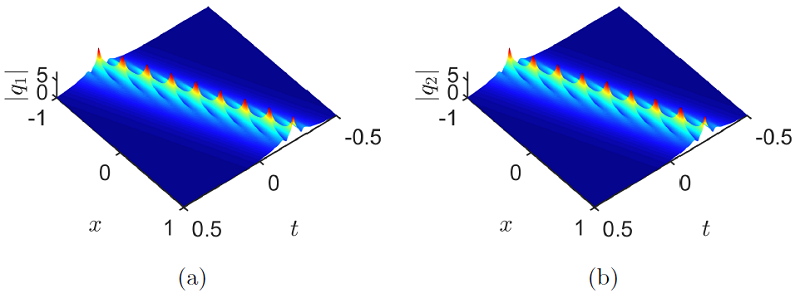
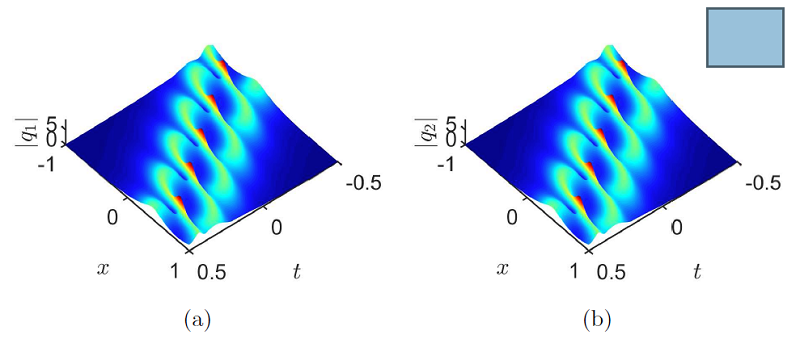
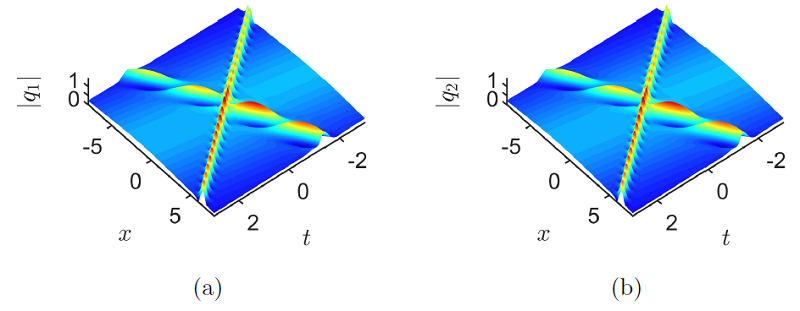
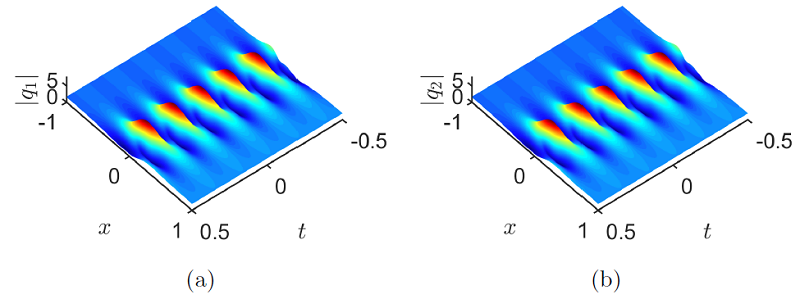
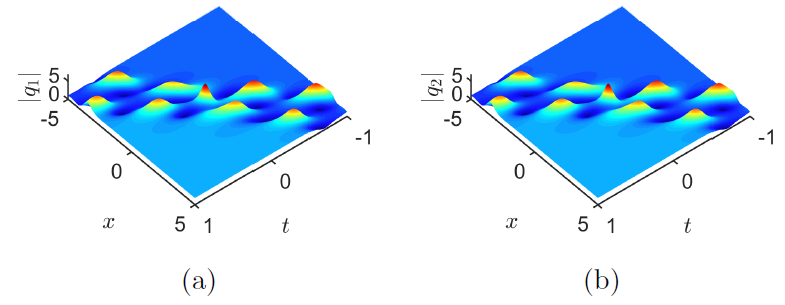
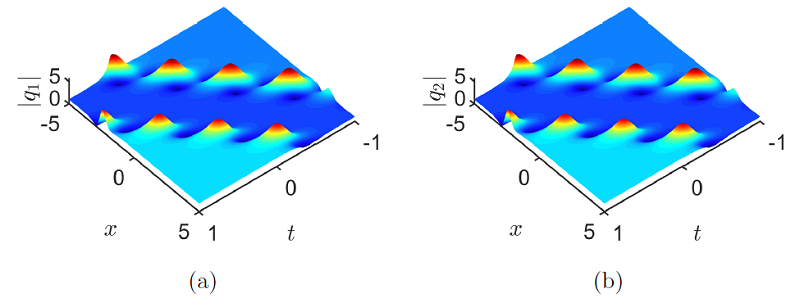
因此, 当 $n_2^2-m_2^2=n_1^2-m_1^2$ 图1 -2 . 图1 展示了类呼吸型孤子. 图2 呈现了带有束缚态结构的孤子分子.
图1
图1
2-孤子分子, 参数为 $a=\frac{1}{2}$ $b=1+{\rm i}$ $c=\frac{1}{2}$ $c_1=1+{\rm i}$ $c_2=1$ $c_3=1$ $m_1=\frac{1}{2}$ $n_1=1$ $m_2=\frac{3}{2}$ $n_2=\sqrt{3}$ .
图2
图2
2-孤子分子, 参数为 $a=\frac{1}{2}$ $b=1+{\rm i}$ $c=\frac{1}{2}$ $c_1=1+\frac{{\rm i}}{2}$ $c_2=1$ $c_3=1$ $m_1=\frac{\sqrt{2}}{2}$ $n_1=\frac{\sqrt{3}}{2}$ $m_2=1$ $n_2=\frac{\sqrt{5}}{2}$ .
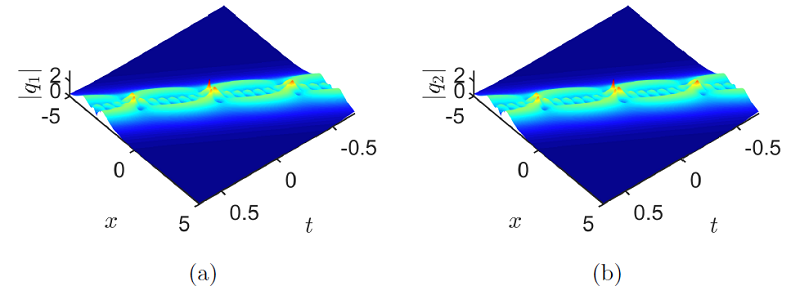
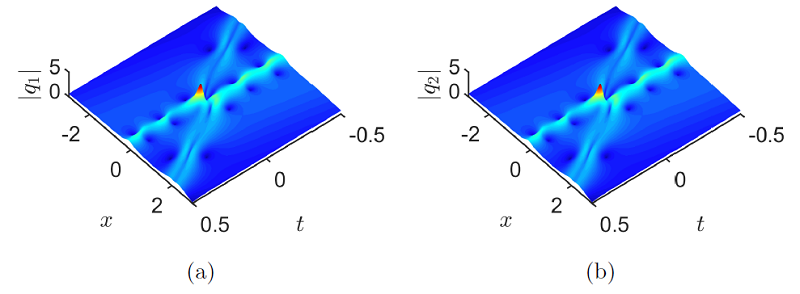
同理, 在 Darboux 变换 (2.13)-(2.14) 中取 $N=3$ $n_3^2-m_3^2=n_2^2-m_2^2=n_1^2-m_1^2$ 图2 -4 . 从图3 中可以发现平行的类呼吸子型孤子分子. 在图4 中, 观察到 3-孤子分子由一个带有束缚态结构的 2-孤子分子和类呼吸子型的孤子分子组成. 若令 $n_3^2-m_3^2\neq n_2^2-m_2^2\neq n_1^2-m_1^2$ 图5 -6 . 图5 所示为由 2-孤子分子和1-暗孤子所组成的孤子共振, 而图6 展示的是由 2-孤子分子和 1-类呼吸子型孤子组成的孤子共振.
图3
图3
3-孤子分子, 参数为 $a=\frac{1}{2}$ $b=1+{\rm i}$ $c=\frac{1}{2}$ $c_1=1+{\rm i}$ $c_2=1$ $c_3=1$ $m_1=1$ $n_1=-1$ $m_2=\frac{1}{2}$ $n_2=\frac{1}{2}$ $m_3=2$ $n_3=-2$ .
图4
图4
3-孤子分子, 参数为 $a=\frac{1}{2}$ $b=1+{\rm i}$ $c=\frac{1}{2}$ $c_1=1+{\rm i}$ $c_2=1$ $c_3=1$ $m_1=1$ $n_1=\frac{1}{2}$ $m_2=\frac{\sqrt{6}}{2}$ $n_2=\frac{3}{2}$ $m_3=\frac{\sqrt{2}}{2}$ $n_3=\frac{\sqrt{5}}{2}$ .
图5
图5
2-孤子分子与 1-暗孤子的孤子共振, 参数为 $a=\frac{1}{2}$ $b=1+{\rm i}$ $c=\frac{1}{2}$ $c_1=1+{\rm i}$ $c_2=1$ $c_3=1$ $m_1=1$ $n_1=-1$ $m_2=\frac{2}{3}$ $n_2=-1$ $m_3=-\frac{1}{4}$ $n_3=\frac{1}{2}$ .
图6
图6
2-孤子分子与 1-类呼吸子型孤子的孤子共振, 参数为 $a=\frac{1}{2}$ $b=1+{\rm i}$ $c=\frac{1}{2}$ $c_1=1+{\rm i}$ $c_2=1$ $c_3=1$ $m_1=\frac{1}{10}$ $n_1=\frac{3}{10}$ $m_2=\frac{4}{5}$ $n_2=-1$ $m_3=-\frac{1}{5}$ $n_3=1$ .
4 高阶 breather-positon 解
这一部分, 借助上述 Darboux 变换和极限技巧, 构造了高阶 breather-positon 解. 选取非零种子解
(4.1) $\begin{equation} q_1=a_1\mathrm{e}^{-\frac{2}{3}{\rm i}\theta x},\quad q_2=a_2\mathrm{e}^{-\frac{2}{3}{\rm i}\theta x},\quad \theta=aa_1^2+a_1a_2{\rm Re}(b)+ca_2^2, \end{equation}$
通过符号计算, Lax 对 (2.1) 的解可表示为
(4.2) $\begin{equation} \Psi_{1}(x,t,\lambda)=\begin{pmatrix} (l_{1}\mathrm{e}^{\Xi_{1}+\Xi_{2}} - l_{2}\mathrm{e}^{\Xi_{1}-\Xi_{2}})\mathrm{e}^{-\frac{{\rm i}}{3}\theta x} \\ \rho_{1}(l_{1}\mathrm{e}^{\Xi_{1}-\Xi_{2}}+l_{2}\mathrm{e}^{\Xi_{1}+\Xi_{2}})\mathrm{e}^{\frac{{\rm i}}{3}\theta x} \\ \rho_{2}(l_{1}\mathrm{e}^{\Xi_{1}-\Xi_{2}} - l_{2}\mathrm{e}^{\Xi_{1}+\Xi_{2}})\mathrm{e}^{\frac{{\rm i}}{3}\theta x} \end{pmatrix}, \end{equation}$
$p_k, q_k$ $(k=1,2,...,N)$
令 $\lambda=\lambda_1+\epsilon$ $\lambda_1=m_1+{\rm i}n_1$ $\Psi_1$ $\epsilon=0$
基于上述讨论, 我们呈现了高阶 breather-positon 解
(4.3) $\begin{equation} q_{1}[N]=q_{1}-\left(\frac{\Omega_{1}}{\Omega}\right)_{x},\quad q_{2}[N]=q_{2}-\left(\frac{\Omega_{2}}{\Omega}\right)_{x}, \end{equation}$
$\Omega_1$ $\Omega_2$
替换 $\Omega$ $(3N-1)$ $3N$
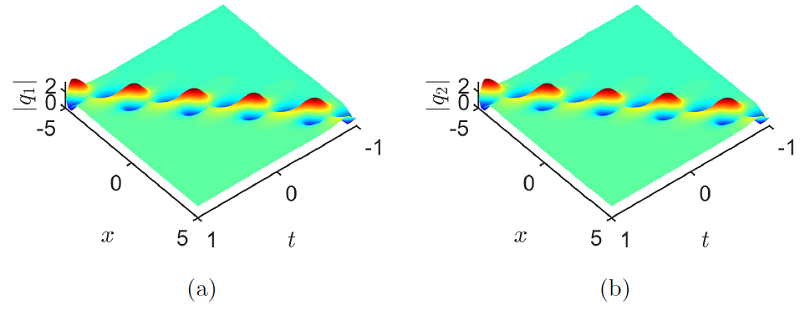
当 $N=1$ 图7 -8 中可以看到两种不同类型的一阶 breather-positon 解. 值得注意的是, 不同于呼吸子, 一阶 breather-positon 解的表达式可表示为有理函数与指数函数的组合. 一方面, 能观察到图7 中的一阶 breather-positon 解关于 $t$ 图8 中的一阶 breather-positon 解既关于 $x$ $t$
图7
图7
一阶 breather-positon 解, 参数为 $a_1=1$ $a_2=1$ $a=\frac{1}{2}$ $b=1+{\rm i}$ $c=\frac{1}{2}$ $m_1=1$ $n_1=-1$ .
图8
图8
一阶 breather-positon 解, 参数为 $a_1=1$ $a_2=1$ $a=\frac{1}{2}$ $b=1+{\rm i}$ $c=\frac{1}{2}$ $m_1=1$ $n_1=-\frac{1}{2}$ .
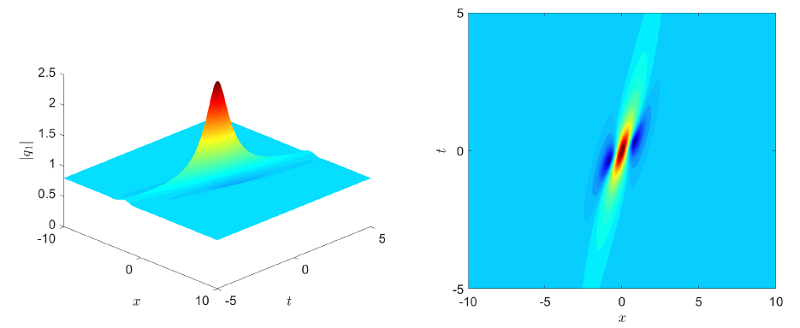
接下来, 我们以图8 中的一阶 breather-positon 解 (分量 $q_1$ ) 为例, 进行数值模拟探究其在极限行为下的演化过程. 图9 展示了 breather-positon 解在时空上的完整演化结构. 可以观察到, 通过参数极限, breather-positon 解中心区域的振幅增强, 同时振荡结构逐渐平滑, 最终演化为类怪波结构, 其呈现出典型的时空局域化特征, 最大振幅达到了 2.39, 且位于 (-0.03, -0.05). 这种强烈的振幅放大效应证实了解在特定参数条件下向怪波模式演化的潜在能力.
图9
图9
一阶 breather-positon 演化为类怪波过程,参数与图8相同.
当 $N=2$ 图10 -图11 . 有趣的是, 随着 $p_k$ $q_k$ $p_k,q_k(k=1,2,...,N)$
图10
图10
二阶 breather-positon 解, 参数为 $a_1=1$ $a_2=1$ $a=\frac{1}{2}$ $b=1+{\rm i}$ $c=\frac{1}{2}$ $m_1=1$ $n_1=-1$ $p_k=0$ $q_k=0$ .
图11
图11
二阶 breather-positon 解, 参数为 $a_1=1$ $a_2=1$ $a=\frac{1}{2}$ $b=1+{\rm i}$ $c=\frac{1}{2}$ $m_1=1$ $n_1=-1$ $p_k=200$ $q_k=200$ .
5 结论
本文系统研究了广义耦合导数非线性薛定谔方程, 该方程在描述窄脉冲非线性自陡峭效应方面具有重要作用. 基于 Lax 对, 成功构建了行列式形式的 $N$ $N$ - 孤子分子的稳定束缚, 并进一步观察到其与暗孤子或类呼吸子孤子之间的非弹性共振现象, 展现了多孤子系统中丰富的相互作用机制. 在非零种子解背景下, 所构造的高阶 breather-positon 解兼具时空局域振荡与代数衰减特性, 且其中心区域可通过参数极限演化为类怪波结构, 为探索怪波的激发机制提供了理论视角与潜在路径. 本工作为非线性光学、流体动力学等物理领域中的复杂波结构的调控与观测提供了理论依据. 未来研究将进一步考察该类解的动力学稳定性, 探索其在更多变系数或非均匀可积模型中的推广, 并推动在超短脉冲激光及深水波等物理场景中的实验验证与应用.
参考文献
View Option
[2]
Bamieh B Paganini F Dahleh M A Distributed control of spatially invariant systems
IEEE Trans Autom Control , 2002 , 47 1091 -1107
DOI:10.1109/TAC.2002.800646
URL
[本文引用: 1]
[4]
Shu C W High order weighted essentially nonoscillatory schemes for convection dominated problems
SIAM Rev , 2009 , 51 81 -126
[本文引用: 1]
[5]
Kadomtsev B B Petviashvili V I On the stability of solitary waves in weakly dispersing media
Sov Phys Dokl , 1970 , 15 639 -541
[本文引用: 1]
[6]
Li B Q Wazwaz A M Ma Y L Two new types of nonlocal Boussinesq equations in water waves: Bright and dark soliton solutions
Chin J Phys , 2022 , 77 1782 -1788
DOI:10.1016/j.cjph.2021.11.008
URL
[本文引用: 1]
[7]
Ma Y L Li B Q Dynamics of soliton resonances and soliton molecules for the AB system in two-layer fluids
Nonlinear Dyn , 2023 , 111 13327 -13341
DOI:10.1007/s11071-023-08529-0
[本文引用: 1]
[8]
Moura S J Argomedo F B Klein R et al . Battery state estimation for a single particle model with electrolyte dynamics
IEEE Trans Control Syst Technol , 2017 , 25 453 -468
DOI:10.1109/TCST.2016.2571663
URL
[本文引用: 1]
[9]
Jia R R Wang Y F Dark soliton solutions for the coupled variable-coefficient fourth-order nonliear Schrödinger equations in the inhomogeneous optical fiber
Wave Motion , 2022 , 114 103042
DOI:10.1016/j.wavemoti.2022.103042
URL
[本文引用: 1]
[10]
Wu X H Gao Y T Yu X Binary Darboux transformation and $N$ - dark solitons for the defocusing Kundu-Eckhaus equation in an optical fiber
Nonlinear Dyn , 2024 , 112 16379 -16388
DOI:10.1007/s11071-024-09889-x
[本文引用: 1]
[13]
Lü X Chen S J Interaction solutions to nonlinear partial differential equations via Hirota bilinear forms: One-lump-multi-stripe and one-lump-multi-soliton types
Nonlinear Dyn , 2021 , 103 947 -977
DOI:10.1007/s11071-020-06068-6
[本文引用: 1]
[14]
Li Y Yao R X Lou S Y An extended Hirota bilinear method and new wave structures of (2+1)-dimensional Sawada-Kotera equation
Appl Math Lett 2023 , 145 108760
DOI:10.1016/j.aml.2023.108760
URL
[本文引用: 1]
[15]
唐宇轩 , 周国全 . 用 Hirota 双线性导数变换求 MNLS 方程的 Rogue 波解
数学物理学报 , 2023 , 43A 1 ): 132 -142
[本文引用: 1]
Tang Y X Zhou G Q The rogue wave solution of MNLS equation based on Hirota's bi-linear derivative transformation
Acta Math Sci , 43A 1 ): 132 -142
[本文引用: 1]
[16]
Geng X G Wang J Xue B Riemann-Hilbert approach and $N$ - soliton solutions for a negative matrix AKNS system with a Hermitian symmetric space
Wave Motion , 2022 , 108 102838
DOI:10.1016/j.wavemoti.2021.102838
URL
[本文引用: 1]
[17]
Zou Z F Guo R The Riemann-Hilbert approach for the higher-order Gerdjikov-Ivanov equation, soliton interactions and position shift
Commun Nonlinear Sci Numer Simul , 2023 , 124 107316
DOI:10.1016/j.cnsns.2023.107316
URL
[本文引用: 1]
[18]
Wu X H Gao Y T Yu X et al . Modified generalized Darboux transformation and solitons for a Lakshmanan-Porsezian-Daniel equation
Chaos Solitons Fractals , 2022 , 162 112399
DOI:10.1016/j.chaos.2022.112399
URL
[本文引用: 1]
[19]
Yang S X Wang Y F Zhang X Conservation laws, Darboux transformation and localized waves for the $N$ - coupled nonautonomous Gross-Pitaevskii equations in the Bose-Einstein condensates
Chaos Solitons Fractals , 2023 , 169 113272
DOI:10.1016/j.chaos.2023.113272
URL
[本文引用: 1]
[20]
Liu S H Tian B Gao X T Generalized (n,$N$ - n)-fold Darboux transformation and localized waves for an integrable reduced spin Hirota-Maxwell-Bloch system in an erbium doped fiber
Chaos Solitons Fractals , 2024 , 186 115285
DOI:10.1016/j.chaos.2024.115285
URL
[本文引用: 1]
[21]
Liu X K Wen W Y Zhang T Magnetic soliton and breather interactions for the higher-order Heisenberg ferromagnetic equation via the iterative $N$ - fold Darboux transformation
Phys Scr , 2024 , 99 045231
DOI:10.1088/1402-4896/ad30eb
[本文引用: 1]
This paper focuses on a higher-order Heisenberg ferromagnetic equation, which may describe the motion of the magnetic vector of isotropic ferromagnetism. The iterative N-fold Darboux transformation is first constructed to generate the dark and anti-dark magnetic solitons on the non-zero constant backgrounds, bright and dark breathers on the trigonometric function and non-zero constant backgrounds as well as breathers on the trigonometric function and vanishing backgrounds. We discover that the soliton structures of three different components can generate rotation with different constant seed solutions. Meanwhile, the trajectory curve and the direction of the magnetic vector are also discussed from the perspective of magnetism, we find that for constant seed solutions, the motion of the magnetic vector is limited to the hemisphere, while for trigonometric seed solutions, the motion of the magnetic vector can be distributed throughout the whole sphere. These novel phenomena may be helpful to understand the dynamics of the magnetic vector in the magnetic materials.
[22]
娄瑜 , 张翼 . 推广的导数非线性薛定谔方程的单/双周期背景上的呼吸子和怪波及其碰撞解
数学物理学报 , 2024 , 44A 6 ): 1511 -1519
[本文引用: 1]
Lou Y Zhang Y Breather and rogue wave on the periodic/double periodic background and interaction solutions of the generalized derivative nonlinear Schrödinger equation
Acta Math Sci , 44A 6 ): 1511 -1519
[本文引用: 1]
[23]
Crasovan L C Kartashov Y V Mihalache D et al . Soliton "molecules": Robust clusters of spatiotemporal optical solitons
Phys Rev E , 2003 , 67 046610
DOI:10.1103/PhysRevE.67.046610
URL
[本文引用: 1]
[26]
Lakomy K Nath R Santos L Soliton molecules in dipolar Bose-Einstein condensates
Phys Rev A , 2012 , 86 013110
[本文引用: 1]
[27]
Herink G Kurtz F Jalali B et al . Real-time spectral interferometry probes the internal dynamics of femtosecond soliton molecules
Science , 2017 , 356 50 -53
DOI:10.1126/science.aal5326
PMID:28386005
[本文引用: 1]
Solitons, particle-like excitations ubiquitous in many fields of physics, have been shown to exhibit bound states akin to molecules. The formation of such temporal soliton bound states and their internal dynamics have escaped direct experimental observation. By means of an emerging time-stretch technique, we resolve the evolution of femtosecond soliton molecules in the cavity of a few-cycle mode-locked laser. We track two- and three-soliton bound states over hundreds of thousands of consecutive cavity roundtrips, identifying fixed points and periodic and aperiodic molecular orbits. A class of trajectories acquires a path-dependent geometrical phase, implying that its dynamics may be topologically protected. These findings highlight the importance of real-time detection in resolving interactions in complex nonlinear systems, including the dynamics of soliton bound states, breathers, and rogue waves.Copyright © 2017, American Association for the Advancement of Science.
[28]
Liu X M Yao X K Cui Y D Real-time observation of the buildup of soliton molecules
Phys Rev Lett , 2018 , 121 23905
DOI:10.1103/PhysRevLett.121.023905
PMID:30085749
[本文引用: 1]
Real-time spectroscopy access to ultrafast fiber lasers opens new opportunities for exploring complex soliton interaction dynamics. Here, we have reported the first observation, to the best of our knowledge, of the entire buildup process of soliton molecules (SMs) in a mode-locked laser. We have observed that the birth dynamics of a stable SM experiences five different stages, i.e., the raised relaxation oscillation (RO) stage, beating dynamics stage, transient single pulse stage, transient bound state, and finally the stable bound state. We have discovered that the evolution of pulses in the raised RO stage follows a law that only the strongest one can ultimately survive and, meanwhile, the pulses periodically appear at the same temporal positions for all lasing spikes during the same RO stage (named as memory ability) but they lose such ability between different RO stages. Moreover, we have found that the buildup dynamics of SMs is quite sensitive to both the polarization state of intracavity light and the fluctuation of pump power. These results provide new perspectives into the ultrafast transient process in mode-locked lasers and the dynamics of complex nonlinear systems.
[29]
Lou S Y Soliton molecules and asymmetric solitons in three fifth order systems via velocity resonance
J Phys Commun , 2020 , 4 041002
DOI:10.1088/2399-6528/ab833e
[本文引用: 1]
Soliton molecules can be formed in some possible mechanisms both theoretically and experimentally. In this paper, we introduce a new mechanism, namely the velocity resonant, to find soliton molecules. Under the velocity resonance mechanism, two solitons can form a kink-antikink molecule, an asymmetric soliton, a two-peak soliton and/or a far away bounded molecule depended on the selections of the wave numbers and the distance between two solitons of a molecule. The results are exhibited via three well known fifth order integrable systems which serve as a general fluid model, as well as models many other physical fields.
[32]
Li B Q Ma Y L Soliton resonances and soliton molecules of pump wave and Stokes wave for a transient stimulated Raman scattering system in optics
Eur Phys J Plus , 2022 , 137 1227
DOI:10.1140/epjp/s13360-022-03455-3
[本文引用: 1]
[33]
Li B Q Ma Y L Optical soliton resonances and soliton molecules for the Lakshmanan-Porsezian-Daniel system in nonlinear optics
Nonlinear Dyn , 2023 , 111 6689 -6699
DOI:10.1007/s11071-022-08195-8
[本文引用: 1]
[35]
Kedziora D J Ankiewicz A Akhmediev N Second-order nonlinear Schrödinger equation breather solutions in the degenerate and rogue wave limits
Phys Rev E , 2012 , 85 066601
DOI:10.1103/PhysRevE.85.066601
URL
[本文引用: 1]
[36]
Chowdury A Krolikowski W Akhmediev A Breather solutions of a fourth-order nonlinear Schrödinger equation in the degenerate, soliton, and rogue wave limits
Phys Rev E , 2017 , 96 042209
DOI:10.1103/PhysRevE.96.042209
URL
[本文引用: 1]
[37]
Wang L H He J S Xu H et al . Generation of higher-order rogue waves from multibreathers by double degeneracy in an optical fiber
Phys Rev E , 2017 , 95 042217
DOI:10.1103/PhysRevE.95.042217
URL
[本文引用: 1]
[39]
Song W J Xu S W Li M H He J S Generating mechanism and dynamic of the smooth positons for the derivative nonlinear Schrödinger equation
Nonlinear Dyn , 2019 , 97 2135 -2145
DOI:10.1007/s11071-019-05111-5
[本文引用: 1]
[40]
Li P He J S Li M H The higher-order positon and breather-positon solutions for the complex short pulse equation
Nonlinear Dyn , 2024 , 112 10239 -10258
DOI:10.1007/s11071-024-09503-0
[本文引用: 1]
[42]
Zhang Z Li B Chen J C Guo Q Construction of higher-order smooth positons and breather positons via Hirota's bilinear method
Nonlinear Dyn , 2021 , 105 2611 -2618
DOI:10.1007/s11071-021-06751-2
[本文引用: 1]
[43]
Lv N N Huang L Breather-soliton molecules and breather-positons for the extended complex modified KdV equation
Commun Nonlinear Sci Numer Simul , 2022 , 107 106148
DOI:10.1016/j.cnsns.2021.106148
URL
[本文引用: 1]
[44]
Yang J Tian H J Nth-order smooth positon and breather-positon solutions for the generalized integrable discrete nonlinear Schrödinger equation
Nonliear Dyn , 2023 , 111 5629 -5639
[本文引用: 1]
[46]
Kuang Y H A general coupled derivative nonlinear Schrödinger system: Darboux transformation and soliton solutions
J Nonlinear Math Phys , 2024 , 31 46
DOI:10.1007/s44198-024-00212-1
[本文引用: 1]
In this work we present a general coupled derivative nonlinear Schrödinger system. We construct the corresponding N-fold Darboux transform and generalized Darboux transform. Under this construction, we give different soliton solutions and plot their figures describing the soliton characteristics and dynamical behaviors, including higher-order soliton and rouge wave solution etc.
Exponential time differecing for stiff systems
1
2002
... 众所周知,偏微分方程 (PDEs) 在物理和工程领域占据关键地位, 众多学术著作中对此有广泛记载[1 ,2 ,3 ,4 ] . 鉴于非线性的普遍性, 含空间和时间自变量的非线性偏微分方程, 有时也被称作非线性演化方程. 例如, 在流体研究中, 非线性偏微分方程是描述非线性流体动力学的基础, 涵盖湍流、冲击波、流体不稳定性等现象[5 ,6 ,7 ] . 在光学领域, 它们对于建模自聚焦、光孤子、非线性波传播等非线性光学现象至关重要[8 ,9 ,10 ] . 此外, 在电磁学背景下, 非线性偏微分方程对理解和预测非线性电磁行为及相互作用意义重大[11 ,12 ] . 探寻偏微分方程的非线性局域解备受关注, 可采用多种方法求解,如 Hirota 双线性方法[13 ,14 ,15 ] , Riemann-Hilbert 方法[16 ,17 ] , Darboux 变换[18 ,19 ,20 ,21 ,22 ] . ...
Distributed control of spatially invariant systems
1
2002
... 众所周知,偏微分方程 (PDEs) 在物理和工程领域占据关键地位, 众多学术著作中对此有广泛记载[1 ,2 ,3 ,4 ] . 鉴于非线性的普遍性, 含空间和时间自变量的非线性偏微分方程, 有时也被称作非线性演化方程. 例如, 在流体研究中, 非线性偏微分方程是描述非线性流体动力学的基础, 涵盖湍流、冲击波、流体不稳定性等现象[5 ,6 ,7 ] . 在光学领域, 它们对于建模自聚焦、光孤子、非线性波传播等非线性光学现象至关重要[8 ,9 ,10 ] . 此外, 在电磁学背景下, 非线性偏微分方程对理解和预测非线性电磁行为及相互作用意义重大[11 ,12 ] . 探寻偏微分方程的非线性局域解备受关注, 可采用多种方法求解,如 Hirota 双线性方法[13 ,14 ,15 ] , Riemann-Hilbert 方法[16 ,17 ] , Darboux 变换[18 ,19 ,20 ,21 ,22 ] . ...
Review of code and solution verification procedures for computational simulation
1
2005
... 众所周知,偏微分方程 (PDEs) 在物理和工程领域占据关键地位, 众多学术著作中对此有广泛记载[1 ,2 ,3 ,4 ] . 鉴于非线性的普遍性, 含空间和时间自变量的非线性偏微分方程, 有时也被称作非线性演化方程. 例如, 在流体研究中, 非线性偏微分方程是描述非线性流体动力学的基础, 涵盖湍流、冲击波、流体不稳定性等现象[5 ,6 ,7 ] . 在光学领域, 它们对于建模自聚焦、光孤子、非线性波传播等非线性光学现象至关重要[8 ,9 ,10 ] . 此外, 在电磁学背景下, 非线性偏微分方程对理解和预测非线性电磁行为及相互作用意义重大[11 ,12 ] . 探寻偏微分方程的非线性局域解备受关注, 可采用多种方法求解,如 Hirota 双线性方法[13 ,14 ,15 ] , Riemann-Hilbert 方法[16 ,17 ] , Darboux 变换[18 ,19 ,20 ,21 ,22 ] . ...
High order weighted essentially nonoscillatory schemes for convection dominated problems
1
2009
... 众所周知,偏微分方程 (PDEs) 在物理和工程领域占据关键地位, 众多学术著作中对此有广泛记载[1 ,2 ,3 ,4 ] . 鉴于非线性的普遍性, 含空间和时间自变量的非线性偏微分方程, 有时也被称作非线性演化方程. 例如, 在流体研究中, 非线性偏微分方程是描述非线性流体动力学的基础, 涵盖湍流、冲击波、流体不稳定性等现象[5 ,6 ,7 ] . 在光学领域, 它们对于建模自聚焦、光孤子、非线性波传播等非线性光学现象至关重要[8 ,9 ,10 ] . 此外, 在电磁学背景下, 非线性偏微分方程对理解和预测非线性电磁行为及相互作用意义重大[11 ,12 ] . 探寻偏微分方程的非线性局域解备受关注, 可采用多种方法求解,如 Hirota 双线性方法[13 ,14 ,15 ] , Riemann-Hilbert 方法[16 ,17 ] , Darboux 变换[18 ,19 ,20 ,21 ,22 ] . ...
On the stability of solitary waves in weakly dispersing media
1
1970
... 众所周知,偏微分方程 (PDEs) 在物理和工程领域占据关键地位, 众多学术著作中对此有广泛记载[1 ,2 ,3 ,4 ] . 鉴于非线性的普遍性, 含空间和时间自变量的非线性偏微分方程, 有时也被称作非线性演化方程. 例如, 在流体研究中, 非线性偏微分方程是描述非线性流体动力学的基础, 涵盖湍流、冲击波、流体不稳定性等现象[5 ,6 ,7 ] . 在光学领域, 它们对于建模自聚焦、光孤子、非线性波传播等非线性光学现象至关重要[8 ,9 ,10 ] . 此外, 在电磁学背景下, 非线性偏微分方程对理解和预测非线性电磁行为及相互作用意义重大[11 ,12 ] . 探寻偏微分方程的非线性局域解备受关注, 可采用多种方法求解,如 Hirota 双线性方法[13 ,14 ,15 ] , Riemann-Hilbert 方法[16 ,17 ] , Darboux 变换[18 ,19 ,20 ,21 ,22 ] . ...
Two new types of nonlocal Boussinesq equations in water waves: Bright and dark soliton solutions
1
2022
... 众所周知,偏微分方程 (PDEs) 在物理和工程领域占据关键地位, 众多学术著作中对此有广泛记载[1 ,2 ,3 ,4 ] . 鉴于非线性的普遍性, 含空间和时间自变量的非线性偏微分方程, 有时也被称作非线性演化方程. 例如, 在流体研究中, 非线性偏微分方程是描述非线性流体动力学的基础, 涵盖湍流、冲击波、流体不稳定性等现象[5 ,6 ,7 ] . 在光学领域, 它们对于建模自聚焦、光孤子、非线性波传播等非线性光学现象至关重要[8 ,9 ,10 ] . 此外, 在电磁学背景下, 非线性偏微分方程对理解和预测非线性电磁行为及相互作用意义重大[11 ,12 ] . 探寻偏微分方程的非线性局域解备受关注, 可采用多种方法求解,如 Hirota 双线性方法[13 ,14 ,15 ] , Riemann-Hilbert 方法[16 ,17 ] , Darboux 变换[18 ,19 ,20 ,21 ,22 ] . ...
Dynamics of soliton resonances and soliton molecules for the AB system in two-layer fluids
1
2023
... 众所周知,偏微分方程 (PDEs) 在物理和工程领域占据关键地位, 众多学术著作中对此有广泛记载[1 ,2 ,3 ,4 ] . 鉴于非线性的普遍性, 含空间和时间自变量的非线性偏微分方程, 有时也被称作非线性演化方程. 例如, 在流体研究中, 非线性偏微分方程是描述非线性流体动力学的基础, 涵盖湍流、冲击波、流体不稳定性等现象[5 ,6 ,7 ] . 在光学领域, 它们对于建模自聚焦、光孤子、非线性波传播等非线性光学现象至关重要[8 ,9 ,10 ] . 此外, 在电磁学背景下, 非线性偏微分方程对理解和预测非线性电磁行为及相互作用意义重大[11 ,12 ] . 探寻偏微分方程的非线性局域解备受关注, 可采用多种方法求解,如 Hirota 双线性方法[13 ,14 ,15 ] , Riemann-Hilbert 方法[16 ,17 ] , Darboux 变换[18 ,19 ,20 ,21 ,22 ] . ...
Battery state estimation for a single particle model with electrolyte dynamics
1
2017
... 众所周知,偏微分方程 (PDEs) 在物理和工程领域占据关键地位, 众多学术著作中对此有广泛记载[1 ,2 ,3 ,4 ] . 鉴于非线性的普遍性, 含空间和时间自变量的非线性偏微分方程, 有时也被称作非线性演化方程. 例如, 在流体研究中, 非线性偏微分方程是描述非线性流体动力学的基础, 涵盖湍流、冲击波、流体不稳定性等现象[5 ,6 ,7 ] . 在光学领域, 它们对于建模自聚焦、光孤子、非线性波传播等非线性光学现象至关重要[8 ,9 ,10 ] . 此外, 在电磁学背景下, 非线性偏微分方程对理解和预测非线性电磁行为及相互作用意义重大[11 ,12 ] . 探寻偏微分方程的非线性局域解备受关注, 可采用多种方法求解,如 Hirota 双线性方法[13 ,14 ,15 ] , Riemann-Hilbert 方法[16 ,17 ] , Darboux 变换[18 ,19 ,20 ,21 ,22 ] . ...
Dark soliton solutions for the coupled variable-coefficient fourth-order nonliear Schr?dinger equations in the inhomogeneous optical fiber
1
2022
... 众所周知,偏微分方程 (PDEs) 在物理和工程领域占据关键地位, 众多学术著作中对此有广泛记载[1 ,2 ,3 ,4 ] . 鉴于非线性的普遍性, 含空间和时间自变量的非线性偏微分方程, 有时也被称作非线性演化方程. 例如, 在流体研究中, 非线性偏微分方程是描述非线性流体动力学的基础, 涵盖湍流、冲击波、流体不稳定性等现象[5 ,6 ,7 ] . 在光学领域, 它们对于建模自聚焦、光孤子、非线性波传播等非线性光学现象至关重要[8 ,9 ,10 ] . 此外, 在电磁学背景下, 非线性偏微分方程对理解和预测非线性电磁行为及相互作用意义重大[11 ,12 ] . 探寻偏微分方程的非线性局域解备受关注, 可采用多种方法求解,如 Hirota 双线性方法[13 ,14 ,15 ] , Riemann-Hilbert 方法[16 ,17 ] , Darboux 变换[18 ,19 ,20 ,21 ,22 ] . ...
Binary Darboux transformation and $N$ -dark solitons for the defocusing Kundu-Eckhaus equation in an optical fiber
1
2024
... 众所周知,偏微分方程 (PDEs) 在物理和工程领域占据关键地位, 众多学术著作中对此有广泛记载[1 ,2 ,3 ,4 ] . 鉴于非线性的普遍性, 含空间和时间自变量的非线性偏微分方程, 有时也被称作非线性演化方程. 例如, 在流体研究中, 非线性偏微分方程是描述非线性流体动力学的基础, 涵盖湍流、冲击波、流体不稳定性等现象[5 ,6 ,7 ] . 在光学领域, 它们对于建模自聚焦、光孤子、非线性波传播等非线性光学现象至关重要[8 ,9 ,10 ] . 此外, 在电磁学背景下, 非线性偏微分方程对理解和预测非线性电磁行为及相互作用意义重大[11 ,12 ] . 探寻偏微分方程的非线性局域解备受关注, 可采用多种方法求解,如 Hirota 双线性方法[13 ,14 ,15 ] , Riemann-Hilbert 方法[16 ,17 ] , Darboux 变换[18 ,19 ,20 ,21 ,22 ] . ...
Modified Kadomtsev-Petviashvili (MKP) equation and electromagnetic soliton
1
2003
... 众所周知,偏微分方程 (PDEs) 在物理和工程领域占据关键地位, 众多学术著作中对此有广泛记载[1 ,2 ,3 ,4 ] . 鉴于非线性的普遍性, 含空间和时间自变量的非线性偏微分方程, 有时也被称作非线性演化方程. 例如, 在流体研究中, 非线性偏微分方程是描述非线性流体动力学的基础, 涵盖湍流、冲击波、流体不稳定性等现象[5 ,6 ,7 ] . 在光学领域, 它们对于建模自聚焦、光孤子、非线性波传播等非线性光学现象至关重要[8 ,9 ,10 ] . 此外, 在电磁学背景下, 非线性偏微分方程对理解和预测非线性电磁行为及相互作用意义重大[11 ,12 ] . 探寻偏微分方程的非线性局域解备受关注, 可采用多种方法求解,如 Hirota 双线性方法[13 ,14 ,15 ] , Riemann-Hilbert 方法[16 ,17 ] , Darboux 变换[18 ,19 ,20 ,21 ,22 ] . ...
Certain electromagnetic waves in a ferromagnetic film
1
2021
... 众所周知,偏微分方程 (PDEs) 在物理和工程领域占据关键地位, 众多学术著作中对此有广泛记载[1 ,2 ,3 ,4 ] . 鉴于非线性的普遍性, 含空间和时间自变量的非线性偏微分方程, 有时也被称作非线性演化方程. 例如, 在流体研究中, 非线性偏微分方程是描述非线性流体动力学的基础, 涵盖湍流、冲击波、流体不稳定性等现象[5 ,6 ,7 ] . 在光学领域, 它们对于建模自聚焦、光孤子、非线性波传播等非线性光学现象至关重要[8 ,9 ,10 ] . 此外, 在电磁学背景下, 非线性偏微分方程对理解和预测非线性电磁行为及相互作用意义重大[11 ,12 ] . 探寻偏微分方程的非线性局域解备受关注, 可采用多种方法求解,如 Hirota 双线性方法[13 ,14 ,15 ] , Riemann-Hilbert 方法[16 ,17 ] , Darboux 变换[18 ,19 ,20 ,21 ,22 ] . ...
Interaction solutions to nonlinear partial differential equations via Hirota bilinear forms: One-lump-multi-stripe and one-lump-multi-soliton types
1
2021
... 众所周知,偏微分方程 (PDEs) 在物理和工程领域占据关键地位, 众多学术著作中对此有广泛记载[1 ,2 ,3 ,4 ] . 鉴于非线性的普遍性, 含空间和时间自变量的非线性偏微分方程, 有时也被称作非线性演化方程. 例如, 在流体研究中, 非线性偏微分方程是描述非线性流体动力学的基础, 涵盖湍流、冲击波、流体不稳定性等现象[5 ,6 ,7 ] . 在光学领域, 它们对于建模自聚焦、光孤子、非线性波传播等非线性光学现象至关重要[8 ,9 ,10 ] . 此外, 在电磁学背景下, 非线性偏微分方程对理解和预测非线性电磁行为及相互作用意义重大[11 ,12 ] . 探寻偏微分方程的非线性局域解备受关注, 可采用多种方法求解,如 Hirota 双线性方法[13 ,14 ,15 ] , Riemann-Hilbert 方法[16 ,17 ] , Darboux 变换[18 ,19 ,20 ,21 ,22 ] . ...
An extended Hirota bilinear method and new wave structures of (2+1)-dimensional Sawada-Kotera equation
1
2023
... 众所周知,偏微分方程 (PDEs) 在物理和工程领域占据关键地位, 众多学术著作中对此有广泛记载[1 ,2 ,3 ,4 ] . 鉴于非线性的普遍性, 含空间和时间自变量的非线性偏微分方程, 有时也被称作非线性演化方程. 例如, 在流体研究中, 非线性偏微分方程是描述非线性流体动力学的基础, 涵盖湍流、冲击波、流体不稳定性等现象[5 ,6 ,7 ] . 在光学领域, 它们对于建模自聚焦、光孤子、非线性波传播等非线性光学现象至关重要[8 ,9 ,10 ] . 此外, 在电磁学背景下, 非线性偏微分方程对理解和预测非线性电磁行为及相互作用意义重大[11 ,12 ] . 探寻偏微分方程的非线性局域解备受关注, 可采用多种方法求解,如 Hirota 双线性方法[13 ,14 ,15 ] , Riemann-Hilbert 方法[16 ,17 ] , Darboux 变换[18 ,19 ,20 ,21 ,22 ] . ...
用 Hirota 双线性导数变换求 MNLS 方程的 Rogue 波解
1
2023
... 众所周知,偏微分方程 (PDEs) 在物理和工程领域占据关键地位, 众多学术著作中对此有广泛记载[1 ,2 ,3 ,4 ] . 鉴于非线性的普遍性, 含空间和时间自变量的非线性偏微分方程, 有时也被称作非线性演化方程. 例如, 在流体研究中, 非线性偏微分方程是描述非线性流体动力学的基础, 涵盖湍流、冲击波、流体不稳定性等现象[5 ,6 ,7 ] . 在光学领域, 它们对于建模自聚焦、光孤子、非线性波传播等非线性光学现象至关重要[8 ,9 ,10 ] . 此外, 在电磁学背景下, 非线性偏微分方程对理解和预测非线性电磁行为及相互作用意义重大[11 ,12 ] . 探寻偏微分方程的非线性局域解备受关注, 可采用多种方法求解,如 Hirota 双线性方法[13 ,14 ,15 ] , Riemann-Hilbert 方法[16 ,17 ] , Darboux 变换[18 ,19 ,20 ,21 ,22 ] . ...
The rogue wave solution of MNLS equation based on Hirota's bi-linear derivative transformation
1
... 众所周知,偏微分方程 (PDEs) 在物理和工程领域占据关键地位, 众多学术著作中对此有广泛记载[1 ,2 ,3 ,4 ] . 鉴于非线性的普遍性, 含空间和时间自变量的非线性偏微分方程, 有时也被称作非线性演化方程. 例如, 在流体研究中, 非线性偏微分方程是描述非线性流体动力学的基础, 涵盖湍流、冲击波、流体不稳定性等现象[5 ,6 ,7 ] . 在光学领域, 它们对于建模自聚焦、光孤子、非线性波传播等非线性光学现象至关重要[8 ,9 ,10 ] . 此外, 在电磁学背景下, 非线性偏微分方程对理解和预测非线性电磁行为及相互作用意义重大[11 ,12 ] . 探寻偏微分方程的非线性局域解备受关注, 可采用多种方法求解,如 Hirota 双线性方法[13 ,14 ,15 ] , Riemann-Hilbert 方法[16 ,17 ] , Darboux 变换[18 ,19 ,20 ,21 ,22 ] . ...
Riemann-Hilbert approach and $N$ -soliton solutions for a negative matrix AKNS system with a Hermitian symmetric space
1
2022
... 众所周知,偏微分方程 (PDEs) 在物理和工程领域占据关键地位, 众多学术著作中对此有广泛记载[1 ,2 ,3 ,4 ] . 鉴于非线性的普遍性, 含空间和时间自变量的非线性偏微分方程, 有时也被称作非线性演化方程. 例如, 在流体研究中, 非线性偏微分方程是描述非线性流体动力学的基础, 涵盖湍流、冲击波、流体不稳定性等现象[5 ,6 ,7 ] . 在光学领域, 它们对于建模自聚焦、光孤子、非线性波传播等非线性光学现象至关重要[8 ,9 ,10 ] . 此外, 在电磁学背景下, 非线性偏微分方程对理解和预测非线性电磁行为及相互作用意义重大[11 ,12 ] . 探寻偏微分方程的非线性局域解备受关注, 可采用多种方法求解,如 Hirota 双线性方法[13 ,14 ,15 ] , Riemann-Hilbert 方法[16 ,17 ] , Darboux 变换[18 ,19 ,20 ,21 ,22 ] . ...
The Riemann-Hilbert approach for the higher-order Gerdjikov-Ivanov equation, soliton interactions and position shift
1
2023
... 众所周知,偏微分方程 (PDEs) 在物理和工程领域占据关键地位, 众多学术著作中对此有广泛记载[1 ,2 ,3 ,4 ] . 鉴于非线性的普遍性, 含空间和时间自变量的非线性偏微分方程, 有时也被称作非线性演化方程. 例如, 在流体研究中, 非线性偏微分方程是描述非线性流体动力学的基础, 涵盖湍流、冲击波、流体不稳定性等现象[5 ,6 ,7 ] . 在光学领域, 它们对于建模自聚焦、光孤子、非线性波传播等非线性光学现象至关重要[8 ,9 ,10 ] . 此外, 在电磁学背景下, 非线性偏微分方程对理解和预测非线性电磁行为及相互作用意义重大[11 ,12 ] . 探寻偏微分方程的非线性局域解备受关注, 可采用多种方法求解,如 Hirota 双线性方法[13 ,14 ,15 ] , Riemann-Hilbert 方法[16 ,17 ] , Darboux 变换[18 ,19 ,20 ,21 ,22 ] . ...
Modified generalized Darboux transformation and solitons for a Lakshmanan-Porsezian-Daniel equation
1
2022
... 众所周知,偏微分方程 (PDEs) 在物理和工程领域占据关键地位, 众多学术著作中对此有广泛记载[1 ,2 ,3 ,4 ] . 鉴于非线性的普遍性, 含空间和时间自变量的非线性偏微分方程, 有时也被称作非线性演化方程. 例如, 在流体研究中, 非线性偏微分方程是描述非线性流体动力学的基础, 涵盖湍流、冲击波、流体不稳定性等现象[5 ,6 ,7 ] . 在光学领域, 它们对于建模自聚焦、光孤子、非线性波传播等非线性光学现象至关重要[8 ,9 ,10 ] . 此外, 在电磁学背景下, 非线性偏微分方程对理解和预测非线性电磁行为及相互作用意义重大[11 ,12 ] . 探寻偏微分方程的非线性局域解备受关注, 可采用多种方法求解,如 Hirota 双线性方法[13 ,14 ,15 ] , Riemann-Hilbert 方法[16 ,17 ] , Darboux 变换[18 ,19 ,20 ,21 ,22 ] . ...
Conservation laws, Darboux transformation and localized waves for the $N$ -coupled nonautonomous Gross-Pitaevskii equations in the Bose-Einstein condensates
1
2023
... 众所周知,偏微分方程 (PDEs) 在物理和工程领域占据关键地位, 众多学术著作中对此有广泛记载[1 ,2 ,3 ,4 ] . 鉴于非线性的普遍性, 含空间和时间自变量的非线性偏微分方程, 有时也被称作非线性演化方程. 例如, 在流体研究中, 非线性偏微分方程是描述非线性流体动力学的基础, 涵盖湍流、冲击波、流体不稳定性等现象[5 ,6 ,7 ] . 在光学领域, 它们对于建模自聚焦、光孤子、非线性波传播等非线性光学现象至关重要[8 ,9 ,10 ] . 此外, 在电磁学背景下, 非线性偏微分方程对理解和预测非线性电磁行为及相互作用意义重大[11 ,12 ] . 探寻偏微分方程的非线性局域解备受关注, 可采用多种方法求解,如 Hirota 双线性方法[13 ,14 ,15 ] , Riemann-Hilbert 方法[16 ,17 ] , Darboux 变换[18 ,19 ,20 ,21 ,22 ] . ...
Generalized (n,$N$ -n)-fold Darboux transformation and localized waves for an integrable reduced spin Hirota-Maxwell-Bloch system in an erbium doped fiber
1
2024
... 众所周知,偏微分方程 (PDEs) 在物理和工程领域占据关键地位, 众多学术著作中对此有广泛记载[1 ,2 ,3 ,4 ] . 鉴于非线性的普遍性, 含空间和时间自变量的非线性偏微分方程, 有时也被称作非线性演化方程. 例如, 在流体研究中, 非线性偏微分方程是描述非线性流体动力学的基础, 涵盖湍流、冲击波、流体不稳定性等现象[5 ,6 ,7 ] . 在光学领域, 它们对于建模自聚焦、光孤子、非线性波传播等非线性光学现象至关重要[8 ,9 ,10 ] . 此外, 在电磁学背景下, 非线性偏微分方程对理解和预测非线性电磁行为及相互作用意义重大[11 ,12 ] . 探寻偏微分方程的非线性局域解备受关注, 可采用多种方法求解,如 Hirota 双线性方法[13 ,14 ,15 ] , Riemann-Hilbert 方法[16 ,17 ] , Darboux 变换[18 ,19 ,20 ,21 ,22 ] . ...
Magnetic soliton and breather interactions for the higher-order Heisenberg ferromagnetic equation via the iterative $N$ -fold Darboux transformation
1
2024
... 众所周知,偏微分方程 (PDEs) 在物理和工程领域占据关键地位, 众多学术著作中对此有广泛记载[1 ,2 ,3 ,4 ] . 鉴于非线性的普遍性, 含空间和时间自变量的非线性偏微分方程, 有时也被称作非线性演化方程. 例如, 在流体研究中, 非线性偏微分方程是描述非线性流体动力学的基础, 涵盖湍流、冲击波、流体不稳定性等现象[5 ,6 ,7 ] . 在光学领域, 它们对于建模自聚焦、光孤子、非线性波传播等非线性光学现象至关重要[8 ,9 ,10 ] . 此外, 在电磁学背景下, 非线性偏微分方程对理解和预测非线性电磁行为及相互作用意义重大[11 ,12 ] . 探寻偏微分方程的非线性局域解备受关注, 可采用多种方法求解,如 Hirota 双线性方法[13 ,14 ,15 ] , Riemann-Hilbert 方法[16 ,17 ] , Darboux 变换[18 ,19 ,20 ,21 ,22 ] . ...
推广的导数非线性薛定谔方程的单/双周期背景上的呼吸子和怪波及其碰撞解
1
2024
... 众所周知,偏微分方程 (PDEs) 在物理和工程领域占据关键地位, 众多学术著作中对此有广泛记载[1 ,2 ,3 ,4 ] . 鉴于非线性的普遍性, 含空间和时间自变量的非线性偏微分方程, 有时也被称作非线性演化方程. 例如, 在流体研究中, 非线性偏微分方程是描述非线性流体动力学的基础, 涵盖湍流、冲击波、流体不稳定性等现象[5 ,6 ,7 ] . 在光学领域, 它们对于建模自聚焦、光孤子、非线性波传播等非线性光学现象至关重要[8 ,9 ,10 ] . 此外, 在电磁学背景下, 非线性偏微分方程对理解和预测非线性电磁行为及相互作用意义重大[11 ,12 ] . 探寻偏微分方程的非线性局域解备受关注, 可采用多种方法求解,如 Hirota 双线性方法[13 ,14 ,15 ] , Riemann-Hilbert 方法[16 ,17 ] , Darboux 变换[18 ,19 ,20 ,21 ,22 ] . ...
Breather and rogue wave on the periodic/double periodic background and interaction solutions of the generalized derivative nonlinear Schr?dinger equation
1
... 众所周知,偏微分方程 (PDEs) 在物理和工程领域占据关键地位, 众多学术著作中对此有广泛记载[1 ,2 ,3 ,4 ] . 鉴于非线性的普遍性, 含空间和时间自变量的非线性偏微分方程, 有时也被称作非线性演化方程. 例如, 在流体研究中, 非线性偏微分方程是描述非线性流体动力学的基础, 涵盖湍流、冲击波、流体不稳定性等现象[5 ,6 ,7 ] . 在光学领域, 它们对于建模自聚焦、光孤子、非线性波传播等非线性光学现象至关重要[8 ,9 ,10 ] . 此外, 在电磁学背景下, 非线性偏微分方程对理解和预测非线性电磁行为及相互作用意义重大[11 ,12 ] . 探寻偏微分方程的非线性局域解备受关注, 可采用多种方法求解,如 Hirota 双线性方法[13 ,14 ,15 ] , Riemann-Hilbert 方法[16 ,17 ] , Darboux 变换[18 ,19 ,20 ,21 ,22 ] . ...
Soliton "molecules": Robust clusters of spatiotemporal optical solitons
1
2003
... "孤子分子" 的概念最初是为了阐释凝聚态物质中一类特殊的平行孤子而提出的, 这类孤子以其具有弹性、 自持和束缚的状态为特征[23 ,24 ] . 孤子分子的一个显著特征是, 基础孤子应具备相等的群速度. 孤子分子的一个显著特点是, 其基本构成单元 (基态孤子) 必须具有相同的传播速度. 显然, 孤子分子在实验和理论研究领域都已成为一个备受关注的课题[25 ,26 ,27 ,28 ,29 ,30 ] . 在物理现象的语境中, 共振被定义为这样一种现象: 当某些物理量 (例如波频率) 被赋予特定值时, 一个物理系统能够产生幅度更大的振动[31 ] . 当孤子——那些极其稳定的波包——处于一种高度特定的相互作用状态时, 共振便会出现. 这种相互作用会导致它们集体行为的显著放大, 常常引发新颖且复杂的波图样的出现[32 ,33 ] . 通常而言, positon 可视为孤子的长程类比物, 其特点是具有振荡行为和强度 (或振幅) 的逐渐衰减[34 ] . 在大多数情况下, 这些存在于非零背景上的非奇异 positons 被称为简并孤子或平滑波势. 值得注意的是, 在非零背景上激发、并在各种非线性薛定谔方程中构造的 breather-positon, 其本质与 positon 不同[35 ,36 ] . 更重要的是, 研究表明, breather-positon 的中心区域会呈现出怪波, 即可以通过特定的极限过程将其转化为怪波[37 ] . 在非线性可积方程中关于平滑 positon 和 breather-positon 的研究活动数量已显著增加[38 ,39 ,40 ,41 ,42 ,43 ,44 ,45 ] . ...
Soliton molecules in trapped vector nonlinear Schr$\rm\ddot{o}$ dinger systems
1
2003
... "孤子分子" 的概念最初是为了阐释凝聚态物质中一类特殊的平行孤子而提出的, 这类孤子以其具有弹性、 自持和束缚的状态为特征[23 ,24 ] . 孤子分子的一个显著特征是, 基础孤子应具备相等的群速度. 孤子分子的一个显著特点是, 其基本构成单元 (基态孤子) 必须具有相同的传播速度. 显然, 孤子分子在实验和理论研究领域都已成为一个备受关注的课题[25 ,26 ,27 ,28 ,29 ,30 ] . 在物理现象的语境中, 共振被定义为这样一种现象: 当某些物理量 (例如波频率) 被赋予特定值时, 一个物理系统能够产生幅度更大的振动[31 ] . 当孤子——那些极其稳定的波包——处于一种高度特定的相互作用状态时, 共振便会出现. 这种相互作用会导致它们集体行为的显著放大, 常常引发新颖且复杂的波图样的出现[32 ,33 ] . 通常而言, positon 可视为孤子的长程类比物, 其特点是具有振荡行为和强度 (或振幅) 的逐渐衰减[34 ] . 在大多数情况下, 这些存在于非零背景上的非奇异 positons 被称为简并孤子或平滑波势. 值得注意的是, 在非零背景上激发、并在各种非线性薛定谔方程中构造的 breather-positon, 其本质与 positon 不同[35 ,36 ] . 更重要的是, 研究表明, breather-positon 的中心区域会呈现出怪波, 即可以通过特定的极限过程将其转化为怪波[37 ] . 在非线性可积方程中关于平滑 positon 和 breather-positon 的研究活动数量已显著增加[38 ,39 ,40 ,41 ,42 ,43 ,44 ,45 ] . ...
Experimental observation of temporal soliton molecules
1
2005
... "孤子分子" 的概念最初是为了阐释凝聚态物质中一类特殊的平行孤子而提出的, 这类孤子以其具有弹性、 自持和束缚的状态为特征[23 ,24 ] . 孤子分子的一个显著特征是, 基础孤子应具备相等的群速度. 孤子分子的一个显著特点是, 其基本构成单元 (基态孤子) 必须具有相同的传播速度. 显然, 孤子分子在实验和理论研究领域都已成为一个备受关注的课题[25 ,26 ,27 ,28 ,29 ,30 ] . 在物理现象的语境中, 共振被定义为这样一种现象: 当某些物理量 (例如波频率) 被赋予特定值时, 一个物理系统能够产生幅度更大的振动[31 ] . 当孤子——那些极其稳定的波包——处于一种高度特定的相互作用状态时, 共振便会出现. 这种相互作用会导致它们集体行为的显著放大, 常常引发新颖且复杂的波图样的出现[32 ,33 ] . 通常而言, positon 可视为孤子的长程类比物, 其特点是具有振荡行为和强度 (或振幅) 的逐渐衰减[34 ] . 在大多数情况下, 这些存在于非零背景上的非奇异 positons 被称为简并孤子或平滑波势. 值得注意的是, 在非零背景上激发、并在各种非线性薛定谔方程中构造的 breather-positon, 其本质与 positon 不同[35 ,36 ] . 更重要的是, 研究表明, breather-positon 的中心区域会呈现出怪波, 即可以通过特定的极限过程将其转化为怪波[37 ] . 在非线性可积方程中关于平滑 positon 和 breather-positon 的研究活动数量已显著增加[38 ,39 ,40 ,41 ,42 ,43 ,44 ,45 ] . ...
Soliton molecules in dipolar Bose-Einstein condensates
1
2012
... "孤子分子" 的概念最初是为了阐释凝聚态物质中一类特殊的平行孤子而提出的, 这类孤子以其具有弹性、 自持和束缚的状态为特征[23 ,24 ] . 孤子分子的一个显著特征是, 基础孤子应具备相等的群速度. 孤子分子的一个显著特点是, 其基本构成单元 (基态孤子) 必须具有相同的传播速度. 显然, 孤子分子在实验和理论研究领域都已成为一个备受关注的课题[25 ,26 ,27 ,28 ,29 ,30 ] . 在物理现象的语境中, 共振被定义为这样一种现象: 当某些物理量 (例如波频率) 被赋予特定值时, 一个物理系统能够产生幅度更大的振动[31 ] . 当孤子——那些极其稳定的波包——处于一种高度特定的相互作用状态时, 共振便会出现. 这种相互作用会导致它们集体行为的显著放大, 常常引发新颖且复杂的波图样的出现[32 ,33 ] . 通常而言, positon 可视为孤子的长程类比物, 其特点是具有振荡行为和强度 (或振幅) 的逐渐衰减[34 ] . 在大多数情况下, 这些存在于非零背景上的非奇异 positons 被称为简并孤子或平滑波势. 值得注意的是, 在非零背景上激发、并在各种非线性薛定谔方程中构造的 breather-positon, 其本质与 positon 不同[35 ,36 ] . 更重要的是, 研究表明, breather-positon 的中心区域会呈现出怪波, 即可以通过特定的极限过程将其转化为怪波[37 ] . 在非线性可积方程中关于平滑 positon 和 breather-positon 的研究活动数量已显著增加[38 ,39 ,40 ,41 ,42 ,43 ,44 ,45 ] . ...
Real-time spectral interferometry probes the internal dynamics of femtosecond soliton molecules
1
2017
... "孤子分子" 的概念最初是为了阐释凝聚态物质中一类特殊的平行孤子而提出的, 这类孤子以其具有弹性、 自持和束缚的状态为特征[23 ,24 ] . 孤子分子的一个显著特征是, 基础孤子应具备相等的群速度. 孤子分子的一个显著特点是, 其基本构成单元 (基态孤子) 必须具有相同的传播速度. 显然, 孤子分子在实验和理论研究领域都已成为一个备受关注的课题[25 ,26 ,27 ,28 ,29 ,30 ] . 在物理现象的语境中, 共振被定义为这样一种现象: 当某些物理量 (例如波频率) 被赋予特定值时, 一个物理系统能够产生幅度更大的振动[31 ] . 当孤子——那些极其稳定的波包——处于一种高度特定的相互作用状态时, 共振便会出现. 这种相互作用会导致它们集体行为的显著放大, 常常引发新颖且复杂的波图样的出现[32 ,33 ] . 通常而言, positon 可视为孤子的长程类比物, 其特点是具有振荡行为和强度 (或振幅) 的逐渐衰减[34 ] . 在大多数情况下, 这些存在于非零背景上的非奇异 positons 被称为简并孤子或平滑波势. 值得注意的是, 在非零背景上激发、并在各种非线性薛定谔方程中构造的 breather-positon, 其本质与 positon 不同[35 ,36 ] . 更重要的是, 研究表明, breather-positon 的中心区域会呈现出怪波, 即可以通过特定的极限过程将其转化为怪波[37 ] . 在非线性可积方程中关于平滑 positon 和 breather-positon 的研究活动数量已显著增加[38 ,39 ,40 ,41 ,42 ,43 ,44 ,45 ] . ...
Real-time observation of the buildup of soliton molecules
1
2018
... "孤子分子" 的概念最初是为了阐释凝聚态物质中一类特殊的平行孤子而提出的, 这类孤子以其具有弹性、 自持和束缚的状态为特征[23 ,24 ] . 孤子分子的一个显著特征是, 基础孤子应具备相等的群速度. 孤子分子的一个显著特点是, 其基本构成单元 (基态孤子) 必须具有相同的传播速度. 显然, 孤子分子在实验和理论研究领域都已成为一个备受关注的课题[25 ,26 ,27 ,28 ,29 ,30 ] . 在物理现象的语境中, 共振被定义为这样一种现象: 当某些物理量 (例如波频率) 被赋予特定值时, 一个物理系统能够产生幅度更大的振动[31 ] . 当孤子——那些极其稳定的波包——处于一种高度特定的相互作用状态时, 共振便会出现. 这种相互作用会导致它们集体行为的显著放大, 常常引发新颖且复杂的波图样的出现[32 ,33 ] . 通常而言, positon 可视为孤子的长程类比物, 其特点是具有振荡行为和强度 (或振幅) 的逐渐衰减[34 ] . 在大多数情况下, 这些存在于非零背景上的非奇异 positons 被称为简并孤子或平滑波势. 值得注意的是, 在非零背景上激发、并在各种非线性薛定谔方程中构造的 breather-positon, 其本质与 positon 不同[35 ,36 ] . 更重要的是, 研究表明, breather-positon 的中心区域会呈现出怪波, 即可以通过特定的极限过程将其转化为怪波[37 ] . 在非线性可积方程中关于平滑 positon 和 breather-positon 的研究活动数量已显著增加[38 ,39 ,40 ,41 ,42 ,43 ,44 ,45 ] . ...
Soliton molecules and asymmetric solitons in three fifth order systems via velocity resonance
1
2020
... "孤子分子" 的概念最初是为了阐释凝聚态物质中一类特殊的平行孤子而提出的, 这类孤子以其具有弹性、 自持和束缚的状态为特征[23 ,24 ] . 孤子分子的一个显著特征是, 基础孤子应具备相等的群速度. 孤子分子的一个显著特点是, 其基本构成单元 (基态孤子) 必须具有相同的传播速度. 显然, 孤子分子在实验和理论研究领域都已成为一个备受关注的课题[25 ,26 ,27 ,28 ,29 ,30 ] . 在物理现象的语境中, 共振被定义为这样一种现象: 当某些物理量 (例如波频率) 被赋予特定值时, 一个物理系统能够产生幅度更大的振动[31 ] . 当孤子——那些极其稳定的波包——处于一种高度特定的相互作用状态时, 共振便会出现. 这种相互作用会导致它们集体行为的显著放大, 常常引发新颖且复杂的波图样的出现[32 ,33 ] . 通常而言, positon 可视为孤子的长程类比物, 其特点是具有振荡行为和强度 (或振幅) 的逐渐衰减[34 ] . 在大多数情况下, 这些存在于非零背景上的非奇异 positons 被称为简并孤子或平滑波势. 值得注意的是, 在非零背景上激发、并在各种非线性薛定谔方程中构造的 breather-positon, 其本质与 positon 不同[35 ,36 ] . 更重要的是, 研究表明, breather-positon 的中心区域会呈现出怪波, 即可以通过特定的极限过程将其转化为怪波[37 ] . 在非线性可积方程中关于平滑 positon 和 breather-positon 的研究活动数量已显著增加[38 ,39 ,40 ,41 ,42 ,43 ,44 ,45 ] . ...
Soliton molecules in Sharma-Tasso-Olver-Burgers equation
1
2020
... "孤子分子" 的概念最初是为了阐释凝聚态物质中一类特殊的平行孤子而提出的, 这类孤子以其具有弹性、 自持和束缚的状态为特征[23 ,24 ] . 孤子分子的一个显著特征是, 基础孤子应具备相等的群速度. 孤子分子的一个显著特点是, 其基本构成单元 (基态孤子) 必须具有相同的传播速度. 显然, 孤子分子在实验和理论研究领域都已成为一个备受关注的课题[25 ,26 ,27 ,28 ,29 ,30 ] . 在物理现象的语境中, 共振被定义为这样一种现象: 当某些物理量 (例如波频率) 被赋予特定值时, 一个物理系统能够产生幅度更大的振动[31 ] . 当孤子——那些极其稳定的波包——处于一种高度特定的相互作用状态时, 共振便会出现. 这种相互作用会导致它们集体行为的显著放大, 常常引发新颖且复杂的波图样的出现[32 ,33 ] . 通常而言, positon 可视为孤子的长程类比物, 其特点是具有振荡行为和强度 (或振幅) 的逐渐衰减[34 ] . 在大多数情况下, 这些存在于非零背景上的非奇异 positons 被称为简并孤子或平滑波势. 值得注意的是, 在非零背景上激发、并在各种非线性薛定谔方程中构造的 breather-positon, 其本质与 positon 不同[35 ,36 ] . 更重要的是, 研究表明, breather-positon 的中心区域会呈现出怪波, 即可以通过特定的极限过程将其转化为怪波[37 ] . 在非线性可积方程中关于平滑 positon 和 breather-positon 的研究活动数量已显著增加[38 ,39 ,40 ,41 ,42 ,43 ,44 ,45 ] . ...
Targeted energy transfer through discrete breathers in nonlinear systems
1
2001
... "孤子分子" 的概念最初是为了阐释凝聚态物质中一类特殊的平行孤子而提出的, 这类孤子以其具有弹性、 自持和束缚的状态为特征[23 ,24 ] . 孤子分子的一个显著特征是, 基础孤子应具备相等的群速度. 孤子分子的一个显著特点是, 其基本构成单元 (基态孤子) 必须具有相同的传播速度. 显然, 孤子分子在实验和理论研究领域都已成为一个备受关注的课题[25 ,26 ,27 ,28 ,29 ,30 ] . 在物理现象的语境中, 共振被定义为这样一种现象: 当某些物理量 (例如波频率) 被赋予特定值时, 一个物理系统能够产生幅度更大的振动[31 ] . 当孤子——那些极其稳定的波包——处于一种高度特定的相互作用状态时, 共振便会出现. 这种相互作用会导致它们集体行为的显著放大, 常常引发新颖且复杂的波图样的出现[32 ,33 ] . 通常而言, positon 可视为孤子的长程类比物, 其特点是具有振荡行为和强度 (或振幅) 的逐渐衰减[34 ] . 在大多数情况下, 这些存在于非零背景上的非奇异 positons 被称为简并孤子或平滑波势. 值得注意的是, 在非零背景上激发、并在各种非线性薛定谔方程中构造的 breather-positon, 其本质与 positon 不同[35 ,36 ] . 更重要的是, 研究表明, breather-positon 的中心区域会呈现出怪波, 即可以通过特定的极限过程将其转化为怪波[37 ] . 在非线性可积方程中关于平滑 positon 和 breather-positon 的研究活动数量已显著增加[38 ,39 ,40 ,41 ,42 ,43 ,44 ,45 ] . ...
Soliton resonances and soliton molecules of pump wave and Stokes wave for a transient stimulated Raman scattering system in optics
1
2022
... "孤子分子" 的概念最初是为了阐释凝聚态物质中一类特殊的平行孤子而提出的, 这类孤子以其具有弹性、 自持和束缚的状态为特征[23 ,24 ] . 孤子分子的一个显著特征是, 基础孤子应具备相等的群速度. 孤子分子的一个显著特点是, 其基本构成单元 (基态孤子) 必须具有相同的传播速度. 显然, 孤子分子在实验和理论研究领域都已成为一个备受关注的课题[25 ,26 ,27 ,28 ,29 ,30 ] . 在物理现象的语境中, 共振被定义为这样一种现象: 当某些物理量 (例如波频率) 被赋予特定值时, 一个物理系统能够产生幅度更大的振动[31 ] . 当孤子——那些极其稳定的波包——处于一种高度特定的相互作用状态时, 共振便会出现. 这种相互作用会导致它们集体行为的显著放大, 常常引发新颖且复杂的波图样的出现[32 ,33 ] . 通常而言, positon 可视为孤子的长程类比物, 其特点是具有振荡行为和强度 (或振幅) 的逐渐衰减[34 ] . 在大多数情况下, 这些存在于非零背景上的非奇异 positons 被称为简并孤子或平滑波势. 值得注意的是, 在非零背景上激发、并在各种非线性薛定谔方程中构造的 breather-positon, 其本质与 positon 不同[35 ,36 ] . 更重要的是, 研究表明, breather-positon 的中心区域会呈现出怪波, 即可以通过特定的极限过程将其转化为怪波[37 ] . 在非线性可积方程中关于平滑 positon 和 breather-positon 的研究活动数量已显著增加[38 ,39 ,40 ,41 ,42 ,43 ,44 ,45 ] . ...
Optical soliton resonances and soliton molecules for the Lakshmanan-Porsezian-Daniel system in nonlinear optics
1
2023
... "孤子分子" 的概念最初是为了阐释凝聚态物质中一类特殊的平行孤子而提出的, 这类孤子以其具有弹性、 自持和束缚的状态为特征[23 ,24 ] . 孤子分子的一个显著特征是, 基础孤子应具备相等的群速度. 孤子分子的一个显著特点是, 其基本构成单元 (基态孤子) 必须具有相同的传播速度. 显然, 孤子分子在实验和理论研究领域都已成为一个备受关注的课题[25 ,26 ,27 ,28 ,29 ,30 ] . 在物理现象的语境中, 共振被定义为这样一种现象: 当某些物理量 (例如波频率) 被赋予特定值时, 一个物理系统能够产生幅度更大的振动[31 ] . 当孤子——那些极其稳定的波包——处于一种高度特定的相互作用状态时, 共振便会出现. 这种相互作用会导致它们集体行为的显著放大, 常常引发新颖且复杂的波图样的出现[32 ,33 ] . 通常而言, positon 可视为孤子的长程类比物, 其特点是具有振荡行为和强度 (或振幅) 的逐渐衰减[34 ] . 在大多数情况下, 这些存在于非零背景上的非奇异 positons 被称为简并孤子或平滑波势. 值得注意的是, 在非零背景上激发、并在各种非线性薛定谔方程中构造的 breather-positon, 其本质与 positon 不同[35 ,36 ] . 更重要的是, 研究表明, breather-positon 的中心区域会呈现出怪波, 即可以通过特定的极限过程将其转化为怪波[37 ] . 在非线性可积方程中关于平滑 positon 和 breather-positon 的研究活动数量已显著增加[38 ,39 ,40 ,41 ,42 ,43 ,44 ,45 ] . ...
Positons: Slowly decreasing analogues of solitons
1
2022
... "孤子分子" 的概念最初是为了阐释凝聚态物质中一类特殊的平行孤子而提出的, 这类孤子以其具有弹性、 自持和束缚的状态为特征[23 ,24 ] . 孤子分子的一个显著特征是, 基础孤子应具备相等的群速度. 孤子分子的一个显著特点是, 其基本构成单元 (基态孤子) 必须具有相同的传播速度. 显然, 孤子分子在实验和理论研究领域都已成为一个备受关注的课题[25 ,26 ,27 ,28 ,29 ,30 ] . 在物理现象的语境中, 共振被定义为这样一种现象: 当某些物理量 (例如波频率) 被赋予特定值时, 一个物理系统能够产生幅度更大的振动[31 ] . 当孤子——那些极其稳定的波包——处于一种高度特定的相互作用状态时, 共振便会出现. 这种相互作用会导致它们集体行为的显著放大, 常常引发新颖且复杂的波图样的出现[32 ,33 ] . 通常而言, positon 可视为孤子的长程类比物, 其特点是具有振荡行为和强度 (或振幅) 的逐渐衰减[34 ] . 在大多数情况下, 这些存在于非零背景上的非奇异 positons 被称为简并孤子或平滑波势. 值得注意的是, 在非零背景上激发、并在各种非线性薛定谔方程中构造的 breather-positon, 其本质与 positon 不同[35 ,36 ] . 更重要的是, 研究表明, breather-positon 的中心区域会呈现出怪波, 即可以通过特定的极限过程将其转化为怪波[37 ] . 在非线性可积方程中关于平滑 positon 和 breather-positon 的研究活动数量已显著增加[38 ,39 ,40 ,41 ,42 ,43 ,44 ,45 ] . ...
Second-order nonlinear Schr?dinger equation breather solutions in the degenerate and rogue wave limits
1
2012
... "孤子分子" 的概念最初是为了阐释凝聚态物质中一类特殊的平行孤子而提出的, 这类孤子以其具有弹性、 自持和束缚的状态为特征[23 ,24 ] . 孤子分子的一个显著特征是, 基础孤子应具备相等的群速度. 孤子分子的一个显著特点是, 其基本构成单元 (基态孤子) 必须具有相同的传播速度. 显然, 孤子分子在实验和理论研究领域都已成为一个备受关注的课题[25 ,26 ,27 ,28 ,29 ,30 ] . 在物理现象的语境中, 共振被定义为这样一种现象: 当某些物理量 (例如波频率) 被赋予特定值时, 一个物理系统能够产生幅度更大的振动[31 ] . 当孤子——那些极其稳定的波包——处于一种高度特定的相互作用状态时, 共振便会出现. 这种相互作用会导致它们集体行为的显著放大, 常常引发新颖且复杂的波图样的出现[32 ,33 ] . 通常而言, positon 可视为孤子的长程类比物, 其特点是具有振荡行为和强度 (或振幅) 的逐渐衰减[34 ] . 在大多数情况下, 这些存在于非零背景上的非奇异 positons 被称为简并孤子或平滑波势. 值得注意的是, 在非零背景上激发、并在各种非线性薛定谔方程中构造的 breather-positon, 其本质与 positon 不同[35 ,36 ] . 更重要的是, 研究表明, breather-positon 的中心区域会呈现出怪波, 即可以通过特定的极限过程将其转化为怪波[37 ] . 在非线性可积方程中关于平滑 positon 和 breather-positon 的研究活动数量已显著增加[38 ,39 ,40 ,41 ,42 ,43 ,44 ,45 ] . ...
Breather solutions of a fourth-order nonlinear Schr?dinger equation in the degenerate, soliton, and rogue wave limits
1
2017
... "孤子分子" 的概念最初是为了阐释凝聚态物质中一类特殊的平行孤子而提出的, 这类孤子以其具有弹性、 自持和束缚的状态为特征[23 ,24 ] . 孤子分子的一个显著特征是, 基础孤子应具备相等的群速度. 孤子分子的一个显著特点是, 其基本构成单元 (基态孤子) 必须具有相同的传播速度. 显然, 孤子分子在实验和理论研究领域都已成为一个备受关注的课题[25 ,26 ,27 ,28 ,29 ,30 ] . 在物理现象的语境中, 共振被定义为这样一种现象: 当某些物理量 (例如波频率) 被赋予特定值时, 一个物理系统能够产生幅度更大的振动[31 ] . 当孤子——那些极其稳定的波包——处于一种高度特定的相互作用状态时, 共振便会出现. 这种相互作用会导致它们集体行为的显著放大, 常常引发新颖且复杂的波图样的出现[32 ,33 ] . 通常而言, positon 可视为孤子的长程类比物, 其特点是具有振荡行为和强度 (或振幅) 的逐渐衰减[34 ] . 在大多数情况下, 这些存在于非零背景上的非奇异 positons 被称为简并孤子或平滑波势. 值得注意的是, 在非零背景上激发、并在各种非线性薛定谔方程中构造的 breather-positon, 其本质与 positon 不同[35 ,36 ] . 更重要的是, 研究表明, breather-positon 的中心区域会呈现出怪波, 即可以通过特定的极限过程将其转化为怪波[37 ] . 在非线性可积方程中关于平滑 positon 和 breather-positon 的研究活动数量已显著增加[38 ,39 ,40 ,41 ,42 ,43 ,44 ,45 ] . ...
Generation of higher-order rogue waves from multibreathers by double degeneracy in an optical fiber
1
2017
... "孤子分子" 的概念最初是为了阐释凝聚态物质中一类特殊的平行孤子而提出的, 这类孤子以其具有弹性、 自持和束缚的状态为特征[23 ,24 ] . 孤子分子的一个显著特征是, 基础孤子应具备相等的群速度. 孤子分子的一个显著特点是, 其基本构成单元 (基态孤子) 必须具有相同的传播速度. 显然, 孤子分子在实验和理论研究领域都已成为一个备受关注的课题[25 ,26 ,27 ,28 ,29 ,30 ] . 在物理现象的语境中, 共振被定义为这样一种现象: 当某些物理量 (例如波频率) 被赋予特定值时, 一个物理系统能够产生幅度更大的振动[31 ] . 当孤子——那些极其稳定的波包——处于一种高度特定的相互作用状态时, 共振便会出现. 这种相互作用会导致它们集体行为的显著放大, 常常引发新颖且复杂的波图样的出现[32 ,33 ] . 通常而言, positon 可视为孤子的长程类比物, 其特点是具有振荡行为和强度 (或振幅) 的逐渐衰减[34 ] . 在大多数情况下, 这些存在于非零背景上的非奇异 positons 被称为简并孤子或平滑波势. 值得注意的是, 在非零背景上激发、并在各种非线性薛定谔方程中构造的 breather-positon, 其本质与 positon 不同[35 ,36 ] . 更重要的是, 研究表明, breather-positon 的中心区域会呈现出怪波, 即可以通过特定的极限过程将其转化为怪波[37 ] . 在非线性可积方程中关于平滑 positon 和 breather-positon 的研究活动数量已显著增加[38 ,39 ,40 ,41 ,42 ,43 ,44 ,45 ] . ...
Positons of the modified Korteweg-de Vries equation
1
1992
... "孤子分子" 的概念最初是为了阐释凝聚态物质中一类特殊的平行孤子而提出的, 这类孤子以其具有弹性、 自持和束缚的状态为特征[23 ,24 ] . 孤子分子的一个显著特征是, 基础孤子应具备相等的群速度. 孤子分子的一个显著特点是, 其基本构成单元 (基态孤子) 必须具有相同的传播速度. 显然, 孤子分子在实验和理论研究领域都已成为一个备受关注的课题[25 ,26 ,27 ,28 ,29 ,30 ] . 在物理现象的语境中, 共振被定义为这样一种现象: 当某些物理量 (例如波频率) 被赋予特定值时, 一个物理系统能够产生幅度更大的振动[31 ] . 当孤子——那些极其稳定的波包——处于一种高度特定的相互作用状态时, 共振便会出现. 这种相互作用会导致它们集体行为的显著放大, 常常引发新颖且复杂的波图样的出现[32 ,33 ] . 通常而言, positon 可视为孤子的长程类比物, 其特点是具有振荡行为和强度 (或振幅) 的逐渐衰减[34 ] . 在大多数情况下, 这些存在于非零背景上的非奇异 positons 被称为简并孤子或平滑波势. 值得注意的是, 在非零背景上激发、并在各种非线性薛定谔方程中构造的 breather-positon, 其本质与 positon 不同[35 ,36 ] . 更重要的是, 研究表明, breather-positon 的中心区域会呈现出怪波, 即可以通过特定的极限过程将其转化为怪波[37 ] . 在非线性可积方程中关于平滑 positon 和 breather-positon 的研究活动数量已显著增加[38 ,39 ,40 ,41 ,42 ,43 ,44 ,45 ] . ...
Generating mechanism and dynamic of the smooth positons for the derivative nonlinear Schr?dinger equation
1
2019
... "孤子分子" 的概念最初是为了阐释凝聚态物质中一类特殊的平行孤子而提出的, 这类孤子以其具有弹性、 自持和束缚的状态为特征[23 ,24 ] . 孤子分子的一个显著特征是, 基础孤子应具备相等的群速度. 孤子分子的一个显著特点是, 其基本构成单元 (基态孤子) 必须具有相同的传播速度. 显然, 孤子分子在实验和理论研究领域都已成为一个备受关注的课题[25 ,26 ,27 ,28 ,29 ,30 ] . 在物理现象的语境中, 共振被定义为这样一种现象: 当某些物理量 (例如波频率) 被赋予特定值时, 一个物理系统能够产生幅度更大的振动[31 ] . 当孤子——那些极其稳定的波包——处于一种高度特定的相互作用状态时, 共振便会出现. 这种相互作用会导致它们集体行为的显著放大, 常常引发新颖且复杂的波图样的出现[32 ,33 ] . 通常而言, positon 可视为孤子的长程类比物, 其特点是具有振荡行为和强度 (或振幅) 的逐渐衰减[34 ] . 在大多数情况下, 这些存在于非零背景上的非奇异 positons 被称为简并孤子或平滑波势. 值得注意的是, 在非零背景上激发、并在各种非线性薛定谔方程中构造的 breather-positon, 其本质与 positon 不同[35 ,36 ] . 更重要的是, 研究表明, breather-positon 的中心区域会呈现出怪波, 即可以通过特定的极限过程将其转化为怪波[37 ] . 在非线性可积方程中关于平滑 positon 和 breather-positon 的研究活动数量已显著增加[38 ,39 ,40 ,41 ,42 ,43 ,44 ,45 ] . ...
The higher-order positon and breather-positon solutions for the complex short pulse equation
1
2024
... "孤子分子" 的概念最初是为了阐释凝聚态物质中一类特殊的平行孤子而提出的, 这类孤子以其具有弹性、 自持和束缚的状态为特征[23 ,24 ] . 孤子分子的一个显著特征是, 基础孤子应具备相等的群速度. 孤子分子的一个显著特点是, 其基本构成单元 (基态孤子) 必须具有相同的传播速度. 显然, 孤子分子在实验和理论研究领域都已成为一个备受关注的课题[25 ,26 ,27 ,28 ,29 ,30 ] . 在物理现象的语境中, 共振被定义为这样一种现象: 当某些物理量 (例如波频率) 被赋予特定值时, 一个物理系统能够产生幅度更大的振动[31 ] . 当孤子——那些极其稳定的波包——处于一种高度特定的相互作用状态时, 共振便会出现. 这种相互作用会导致它们集体行为的显著放大, 常常引发新颖且复杂的波图样的出现[32 ,33 ] . 通常而言, positon 可视为孤子的长程类比物, 其特点是具有振荡行为和强度 (或振幅) 的逐渐衰减[34 ] . 在大多数情况下, 这些存在于非零背景上的非奇异 positons 被称为简并孤子或平滑波势. 值得注意的是, 在非零背景上激发、并在各种非线性薛定谔方程中构造的 breather-positon, 其本质与 positon 不同[35 ,36 ] . 更重要的是, 研究表明, breather-positon 的中心区域会呈现出怪波, 即可以通过特定的极限过程将其转化为怪波[37 ] . 在非线性可积方程中关于平滑 positon 和 breather-positon 的研究活动数量已显著增加[38 ,39 ,40 ,41 ,42 ,43 ,44 ,45 ] . ...
Dynamics of the smooth positons of the complex modified KdV equation
1
2018
... "孤子分子" 的概念最初是为了阐释凝聚态物质中一类特殊的平行孤子而提出的, 这类孤子以其具有弹性、 自持和束缚的状态为特征[23 ,24 ] . 孤子分子的一个显著特征是, 基础孤子应具备相等的群速度. 孤子分子的一个显著特点是, 其基本构成单元 (基态孤子) 必须具有相同的传播速度. 显然, 孤子分子在实验和理论研究领域都已成为一个备受关注的课题[25 ,26 ,27 ,28 ,29 ,30 ] . 在物理现象的语境中, 共振被定义为这样一种现象: 当某些物理量 (例如波频率) 被赋予特定值时, 一个物理系统能够产生幅度更大的振动[31 ] . 当孤子——那些极其稳定的波包——处于一种高度特定的相互作用状态时, 共振便会出现. 这种相互作用会导致它们集体行为的显著放大, 常常引发新颖且复杂的波图样的出现[32 ,33 ] . 通常而言, positon 可视为孤子的长程类比物, 其特点是具有振荡行为和强度 (或振幅) 的逐渐衰减[34 ] . 在大多数情况下, 这些存在于非零背景上的非奇异 positons 被称为简并孤子或平滑波势. 值得注意的是, 在非零背景上激发、并在各种非线性薛定谔方程中构造的 breather-positon, 其本质与 positon 不同[35 ,36 ] . 更重要的是, 研究表明, breather-positon 的中心区域会呈现出怪波, 即可以通过特定的极限过程将其转化为怪波[37 ] . 在非线性可积方程中关于平滑 positon 和 breather-positon 的研究活动数量已显著增加[38 ,39 ,40 ,41 ,42 ,43 ,44 ,45 ] . ...
Construction of higher-order smooth positons and breather positons via Hirota's bilinear method
1
2021
... "孤子分子" 的概念最初是为了阐释凝聚态物质中一类特殊的平行孤子而提出的, 这类孤子以其具有弹性、 自持和束缚的状态为特征[23 ,24 ] . 孤子分子的一个显著特征是, 基础孤子应具备相等的群速度. 孤子分子的一个显著特点是, 其基本构成单元 (基态孤子) 必须具有相同的传播速度. 显然, 孤子分子在实验和理论研究领域都已成为一个备受关注的课题[25 ,26 ,27 ,28 ,29 ,30 ] . 在物理现象的语境中, 共振被定义为这样一种现象: 当某些物理量 (例如波频率) 被赋予特定值时, 一个物理系统能够产生幅度更大的振动[31 ] . 当孤子——那些极其稳定的波包——处于一种高度特定的相互作用状态时, 共振便会出现. 这种相互作用会导致它们集体行为的显著放大, 常常引发新颖且复杂的波图样的出现[32 ,33 ] . 通常而言, positon 可视为孤子的长程类比物, 其特点是具有振荡行为和强度 (或振幅) 的逐渐衰减[34 ] . 在大多数情况下, 这些存在于非零背景上的非奇异 positons 被称为简并孤子或平滑波势. 值得注意的是, 在非零背景上激发、并在各种非线性薛定谔方程中构造的 breather-positon, 其本质与 positon 不同[35 ,36 ] . 更重要的是, 研究表明, breather-positon 的中心区域会呈现出怪波, 即可以通过特定的极限过程将其转化为怪波[37 ] . 在非线性可积方程中关于平滑 positon 和 breather-positon 的研究活动数量已显著增加[38 ,39 ,40 ,41 ,42 ,43 ,44 ,45 ] . ...
Breather-soliton molecules and breather-positons for the extended complex modified KdV equation
1
2022
... "孤子分子" 的概念最初是为了阐释凝聚态物质中一类特殊的平行孤子而提出的, 这类孤子以其具有弹性、 自持和束缚的状态为特征[23 ,24 ] . 孤子分子的一个显著特征是, 基础孤子应具备相等的群速度. 孤子分子的一个显著特点是, 其基本构成单元 (基态孤子) 必须具有相同的传播速度. 显然, 孤子分子在实验和理论研究领域都已成为一个备受关注的课题[25 ,26 ,27 ,28 ,29 ,30 ] . 在物理现象的语境中, 共振被定义为这样一种现象: 当某些物理量 (例如波频率) 被赋予特定值时, 一个物理系统能够产生幅度更大的振动[31 ] . 当孤子——那些极其稳定的波包——处于一种高度特定的相互作用状态时, 共振便会出现. 这种相互作用会导致它们集体行为的显著放大, 常常引发新颖且复杂的波图样的出现[32 ,33 ] . 通常而言, positon 可视为孤子的长程类比物, 其特点是具有振荡行为和强度 (或振幅) 的逐渐衰减[34 ] . 在大多数情况下, 这些存在于非零背景上的非奇异 positons 被称为简并孤子或平滑波势. 值得注意的是, 在非零背景上激发、并在各种非线性薛定谔方程中构造的 breather-positon, 其本质与 positon 不同[35 ,36 ] . 更重要的是, 研究表明, breather-positon 的中心区域会呈现出怪波, 即可以通过特定的极限过程将其转化为怪波[37 ] . 在非线性可积方程中关于平滑 positon 和 breather-positon 的研究活动数量已显著增加[38 ,39 ,40 ,41 ,42 ,43 ,44 ,45 ] . ...
Nth-order smooth positon and breather-positon solutions for the generalized integrable discrete nonlinear Schr?dinger equation
1
2023
... "孤子分子" 的概念最初是为了阐释凝聚态物质中一类特殊的平行孤子而提出的, 这类孤子以其具有弹性、 自持和束缚的状态为特征[23 ,24 ] . 孤子分子的一个显著特征是, 基础孤子应具备相等的群速度. 孤子分子的一个显著特点是, 其基本构成单元 (基态孤子) 必须具有相同的传播速度. 显然, 孤子分子在实验和理论研究领域都已成为一个备受关注的课题[25 ,26 ,27 ,28 ,29 ,30 ] . 在物理现象的语境中, 共振被定义为这样一种现象: 当某些物理量 (例如波频率) 被赋予特定值时, 一个物理系统能够产生幅度更大的振动[31 ] . 当孤子——那些极其稳定的波包——处于一种高度特定的相互作用状态时, 共振便会出现. 这种相互作用会导致它们集体行为的显著放大, 常常引发新颖且复杂的波图样的出现[32 ,33 ] . 通常而言, positon 可视为孤子的长程类比物, 其特点是具有振荡行为和强度 (或振幅) 的逐渐衰减[34 ] . 在大多数情况下, 这些存在于非零背景上的非奇异 positons 被称为简并孤子或平滑波势. 值得注意的是, 在非零背景上激发、并在各种非线性薛定谔方程中构造的 breather-positon, 其本质与 positon 不同[35 ,36 ] . 更重要的是, 研究表明, breather-positon 的中心区域会呈现出怪波, 即可以通过特定的极限过程将其转化为怪波[37 ] . 在非线性可积方程中关于平滑 positon 和 breather-positon 的研究活动数量已显著增加[38 ,39 ,40 ,41 ,42 ,43 ,44 ,45 ] . ...
Soliton molecules and breather positon solutions for the coupled modified nonlinear Schr?dinger equation
1
2024
... "孤子分子" 的概念最初是为了阐释凝聚态物质中一类特殊的平行孤子而提出的, 这类孤子以其具有弹性、 自持和束缚的状态为特征[23 ,24 ] . 孤子分子的一个显著特征是, 基础孤子应具备相等的群速度. 孤子分子的一个显著特点是, 其基本构成单元 (基态孤子) 必须具有相同的传播速度. 显然, 孤子分子在实验和理论研究领域都已成为一个备受关注的课题[25 ,26 ,27 ,28 ,29 ,30 ] . 在物理现象的语境中, 共振被定义为这样一种现象: 当某些物理量 (例如波频率) 被赋予特定值时, 一个物理系统能够产生幅度更大的振动[31 ] . 当孤子——那些极其稳定的波包——处于一种高度特定的相互作用状态时, 共振便会出现. 这种相互作用会导致它们集体行为的显著放大, 常常引发新颖且复杂的波图样的出现[32 ,33 ] . 通常而言, positon 可视为孤子的长程类比物, 其特点是具有振荡行为和强度 (或振幅) 的逐渐衰减[34 ] . 在大多数情况下, 这些存在于非零背景上的非奇异 positons 被称为简并孤子或平滑波势. 值得注意的是, 在非零背景上激发、并在各种非线性薛定谔方程中构造的 breather-positon, 其本质与 positon 不同[35 ,36 ] . 更重要的是, 研究表明, breather-positon 的中心区域会呈现出怪波, 即可以通过特定的极限过程将其转化为怪波[37 ] . 在非线性可积方程中关于平滑 positon 和 breather-positon 的研究活动数量已显著增加[38 ,39 ,40 ,41 ,42 ,43 ,44 ,45 ] . ...
A general coupled derivative nonlinear Schr?dinger system: Darboux transformation and soliton solutions
1
2024
... 其中 $q_1=q_1(x,t)$ $q_2=q_2(x,t)$ $*$ $a$ $c$ $b$ $a$ $c$ $b$ $b^*$ $a=c$ $b=0$ [46 ] , 其在孤子分子、孤子共振及 breather-positon 等高阶非线性结构方面的系统性研究尚属空白. 本文基于该方程的 Lax 对, 构建了行列式形式的 $N$ $N$ - 孤子分析, 揭示了多孤子在速度共振条件下的束缚机制; ii) 孤子共振态, 展示了孤子分子与暗孤子/类呼吸子之间的非弹性相互作用; iii) 高阶 breather-positon 解, 其中心区域在特定极限下可演化为怪波结构. ...