1 引言
孤子、呼吸波和怪波作为三种基本的局域波, 在各种非线性模型中引起了研究人员的广泛关注. 呼吸波在空间或时间上稳定传播并具有周期性[1 4] . 怪波在空间和时间上都是局域的, 具有一个三倍于平面波高度的峰, 以及两个由于能量守恒而出现的侧孔. 除了常见的怪波之外, 非线性模型还研究了大量具有各种特殊波形的局域波[5 8] . 在平面波或周期背景上将这种局域波应用于多个领域的实际可行性促使人们对其形成、传播和相互作用产生了浓厚的兴趣, 从而引发了这一领域研究活动的激增[9 14] . 寻找局域波解是数学物理界相当关注的一个课题, 为此提出了许多求解方法, 比如, 双线性 KP 约化[15 ] , 黎曼希尔伯特方法[16 18] 和达布变换方法[19 23] .
非线性薛定谔方程作为一个重要的非线性模型, 可以描述各种非线性介质中缓慢变化的波包的演变, 它已在流体力学、等离子体、光学等多个学科中得到广泛研究[24 26] . 从物理角度看, 由于不同分量场之间相对速度的相互影响以及交叉相位调制的影响, 多分量非线性模型比其标量模型能表现出更大范围的动态行为. 原子的跃迁通常存在两种路径: 单粒子跃迁与双粒子跃迁. 在接触相互作用强度较弱的情形下, 单粒子跃迁在粒子跃迁中起主导作用, 双粒子跃迁可忽略不计. 但在相互作用强度较强时, 双粒子跃迁效应成为主导. 因此, 我们考虑二阶跃迁起主导作用的情形, 其动力学方程可写为含双粒子跃迁耦合效应的可积耦合非线性薛定谔方程, 即对跃迁耦合非线性薛定谔方程
(1.1) $\begin{equation}\label{pt} \begin{split} &{\rm i}q_{1,t}+\frac{1}{2}q_{1,xx}+\sigma(|q_1|^2+2|q_2|^2)q_{1}+\sigma q_2^2q_1^*=0,\\ &{\rm i}q_{2,t}+\frac{1}{2}q_{2,xx}+\sigma(2|q_1|^2+|q_2|^2)q_{2}+\sigma q_1^2q_2^*=0, \end{split} \end{equation}$
其中, $q_1=q_1(x,t)$ $q_2=q_2(x,t)$ $*$ $\sigma q_2^2q_1^*$ $\sigma q_1^2q_2^*$ . 这一非线性项可用于描述正交偏振光波在传播过程中的模式间非线性跃迁效应: 当两束正交偏振光在各向异性介质中传播时, 除强度关联的交叉调制外, 还会因介质的三阶非线性极化率张量非对角元的贡献, 发生偏振态的非线性转换. 这种跃迁耦合项使得方程不仅能刻画孤子的弹性碰撞, 还能描述非弹性相互作用中偏振态的能量转移. 迄今为止, 学者们已经对对跃迁非线性薛定谔方程方程 (1.1) 进行了有效的研究[27 29] . 然而, 方程 (1.1) 在平面波/周期背景上的多种类型的怪波和呼吸波的相互作用解却还尚未被研究过. 因此, 我们通过广义达布变换, 研究了几种类型的怪波和呼吸波在平面波/周期背景上的相互作用解, 并发现了一些具有不同动态特性的新的怪波和呼吸波. 此外, 我们还将分析受参数影响的解的位置、角度、结构和能量分布情况. 在第 2 节, 基于方程 (1.1) 的 Lax 对, 我们构造了 其 $N$
2 广义达布变换
(2.1) $\begin{equation}\label{lax} \begin{split} \Psi_x=U\Psi,\quad U&= {\rm i}\lambda \sigma_3+U_0,\\ \Psi_t=V\Psi, \quad V&={\rm i}(\lambda^2\sigma_3+\lambda U_0)+\frac{1}{2}\sigma_3(U_{0,x}-{\rm i}U_0^2), \end{split} \end{equation}$
这里 $\Psi$ $\lambda$ $U_t-V_x+[U,V]=0$
借助 Lax 对, 我们以定理形式给出方程 (1.1) 的 $N$
定理 2.1 设 $\Psi_1=(\psi_1,\varphi_1,\phi_1,\chi_1)^T$ $\lambda_1$ $q_1[0]$ $q_2[0]$ $\Psi_1(\lambda_1+\epsilon^2)$ $\epsilon=0$
(2.2) $\begin{equation} \Psi_1(\lambda_1+\epsilon^2)=\Psi_1^{[0]}+\Psi_1^{1]}\epsilon^2+\Psi_1^{2]}\epsilon^4+\cdots+\Psi_1^{[l]}\epsilon^{2l}+\cdots, \end{equation}$
则方程 (1.1) 新的位势函数 $q_1[N], q_2[N]$ $N$
(2.3) $\begin{align*} &\Psi_1[N-1]=\Psi_1^{[0]}+\sum_{l=1}^{N-1}T_1[l]\Psi_1^{[1]}+\sum_{l=1}^{N-1}\sum_{k=1}^{l-1}T_1[l]T_1[k]\Psi_1^{2]}+\cdots\nonumber\\ &\qquad\qquad\quad~+T_1[N-1]T[N-2]\cdots T_11]\Psi_1^{[N-1]},\nonumber\\ &\Psi_1[N]=T[N]T[N-1]\cdots T[1]\Psi_1,\qquad T[l]=\lambda I-H[l-1]\Lambda_lH[l-1]^{-1},\nonumber\\ &q_1[N]=q_1[N-1]-\frac{2(\lambda_1-\lambda_1^*)(\Delta_1[l-1]\Delta_3[l-1]^*+\sigma\Delta_4[l-1]\Delta_1[l-1]^*)}{|\Delta_3[l-1]|^2+|\Delta_4[l-1]|^2+2\sigma(\Delta_5[l-1]\Delta_6[l-1]-\Delta_7[l-1]\Delta_8[l-1])},\\ \end{align*}$
(2.4) $q_2[N]=q_2[N-1]-\frac{2(\lambda_1-\lambda_1^*)(\Delta_2[l-1]\Delta_3[l-1]^*-\sigma\Delta_4[l-1]\Delta_2[l-1]^*)}{|\Delta_3[l-1]|^2+|\Delta_4[l-1]|^2+2\sigma(\Delta_5[l-1]\Delta_6[l-1]-\Delta_7[l-1]\Delta_8[l-1])},$
$(\psi_1[N-1],\varphi_1[N-1],\phi_1[N-1],\chi_1[N-1])^T=\Psi_1[N-1]$
3 平面波上的怪波与呼吸波的相互作用解
为了获得方程 (1.1) 平面波上的多种怪波与呼吸波的相互作用解, 取种子解为
(3.1) $\begin{equation} \Psi_1=\begin{pmatrix} (-C_1{\rm e}^{\Theta_1}+C_2{\rm e}^{-\Theta_1}+C_3{\rm e}^{-\Theta_2}){\rm e}^{-\frac{1}{2}{\rm i}t}\\ (-C_1{\rm e}^{\Theta_1}+C_2{\rm e}^{-\Theta_1}-C_3{\rm e}^{-\Theta_2}){\rm e}^{-\frac{1}{2}{\rm i}t}\\ ({\rm i}C_2{\rm e}^{\Theta_1}-{\rm i}C_1{\rm e}^{-\Theta_1}+C_4{\rm e}^{\Theta_2}){\rm e}^{\frac{1}{2}{\rm i}t}\\ ({\rm i}C_2{\rm e}^{\Theta_1}-{\rm i}C_1{\rm e}^{-\Theta_1}-C_4{\rm e}^{\Theta_2}){\rm e}^{\frac{1}{2}{\rm i}t} \end{pmatrix}, \end{equation}$
这里的 $C_3$ $C_4$ $m_k(k=0,1,2,\cdots,N-1)$ $h=1+\epsilon^2$
当 $N=1$ $f(\epsilon)=m_0$ $h=1$
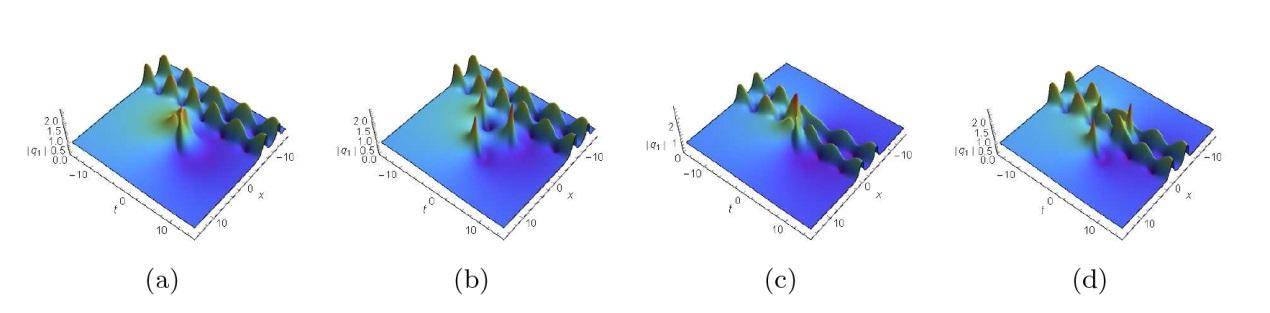
图 1 展示了一阶喙状怪波与一阶呼吸波的相互作用解. 怪波呈现出喙状轮廓, 其特征是有一个峰和两个谷, 但驼峰和谷并不是线性排列的. 图 1 表明随着 $|\frac{C_4}{C_3}|$ $C_3$ $x$ $C_4$ $x$ $C_3$ $C_4$ $C_4=0$ $C_3=0$ 图 1(d) ).
图1
图1
一阶喙状怪波与一阶呼吸波的相互作用, 参数为 $m_0=0$ $C_3=\frac{1}{100},C_4=100$ $C_3=\frac{1}{100000},C_4=100000$ $C_3=\frac{1}{100000},C_4=0$ $C_3=0,C_4=\frac{1}{100000}$ .
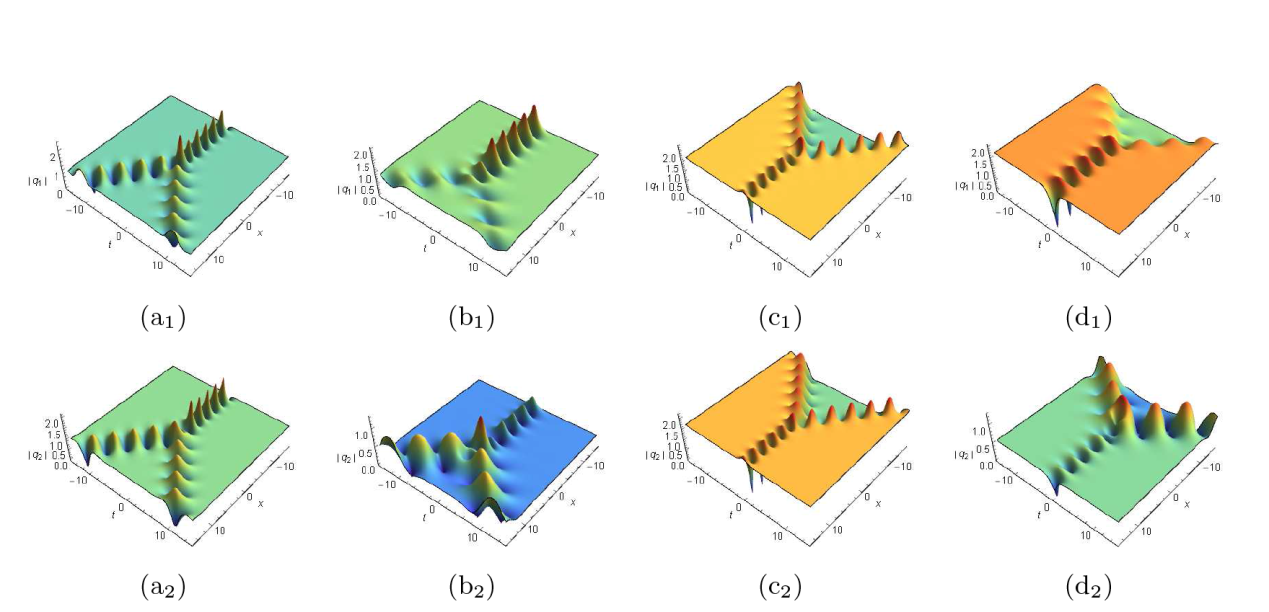
当 $N=2$ $f(\epsilon)=m_0+m_1\epsilon^2$ $h=1$ 图2 中呈现了二阶怪波与二阶呼吸波的相互作用解. 令 $m_0=m_1=0$ 图2(a) . 令 $m_0=0,m_1\neq0$ 图2(b) 中可以看到二阶喙状怪波会分离成三个呈三角结构的一阶喙状怪波. 由图2(c) 和 (d) 可知, $C_3$ $C_4$
图2
图2
二阶喙状怪波与二阶呼吸波的相互作用, 参数为 $m_0=0$ $C_3=\frac{1}{100}$ $C_4=100$ $m_1=0$ $C_3=\frac{1}{100}$ $C_4=100$ $m_1=50$ $C_3=\frac{1}{1000000}$ $C_4=1000000$ $m_1=0$ $C_3=\frac{1}{1000000}$ $C_4=1000000$ $m_1=50$ .
当 $N=1$ $f(\epsilon)=m_0$ $h=\pm\frac{1}{3}$ 图 3 展示了一阶呼吸波的裂变和聚变. 从物理学的角度看, 呼吸波的振幅会在裂变后变小. 这一现象可归因于图 3($a_1$-$a_2$) 中能量分布的守恒性质. 在聚变过程中, 不仅呼吸波的振幅发生了变化, 其结构也发生了变化. 同时, 亮呼吸波转变为了反暗呼吸波, 见图 3($c_1$-$c_2$) . 除此之外, 通过分析图 3($b_1$-$b_2$) 和 ($d_1$-$d_2$) 可知, 随着 $|\frac{C_4}{C_3}|$
图3
图3
一阶呼吸波裂变和聚变, 参数为 $m_0=0$, ($a_1$-$a_2$) $h=\frac{1}{5}$, $C_3=\frac{1}{100}$, $C_4=100$; ($b_1$-$b_2$) $h=\frac{1}{5}$, $C_3=\frac{1}{100000}$, $C_4=100000$; ($c_1$-$c_2$) $h=-\frac{1}{3}$, $C_3=\frac{1}{100}$, $C_4=100$; ($d_1$-$d_2$) $h=-\frac{1}{3}$, $C_3=\frac{1}{100000}$, $C_4=100000$
图4
图4
一阶呼吸波裂变和聚变, 参数为 $m_0=0$, ($a_1$-$a_2$) $h=\frac{1}{3}$, $C_3=\frac{1}{100}$, $C_4=100$, $m_1=0$; ($b_1$-$b_2$) $h=\frac{1}{3}$, $C_3=\frac{1}{100}$, $C_4=100$, $m_1=50$; ($c_1$-$c_2$) $h=-\frac{1}{3}$, $C_3=\frac{1}{1000000}$, $C_4=1000000$, $m_1=0$; ($d_1$-$d_2$) $h=-\frac{1}{3}$, $C_3=\frac{1}{1000000}$, $C_4=1000000$, $m_1=50$.
4 周期背景上的怪波与呼吸波的相互作用解
在本节, 为了得到周期背景上的怪波与呼吸波的相互作用解, 我们选择 $q_1[0]=c\cos(\kappa x){\rm e}^{{\rm i}\rho}$, $q_2[0]=-{\rm i}c\sin(\kappa x){\rm e}^{{\rm i}\rho}$, $\rho=|c|^2t-\frac{\kappa^2}{2}t$ 作为种子解, 其中 $c$ 是一个复数, $\kappa$ 是一个实数.
当 $N=1$, $f(\epsilon)=m_0$, $C_3$ 和 $C_4$ 其中一个等于零时, 图 5 展示了 $\kappa$, $c$, $C_3$ 和 $C_4$的不同值对周期背景上怪波的结构的影响. 图 5($a_1$-$a_2$) 给出了由一个峰和两个谷组成一条线的眼型怪波. 图 5($b_1$-$b_2$) 展示了喙状怪波. 在图 5($c_1$-$c_2$) 和 ($d_1$-$d_2$) 中, 我们得到了两种类型的新型怪波. 第 I 型怪波的特点是拥有一个波峰和四个不对称的波谷. 与其他类型的怪波相比, 图 5($c_1$-$c_2$) 中的怪波的振幅更大. 第 II 型怪波拥有两个波峰和四个波谷, 并会沿着一条确定的轴线成对排列. 同时, 在图 5($d_1$-$d_2$) 中, 峰和谷关于直线 $t=0$ 对称.
图5
图5
周期背景上的一阶怪波, 参数为 $m_0=0$,($a_1$-$a_2$) $\kappa=2$, $c=1+{\rm i}$, $C_3=0$, $C_4=100000$; ($b_1$-$b_2$) $\kappa=1$, $c=1$, $C_3=\frac{1}{100000}$, $C_4=0$; ($c_1$-$c_2$) $\kappa=3$, $c=\frac{1}{2}+\frac{\rm i}{2}$, $C_3=0$, $C_4=100000$; ($d_1$-$d_2$) $\kappa=\frac{5}{2}$, $c=1+\frac{\rm i}{2}$, $C_3=\frac{1}{100000}$, $C_4=0$.
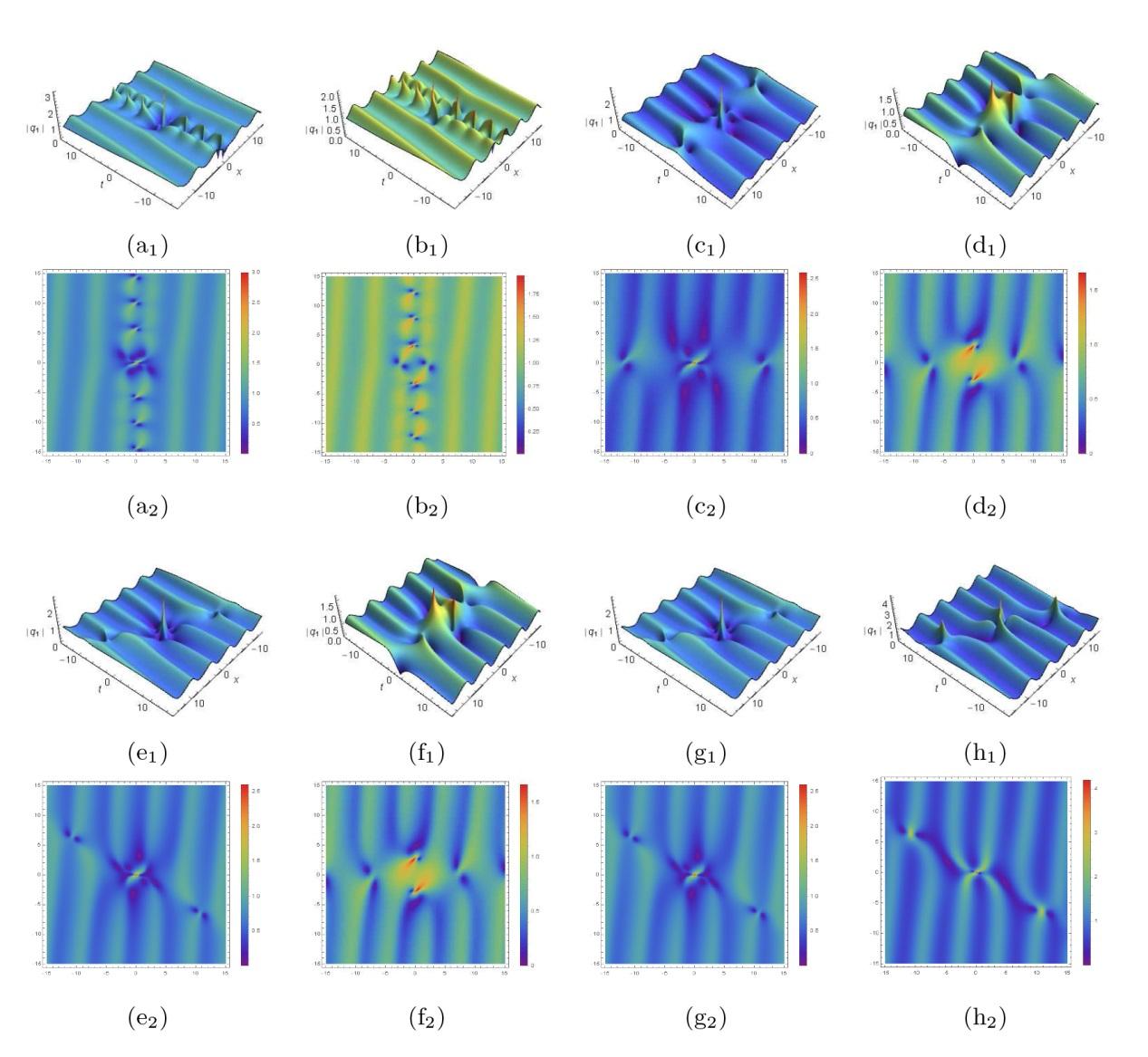
当 $N=1$, $f(\epsilon)=m_0$, $C_3\neq0$ 和 $C_4\neq0$ 时, 得到了在周期背景上的一阶怪波和一阶呼吸波的相互作用解. 通过对参数的控制, 可以产生多种怪波, 如喙型呼吸波、X 型呼吸波、Y 型呼吸波、眼型呼吸波等. 图 6($a_1$-$a_2$) 描述了周期背景上的眼型怪波与喙型呼吸波的相互作用解. 当改变 $c$ 的值时, 眼型怪波发生分离, 形成两个四瓣怪波. 从图 6($b_1$-$b_2$) 可知, 初始的眼型怪波的振幅约为 3, 而四瓣波的振幅仅为 2. 这是由于在分离过程中, 眼型怪波的形成能量被分配给了两个四瓣波, 这个过程满足能量守恒定律. 在图 6($c_1$-$c_2$) 中, 我们展示了周期背景上的眼型呼吸波与眼型怪波的相互作用解. 同样地, 在图 6($d_1$-$d_2$) 中, 选择不同的 $c$ 的值会产生眼型怪波转移成两个喙型怪波的现象. 此外, 图 6(e$_1$-e$_2$)-(h$_1$-h$_2$) 展示了在周期背景上的反眼型呼吸波与眼型怪波的相互作用解、X 型呼吸波与 X 型怪波的相互作用解、Y 型呼吸波与两个眼型怪波的相互作用解以及眼型呼吸波的两个喙形怪波的相互作用解.
图6
图6
周期背景上的一阶怪波与一阶呼吸波的相互作用, 参数为 $m_0=0$, ($a_1$-$a_2$) $\kappa=2$, $c=1+{\rm i}$, $C_3=\frac{1}{2000}$, $C_4=100000$; ($b_1$-$b_2$) $\kappa=1$, $c=\frac{2}{3}+\frac{2}{3}{\rm i}$, $C_3=\frac{1}{20000}$, $C_4=10000$; ($c_1$-$c_2$) $\kappa=2$, $c=\frac{1}{3}+\frac{{\rm i}}{3}$, $C_3=1$, $C_4=\frac{1}{10000}$; ($d_1$-$d_2$) $\kappa=1$, $c=\frac{1}{4}+\frac{{\rm i}}{4}$, $C_3=100$, $C_4=\frac{1}{100000}$; (e$_1$-e$_2$) $\kappa=2$, $c=\frac{2}{3}+\frac{{\rm i}}{3}$, $C_3=10$, $C_4=1000$; (f$_1$-f$_2$) $\kappa=\frac{3}{2}$, $c=\frac{2}{3}+\frac{{\rm i}}{4}$, $C_3=20$, $C_4=2000$; (g$_1$-g$_2$) $\kappa=\frac{1}{2}$, $c=\frac{1}{3}+\frac{2}{3}{\rm i}$, $C_3=1000$, $C_4=100$; (h$_1$-h$_2$) $\kappa=4$, $c=\frac{1}{4}+\frac{4}{5}{\rm i}$, $C_3=500$, $C_4=100000$.
5 结论
本文探究了描述正交偏振光波传播的对跃迁耦合非线性薛定谔方程. 通过应用 $N$
参考文献
View Option
[1]
Kuznetsov E A Solitons in a parametrically unstable plasma
Dokl Akad Nauk SSSR , 1977 , 236 3 ): 575 -577
[本文引用: 1]
[2]
Kawata T Inoue H Inverse scattering method for the nonlinear evolution equations under nonvanishing conidtions
J Phys Soc Jpn , 1978 , 44 5 ): 1722 -1729
DOI:10.1143/JPSJ.44.1722
URL
[3]
Akhmediev N N Eleonskii V M Kulagin N E Generation of periodic trains of picosecond pulses in an optical fiber: exact solutions
Soviet Physics, J Exp Theor Phys , 1985 , 62 5 ): 894 -899
[4]
Kibler B Fatome J Finot C et al . Observation of Kuznestov-Ma soliton dynamics in optical fibre
Sci Rep , 2012 , 2 1 ): Art 463
DOI:10.1038/srep00463
[本文引用: 1]
[5]
Bludov Y V Konotop V Akhmediev N Vector rogue waves in binary mixtures of Bose-Einstein condensates
Eur Phys J Special Top , 2010 , 185 1 ): 169 -180
DOI:10.1140/epjst/e2010-01247-6
URL
[本文引用: 1]
[6]
Zhao L C Xin G G Yang Z Y Rogue-wave pattern transition induced by relative frequency
Phys Rev E , 2014 , 90 2 ): Art 022918
DOI:10.1103/PhysRevE.90.022918
URL
[7]
Du Z Ma Y P Beak-shaped rogue waves for a higher-order coupled nonlinear Schrödinger system with $4\times4$
Appl Math Lett , 2021 , 116 106999
DOI:10.1016/j.aml.2020.106999
URL
[8]
Lin Z Wen X Y Dynamical analysis of position-controllable loop rogue wave and mixed interaction phenomena for the complex short pulse equation in optical fiber
Nonlinear Dynam , 2022 , 108 3 ): 2573 -2593
DOI:10.1007/s11071-022-07315-8
[本文引用: 1]
[9]
Song J Y Xiao Y Zhang C P Dynamical analysis of higher-order rogue waves on the various backgrounds for the reverse space-time Fokas-Lenells equation
Appl Math Lett , 2024 , 150 108971
DOI:10.1016/j.aml.2023.108971
URL
[本文引用: 1]
[10]
Zhao L C Ling L M Qi J W et al . Dynamics of rogue wave excitation pattern on stripe phase backgrounds in a two-component Bose-Einstein condensate
Commun Nonlinear Sci Numer Simulat , 2017 , 49 39 -47
DOI:10.1016/j.cnsns.2017.02.004
URL
[11]
Feng B F Ling L M Takahashi D A Multi-breather and high-order rogue waves for the nonlinear Schrödinger equation on the elliptic function background
Stud Appl Math , 2020 , 144 1 ): 46 -101
DOI:10.1111/sapm.v144.1
URL
[12]
Ding C C Gao Y T Yu X et al . $N$ - fold generalized Darboux transformation and breather-rogue waves on the constant/periodic background for the generalized mixed nonlinear Schrödinger equation
Nonlinear Dynam , 2022 , 109 2 ): 989 -1004
DOI:10.1007/s11071-022-07423-5
[13]
Ma Y L Li B Q Hybrid rogue wave and breather solutions for a complex mKdV equation in few-cycle ultra-short pulse optics
Eur Phys J Plus , 2022 , 137 7 ): 1 -10
DOI:10.1140/epjp/s13360-021-02162-9
[14]
Li X L Guo R Interactions of localized wave structures on periodic background for the coupled Lakshmanan-Porsezian-Daniel equations in birefringent optical fiber
Ann Phys (Berlin) , 2023 , 535 1 ): Art 2200472
DOI:10.1002/andp.v535.1
URL
[本文引用: 1]
[15]
Rao J G Porsezian K He J S Semi-rational solutions of the third-type Davey-Stewartson equation
Chaos , 2017 , 27 8 ): Art 083115
DOI:10.1063/1.4999083
URL
[本文引用: 1]
[16]
刘甲玉 , 魏含玉 , 张燕 , 夏铁成 , 王惠 . 阿尔法螺旋蛋白中三分量四阶非线性 Schrödinger 系统孤子解及其非线性动力行为研究
数学物理学报 , 2022 , 42A 6 ): 1873 -1885
[本文引用: 1]
Liu J Y Wei H Y Zhang Y Xia T C Wang H Soliton solutions and its nonlinear dynamics behavior research of the three-component four-order nonlinear Schrödinger system in alpha helical protein
Acta Math Sci , 2022 , 42A 6 ): 1873 -1885
[本文引用: 1]
[17]
Zou Z F Guo R The Riemann-Hilbert approach for the higher-order Gerdjikov-Ivanov equation, soliton interactions and position shift
Commun Nonlinear Sci Numer Simulat , 2023 , 124 107316
DOI:10.1016/j.cnsns.2023.107316
URL
[18]
Chen M S Fan E G He J S Riemann-Hilbert approach and the soliton solutions of the discrete mKdV equations
Chaos Solitons Fract , 2023 , 168 113209
DOI:10.1016/j.chaos.2023.113209
URL
[本文引用: 1]
[19]
Feng L L Zhu Z N Darboux transformation and soliton solutions for a nonlocal two-component complex modified Korteweg-de Vries equation
J Nonlinear Math Phys , 2023 , 30 3 ): 1011 -1301
DOI:10.1007/s44198-023-00112-w
[本文引用: 1]
[20]
Wu X H Gao Y T Yu X Ding C C Binary Darboux transformation, solitons and breathers for a second-order three-wave resonant interaction system
Nonlinear Dynam , 2023 , 111 17 ): 16449 -16465
DOI:10.1007/s11071-023-08544-1
[21]
Zhang X. Wang Y F Yang S X Hybrid structures of the rogue waves and breather-like waves for the higher-order coupled nonlinear Schrödinger equations
Chaos Solitons Fract , 2024 , 180 114563
DOI:10.1016/j.chaos.2024.114563
URL
[22]
Song C Q Liu D Y Ma L Y Soliton solutions of a novel nonlocal Hirota system and a nonlocal complex modified Korteweg-de Vries equation
Chaos Solitons Fract , 2024 , 181 114707
DOI:10.1016/j.chaos.2024.114707
URL
[23]
娄瑜 , 张翼 . 推广的导数非线性薛定谔方程的单/双周期背景上的呼吸子和怪波及其碰撞解
数学物理学报 , 2024 , 44A 6 ): 1511 -1519
[本文引用: 1]
Lou Y Zhang Y Breather and rogue wave on the periodic/double periodic background and interaction solutions of the generalized derivative nonlinear Schrödinger equation
Acta Math Sci , 2024 , 44A 6 ): 1511 -1519
[本文引用: 1]
[25]
Bailung H Sharma S K Nakamura Y Observation of peregrine solitons in a multicomponent plasma with negative lons
Phys Rev Lett , 2011 , 107 25 ): Art 255005
DOI:10.1103/PhysRevLett.107.255005
URL
[26]
He J S Xu S W Porsezian K New types of rogue wave in an erbium-doped fibre system
J Phys Soc of Jpn , 2012 , 81 3 ): Art 033002
DOI:10.1143/JPSJ.81.033002
URL
[本文引用: 1]
[28]
Zhang G Q Yan Z Y Wen X Y Modulational instability, beak-shaped rogue waves, multi-dark-dark solitons and dynamics in pair-transition-coupled nonlinear Schrödinger equations
P Roy Soc A-Math Phys , 2017 , 473 2203 ): Art 20170243
[29]
Lou Y Zhang Y Ye R S Li M Solitons and dynamics for the integrable nonlocal pair-transition-coupled nonlinear Schrödinger equation
Appl Math Comput , 2021 , 409 126417
[本文引用: 1]
Solitons in a parametrically unstable plasma
1
1977
... 孤子、呼吸波和怪波作为三种基本的局域波, 在各种非线性模型中引起了研究人员的广泛关注. 呼吸波在空间或时间上稳定传播并具有周期性[1 4 ] . 怪波在空间和时间上都是局域的, 具有一个三倍于平面波高度的峰, 以及两个由于能量守恒而出现的侧孔. 除了常见的怪波之外, 非线性模型还研究了大量具有各种特殊波形的局域波[5 8 ] . 在平面波或周期背景上将这种局域波应用于多个领域的实际可行性促使人们对其形成、传播和相互作用产生了浓厚的兴趣, 从而引发了这一领域研究活动的激增[9 14 ] . 寻找局域波解是数学物理界相当关注的一个课题, 为此提出了许多求解方法, 比如, 双线性 KP 约化[15 ] , 黎曼希尔伯特方法[16 18 ] 和达布变换方法[19 23 ] . ...
Inverse scattering method for the nonlinear evolution equations under nonvanishing conidtions
0
1978
Generation of periodic trains of picosecond pulses in an optical fiber: exact solutions
0
1985
Observation of Kuznestov-Ma soliton dynamics in optical fibre
1
2012
... 孤子、呼吸波和怪波作为三种基本的局域波, 在各种非线性模型中引起了研究人员的广泛关注. 呼吸波在空间或时间上稳定传播并具有周期性[1 4 ] . 怪波在空间和时间上都是局域的, 具有一个三倍于平面波高度的峰, 以及两个由于能量守恒而出现的侧孔. 除了常见的怪波之外, 非线性模型还研究了大量具有各种特殊波形的局域波[5 8 ] . 在平面波或周期背景上将这种局域波应用于多个领域的实际可行性促使人们对其形成、传播和相互作用产生了浓厚的兴趣, 从而引发了这一领域研究活动的激增[9 14 ] . 寻找局域波解是数学物理界相当关注的一个课题, 为此提出了许多求解方法, 比如, 双线性 KP 约化[15 ] , 黎曼希尔伯特方法[16 18 ] 和达布变换方法[19 23 ] . ...
Vector rogue waves in binary mixtures of Bose-Einstein condensates
1
2010
... 孤子、呼吸波和怪波作为三种基本的局域波, 在各种非线性模型中引起了研究人员的广泛关注. 呼吸波在空间或时间上稳定传播并具有周期性[1 4 ] . 怪波在空间和时间上都是局域的, 具有一个三倍于平面波高度的峰, 以及两个由于能量守恒而出现的侧孔. 除了常见的怪波之外, 非线性模型还研究了大量具有各种特殊波形的局域波[5 8 ] . 在平面波或周期背景上将这种局域波应用于多个领域的实际可行性促使人们对其形成、传播和相互作用产生了浓厚的兴趣, 从而引发了这一领域研究活动的激增[9 14 ] . 寻找局域波解是数学物理界相当关注的一个课题, 为此提出了许多求解方法, 比如, 双线性 KP 约化[15 ] , 黎曼希尔伯特方法[16 18 ] 和达布变换方法[19 23 ] . ...
Rogue-wave pattern transition induced by relative frequency
0
2014
Beak-shaped rogue waves for a higher-order coupled nonlinear Schrödinger system with $4\times4$ Lax pair
0
2021
Dynamical analysis of position-controllable loop rogue wave and mixed interaction phenomena for the complex short pulse equation in optical fiber
1
2022
... 孤子、呼吸波和怪波作为三种基本的局域波, 在各种非线性模型中引起了研究人员的广泛关注. 呼吸波在空间或时间上稳定传播并具有周期性[1 4 ] . 怪波在空间和时间上都是局域的, 具有一个三倍于平面波高度的峰, 以及两个由于能量守恒而出现的侧孔. 除了常见的怪波之外, 非线性模型还研究了大量具有各种特殊波形的局域波[5 8 ] . 在平面波或周期背景上将这种局域波应用于多个领域的实际可行性促使人们对其形成、传播和相互作用产生了浓厚的兴趣, 从而引发了这一领域研究活动的激增[9 14 ] . 寻找局域波解是数学物理界相当关注的一个课题, 为此提出了许多求解方法, 比如, 双线性 KP 约化[15 ] , 黎曼希尔伯特方法[16 18 ] 和达布变换方法[19 23 ] . ...
Dynamical analysis of higher-order rogue waves on the various backgrounds for the reverse space-time Fokas-Lenells equation
1
2024
... 孤子、呼吸波和怪波作为三种基本的局域波, 在各种非线性模型中引起了研究人员的广泛关注. 呼吸波在空间或时间上稳定传播并具有周期性[1 4 ] . 怪波在空间和时间上都是局域的, 具有一个三倍于平面波高度的峰, 以及两个由于能量守恒而出现的侧孔. 除了常见的怪波之外, 非线性模型还研究了大量具有各种特殊波形的局域波[5 8 ] . 在平面波或周期背景上将这种局域波应用于多个领域的实际可行性促使人们对其形成、传播和相互作用产生了浓厚的兴趣, 从而引发了这一领域研究活动的激增[9 14 ] . 寻找局域波解是数学物理界相当关注的一个课题, 为此提出了许多求解方法, 比如, 双线性 KP 约化[15 ] , 黎曼希尔伯特方法[16 18 ] 和达布变换方法[19 23 ] . ...
Dynamics of rogue wave excitation pattern on stripe phase backgrounds in a two-component Bose-Einstein condensate
0
2017
Multi-breather and high-order rogue waves for the nonlinear Schrödinger equation on the elliptic function background
0
2020
$N$ -fold generalized Darboux transformation and breather-rogue waves on the constant/periodic background for the generalized mixed nonlinear Schrödinger equation
0
2022
Hybrid rogue wave and breather solutions for a complex mKdV equation in few-cycle ultra-short pulse optics
0
2022
Interactions of localized wave structures on periodic background for the coupled Lakshmanan-Porsezian-Daniel equations in birefringent optical fiber
1
2023
... 孤子、呼吸波和怪波作为三种基本的局域波, 在各种非线性模型中引起了研究人员的广泛关注. 呼吸波在空间或时间上稳定传播并具有周期性[1 4 ] . 怪波在空间和时间上都是局域的, 具有一个三倍于平面波高度的峰, 以及两个由于能量守恒而出现的侧孔. 除了常见的怪波之外, 非线性模型还研究了大量具有各种特殊波形的局域波[5 8 ] . 在平面波或周期背景上将这种局域波应用于多个领域的实际可行性促使人们对其形成、传播和相互作用产生了浓厚的兴趣, 从而引发了这一领域研究活动的激增[9 14 ] . 寻找局域波解是数学物理界相当关注的一个课题, 为此提出了许多求解方法, 比如, 双线性 KP 约化[15 ] , 黎曼希尔伯特方法[16 18 ] 和达布变换方法[19 23 ] . ...
Semi-rational solutions of the third-type Davey-Stewartson equation
1
2017
... 孤子、呼吸波和怪波作为三种基本的局域波, 在各种非线性模型中引起了研究人员的广泛关注. 呼吸波在空间或时间上稳定传播并具有周期性[1 4 ] . 怪波在空间和时间上都是局域的, 具有一个三倍于平面波高度的峰, 以及两个由于能量守恒而出现的侧孔. 除了常见的怪波之外, 非线性模型还研究了大量具有各种特殊波形的局域波[5 8 ] . 在平面波或周期背景上将这种局域波应用于多个领域的实际可行性促使人们对其形成、传播和相互作用产生了浓厚的兴趣, 从而引发了这一领域研究活动的激增[9 14 ] . 寻找局域波解是数学物理界相当关注的一个课题, 为此提出了许多求解方法, 比如, 双线性 KP 约化[15 ] , 黎曼希尔伯特方法[16 18 ] 和达布变换方法[19 23 ] . ...
阿尔法螺旋蛋白中三分量四阶非线性 Schrödinger 系统孤子解及其非线性动力行为研究
1
2022
... 孤子、呼吸波和怪波作为三种基本的局域波, 在各种非线性模型中引起了研究人员的广泛关注. 呼吸波在空间或时间上稳定传播并具有周期性[1 4 ] . 怪波在空间和时间上都是局域的, 具有一个三倍于平面波高度的峰, 以及两个由于能量守恒而出现的侧孔. 除了常见的怪波之外, 非线性模型还研究了大量具有各种特殊波形的局域波[5 8 ] . 在平面波或周期背景上将这种局域波应用于多个领域的实际可行性促使人们对其形成、传播和相互作用产生了浓厚的兴趣, 从而引发了这一领域研究活动的激增[9 14 ] . 寻找局域波解是数学物理界相当关注的一个课题, 为此提出了许多求解方法, 比如, 双线性 KP 约化[15 ] , 黎曼希尔伯特方法[16 18 ] 和达布变换方法[19 23 ] . ...
Soliton solutions and its nonlinear dynamics behavior research of the three-component four-order nonlinear Schrödinger system in alpha helical protein
1
2022
... 孤子、呼吸波和怪波作为三种基本的局域波, 在各种非线性模型中引起了研究人员的广泛关注. 呼吸波在空间或时间上稳定传播并具有周期性[1 4 ] . 怪波在空间和时间上都是局域的, 具有一个三倍于平面波高度的峰, 以及两个由于能量守恒而出现的侧孔. 除了常见的怪波之外, 非线性模型还研究了大量具有各种特殊波形的局域波[5 8 ] . 在平面波或周期背景上将这种局域波应用于多个领域的实际可行性促使人们对其形成、传播和相互作用产生了浓厚的兴趣, 从而引发了这一领域研究活动的激增[9 14 ] . 寻找局域波解是数学物理界相当关注的一个课题, 为此提出了许多求解方法, 比如, 双线性 KP 约化[15 ] , 黎曼希尔伯特方法[16 18 ] 和达布变换方法[19 23 ] . ...
The Riemann-Hilbert approach for the higher-order Gerdjikov-Ivanov equation, soliton interactions and position shift
0
2023
Riemann-Hilbert approach and the soliton solutions of the discrete mKdV equations
1
2023
... 孤子、呼吸波和怪波作为三种基本的局域波, 在各种非线性模型中引起了研究人员的广泛关注. 呼吸波在空间或时间上稳定传播并具有周期性[1 4 ] . 怪波在空间和时间上都是局域的, 具有一个三倍于平面波高度的峰, 以及两个由于能量守恒而出现的侧孔. 除了常见的怪波之外, 非线性模型还研究了大量具有各种特殊波形的局域波[5 8 ] . 在平面波或周期背景上将这种局域波应用于多个领域的实际可行性促使人们对其形成、传播和相互作用产生了浓厚的兴趣, 从而引发了这一领域研究活动的激增[9 14 ] . 寻找局域波解是数学物理界相当关注的一个课题, 为此提出了许多求解方法, 比如, 双线性 KP 约化[15 ] , 黎曼希尔伯特方法[16 18 ] 和达布变换方法[19 23 ] . ...
Darboux transformation and soliton solutions for a nonlocal two-component complex modified Korteweg-de Vries equation
1
2023
... 孤子、呼吸波和怪波作为三种基本的局域波, 在各种非线性模型中引起了研究人员的广泛关注. 呼吸波在空间或时间上稳定传播并具有周期性[1 4 ] . 怪波在空间和时间上都是局域的, 具有一个三倍于平面波高度的峰, 以及两个由于能量守恒而出现的侧孔. 除了常见的怪波之外, 非线性模型还研究了大量具有各种特殊波形的局域波[5 8 ] . 在平面波或周期背景上将这种局域波应用于多个领域的实际可行性促使人们对其形成、传播和相互作用产生了浓厚的兴趣, 从而引发了这一领域研究活动的激增[9 14 ] . 寻找局域波解是数学物理界相当关注的一个课题, 为此提出了许多求解方法, 比如, 双线性 KP 约化[15 ] , 黎曼希尔伯特方法[16 18 ] 和达布变换方法[19 23 ] . ...
Binary Darboux transformation, solitons and breathers for a second-order three-wave resonant interaction system
0
2023
Hybrid structures of the rogue waves and breather-like waves for the higher-order coupled nonlinear Schrödinger equations
0
2024
Soliton solutions of a novel nonlocal Hirota system and a nonlocal complex modified Korteweg-de Vries equation
0
2024
推广的导数非线性薛定谔方程的单/双周期背景上的呼吸子和怪波及其碰撞解
1
2024
... 孤子、呼吸波和怪波作为三种基本的局域波, 在各种非线性模型中引起了研究人员的广泛关注. 呼吸波在空间或时间上稳定传播并具有周期性[1 4 ] . 怪波在空间和时间上都是局域的, 具有一个三倍于平面波高度的峰, 以及两个由于能量守恒而出现的侧孔. 除了常见的怪波之外, 非线性模型还研究了大量具有各种特殊波形的局域波[5 8 ] . 在平面波或周期背景上将这种局域波应用于多个领域的实际可行性促使人们对其形成、传播和相互作用产生了浓厚的兴趣, 从而引发了这一领域研究活动的激增[9 14 ] . 寻找局域波解是数学物理界相当关注的一个课题, 为此提出了许多求解方法, 比如, 双线性 KP 约化[15 ] , 黎曼希尔伯特方法[16 18 ] 和达布变换方法[19 23 ] . ...
Breather and rogue wave on the periodic/double periodic background and interaction solutions of the generalized derivative nonlinear Schrödinger equation
1
2024
... 孤子、呼吸波和怪波作为三种基本的局域波, 在各种非线性模型中引起了研究人员的广泛关注. 呼吸波在空间或时间上稳定传播并具有周期性[1 4 ] . 怪波在空间和时间上都是局域的, 具有一个三倍于平面波高度的峰, 以及两个由于能量守恒而出现的侧孔. 除了常见的怪波之外, 非线性模型还研究了大量具有各种特殊波形的局域波[5 8 ] . 在平面波或周期背景上将这种局域波应用于多个领域的实际可行性促使人们对其形成、传播和相互作用产生了浓厚的兴趣, 从而引发了这一领域研究活动的激增[9 14 ] . 寻找局域波解是数学物理界相当关注的一个课题, 为此提出了许多求解方法, 比如, 双线性 KP 约化[15 ] , 黎曼希尔伯特方法[16 18 ] 和达布变换方法[19 23 ] . ...
Rogue waves in the atmosphere
1
2010
... 非线性薛定谔方程作为一个重要的非线性模型, 可以描述各种非线性介质中缓慢变化的波包的演变, 它已在流体力学、等离子体、光学等多个学科中得到广泛研究[24 26 ] . 从物理角度看, 由于不同分量场之间相对速度的相互影响以及交叉相位调制的影响, 多分量非线性模型比其标量模型能表现出更大范围的动态行为. 原子的跃迁通常存在两种路径: 单粒子跃迁与双粒子跃迁. 在接触相互作用强度较弱的情形下, 单粒子跃迁在粒子跃迁中起主导作用, 双粒子跃迁可忽略不计. 但在相互作用强度较强时, 双粒子跃迁效应成为主导. 因此, 我们考虑二阶跃迁起主导作用的情形, 其动力学方程可写为含双粒子跃迁耦合效应的可积耦合非线性薛定谔方程, 即对跃迁耦合非线性薛定谔方程 ...
Observation of peregrine solitons in a multicomponent plasma with negative lons
0
2011
New types of rogue wave in an erbium-doped fibre system
1
2012
... 非线性薛定谔方程作为一个重要的非线性模型, 可以描述各种非线性介质中缓慢变化的波包的演变, 它已在流体力学、等离子体、光学等多个学科中得到广泛研究[24 26 ] . 从物理角度看, 由于不同分量场之间相对速度的相互影响以及交叉相位调制的影响, 多分量非线性模型比其标量模型能表现出更大范围的动态行为. 原子的跃迁通常存在两种路径: 单粒子跃迁与双粒子跃迁. 在接触相互作用强度较弱的情形下, 单粒子跃迁在粒子跃迁中起主导作用, 双粒子跃迁可忽略不计. 但在相互作用强度较强时, 双粒子跃迁效应成为主导. 因此, 我们考虑二阶跃迁起主导作用的情形, 其动力学方程可写为含双粒子跃迁耦合效应的可积耦合非线性薛定谔方程, 即对跃迁耦合非线性薛定谔方程 ...
Integrable pair-transition-coupled nonlinear Schrödinger equation
1
2015
... 其中, $q_1=q_1(x,t)$ $q_2=q_2(x,t)$ $*$ $\sigma q_2^2q_1^*$ $\sigma q_1^2q_2^*$ . 这一非线性项可用于描述正交偏振光波在传播过程中的模式间非线性跃迁效应: 当两束正交偏振光在各向异性介质中传播时, 除强度关联的交叉调制外, 还会因介质的三阶非线性极化率张量非对角元的贡献, 发生偏振态的非线性转换. 这种跃迁耦合项使得方程不仅能刻画孤子的弹性碰撞, 还能描述非弹性相互作用中偏振态的能量转移. 迄今为止, 学者们已经对对跃迁非线性薛定谔方程方程 (1.1) 进行了有效的研究[27 29 ] . 然而, 方程 (1.1) 在平面波/周期背景上的多种类型的怪波和呼吸波的相互作用解却还尚未被研究过. 因此, 我们通过广义达布变换, 研究了几种类型的怪波和呼吸波在平面波/周期背景上的相互作用解, 并发现了一些具有不同动态特性的新的怪波和呼吸波. 此外, 我们还将分析受参数影响的解的位置、角度、结构和能量分布情况. 在第 2 节, 基于方程 (1.1) 的 Lax 对, 我们构造了 其 $N$
Modulational instability, beak-shaped rogue waves, multi-dark-dark solitons and dynamics in pair-transition-coupled nonlinear Schrödinger equations
0
2017
Solitons and dynamics for the integrable nonlocal pair-transition-coupled nonlinear Schrödinger equation
1
2021
... 其中, $q_1=q_1(x,t)$ $q_2=q_2(x,t)$ $*$ $\sigma q_2^2q_1^*$ $\sigma q_1^2q_2^*$ . 这一非线性项可用于描述正交偏振光波在传播过程中的模式间非线性跃迁效应: 当两束正交偏振光在各向异性介质中传播时, 除强度关联的交叉调制外, 还会因介质的三阶非线性极化率张量非对角元的贡献, 发生偏振态的非线性转换. 这种跃迁耦合项使得方程不仅能刻画孤子的弹性碰撞, 还能描述非弹性相互作用中偏振态的能量转移. 迄今为止, 学者们已经对对跃迁非线性薛定谔方程方程 (1.1) 进行了有效的研究[27 29 ] . 然而, 方程 (1.1) 在平面波/周期背景上的多种类型的怪波和呼吸波的相互作用解却还尚未被研究过. 因此, 我们通过广义达布变换, 研究了几种类型的怪波和呼吸波在平面波/周期背景上的相互作用解, 并发现了一些具有不同动态特性的新的怪波和呼吸波. 此外, 我们还将分析受参数影响的解的位置、角度、结构和能量分布情况. 在第 2 节, 基于方程 (1.1) 的 Lax 对, 我们构造了 其 $N$